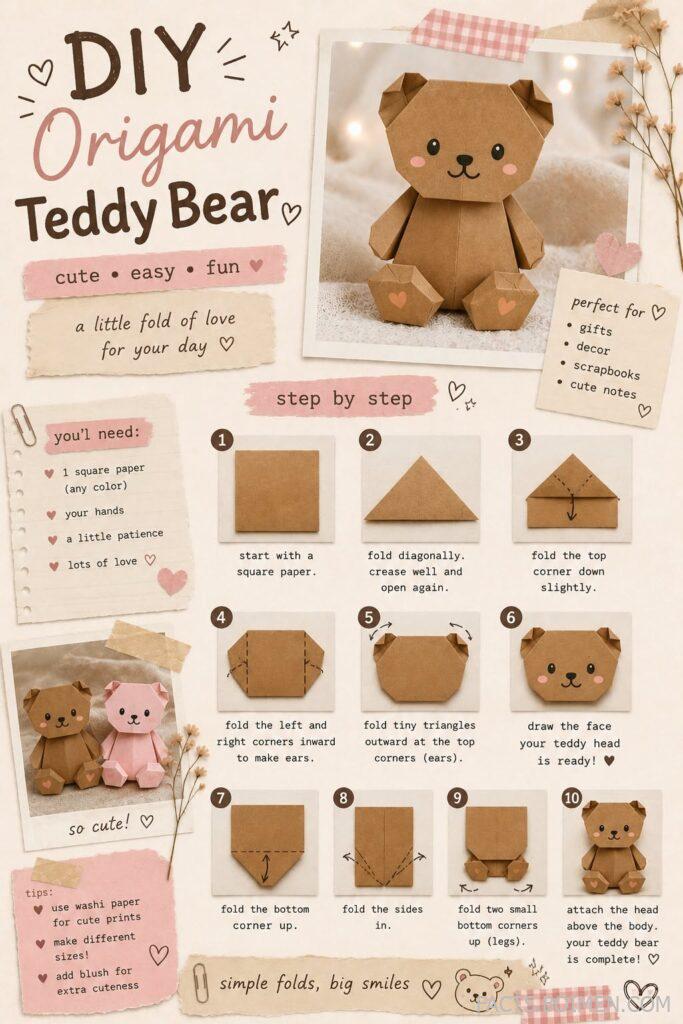
There is something quietly magical about turning one flat square of paper into a tiny friend. The origami teddy bear you may have seen pinned everywhere is the perfect example: a single square, any color you like, folded diagonally, then brought to life with just a few more creases. It asks for two things only, a little patience and lots of love. Below you will find fifteen origami teddy bear tutorials, folding guides, and paper-craft resources that make the process simple, even if you have never folded anything before. Every one of them is beginner-friendly, and most need nothing more than paper and your hands.
Table of Contents(Click to Toggle)
Why the Origami Teddy Bear Is the Perfect First Fold
Most people assume origami belongs to experts with nimble fingers and endless time. The teddy bear proves the opposite. It is built from a handful of moves: fold the square diagonally, crease it well, open it again, bring the top corner down slightly, fold the left and right corners inward for the ears, then fold tiny triangles outward at the top corners. Draw the face and the teddy head is finished. That short sequence teaches the core vocabulary of paper folding, valley folds, mountain folds, and corner-to-center alignment, without overwhelming anyone.
There is also a practical charm to it. A finished bear is small enough to sit on a study desk, tuck into a journal, or glue onto a scrapbook page. It works as a handmade gift tag, a bookmark companion, or a quiet five-minute break between tasks. Because it needs only one square of paper, it is one of the cheapest creative hobbies you can start today. The resources below range from photo-heavy step-by-step guides to video tutorials and printable diagram collections, so you can choose the format that suits how you learn best.
15 Origami Teddy Bear Tutorials and Paper Craft Resources
1. Origami.me : Clear photo-and-diagram guides for absolute beginners
What it is: A long-running origami library with hundreds of free tutorials, including several teddy bear and bear-face designs.
Category: Step-by-step tutorial site
Why it stands out:
- Instructions use real photographs alongside diagrams, which makes the tricky ear folds much easier to follow than line drawings alone.
- Each model lists difficulty level and estimated folding time, so you can start with a beginner bear before attempting a full-body version.
Best for: First-timers who want to see exactly where their fingers should go.
2. Origami Way : Fast, printable instructions you can fold along with
What it is: A beginner-focused collection of origami diagrams with a clean, ad-light layout.
Category: Printable diagram archive
Why it stands out:
- Diagrams are drawn in high contrast, so the difference between a valley fold and a mountain fold is obvious at a glance.
- Pages print neatly on a single sheet, which is handy for folding sessions with kids away from a screen.
Best for: Parents and teachers preparing a paper-craft table.
3. Origami Guide : Difficulty-rated tutorials that grow with your skills
What it is: A structured guide site that sorts models by easy, intermediate, and advanced levels.
Category: Skill-graded tutorial hub
Why it stands out:
- The bear section includes both a simple head and a more detailed standing bear, so you can level up in one sitting.
- Short video clips accompany many written steps, covering the small adjustments that text alone struggles to explain.
Best for: Folders who want a clear next challenge after their first bear.
4. Paper Kawaii : Cute, aesthetic paper crafts with video walkthroughs
What it is: A kawaii-style crafting blog known for adorable paper projects and origami models.
Category: Craft blog with video tutorials
Why it stands out:
- The tutorials are filmed from directly overhead, so every fold is visible without awkward camera angles.
- Projects are styled with pastel papers and cute props, which suits journal makers and scrapbook lovers perfectly.
Best for: Anyone who wants their finished bear to look Pinterest-ready.
5. Origami-Fun : Animated diagrams that show the fold in motion
What it is: A diagram site that animates each step so you can watch the paper move.
Category: Animated instruction library
Why it stands out:
- Animation removes the guesswork from confusing steps like the outward ear triangles, a common stumbling point.
- Models are grouped by theme, making it easy to build a matching set of paper animals.
Best for: Visual learners who struggle with static diagrams.
6. Origami Instructions : A deep archive of traditional and modern models
What it is: One of the older origami instruction sites, with a large catalogue of traditional designs.
Category: Traditional origami archive
Why it stands out:
- It explains the history behind traditional folds, adding context that pure tutorials skip.
- Step numbering is consistent across models, so once you learn its system you can fold almost anything on the site.
Best for: Readers who enjoy learning the story behind a craft.
7. Origami Resource Center : Reference material, paper guides, and folding theory
What it is: A reference-heavy site covering origami techniques, paper types, and terminology.
Category: Educational reference site
Why it stands out:
- Its paper comparison pages explain why thinner paper holds a crease better, which directly improves how your bear looks.
- Glossaries decode terms like squash fold and reverse fold before you meet them in a tutorial.
Best for: Crafters who want to understand the why, not just the how.
8. Red Ted Art : Family-friendly paper crafts with printable templates
What it is: A popular kids’ craft blog with a strong origami and paper section.
Category: Family craft blog
Why it stands out:
- Many projects include free printable templates, useful if you want perfectly sized squares without measuring.
- Instructions are written for adults crafting alongside children, with tips for smaller hands.
Best for: Craft afternoons with kids or classroom activities.
9. Origami Spirit : Thoughtful tutorials with a calm, mindful pace
What it is: A well-regarded origami blog by a longtime folder and teacher.
Category: Instructional blog
Why it stands out:
- Posts often explain how to fix a fold that went wrong, a genuinely rare and useful feature.
- The writing treats folding as a slow, relaxing practice, which suits anyone using crafts to unwind.
Best for: Mindful crafters who value patience over speed.
10. Origami Plus : Video-first tutorials for fold-along learning
What it is: A video-driven origami channel and site focused on clear, follow-along folding.
Category: Video tutorial platform
Why it stands out:
- Videos are filmed at a steady pace with no skipped steps, so you can pause exactly where you need to.
- Beginner playlists group the easiest models together, including simple animal faces.
Best for: People who learn best by watching a pair of hands fold.
11. Origami Art : A gallery-style look at what paper can become
What it is: A curated collection of origami models and diagrams with an artistic focus.
Category: Origami gallery and diagram site
Why it stands out:
- Seeing finished, beautifully folded bears is surprisingly motivating when your first attempt looks lumpy.
- Many entries link to diagrams, so inspiration converts into a project rather than just a scroll.
Best for: Crafters who need a visual push to start folding.
12. Craft Foxes : Curated craft tutorials from across the web
What it is: A craft discovery site that rounds up tutorials from many makers and blogs.
Category: Craft curation platform
Why it stands out:
- Its roundups surface origami projects you would not find through a single search, including unusual bear variations.
- Each entry links to the original creator, so you always reach the full tutorial.
Best for: Browsers who like discovering new craft blogs.
13. The Spruce Crafts : Reliable, well-edited paper craft guides
What it is: A large craft publication with edited, fact-checked paper craft tutorials.
Category: Mainstream craft publication
Why it stands out:
- Tutorials are professionally edited for clarity, which means fewer ambiguous steps than hobby blogs.
- Related articles cover paper selection, folding tools, and display ideas in one place.
Best for: Readers who prefer polished, predictable instructions.
14. Origami 4 Kids : Simple models sized for small hands
What it is: A beginner site aimed at children and new folders.
Category: Kids’ origami resource
Why it stands out:
- Models are deliberately short, often under ten steps, so a bear head can be finished in one sitting.
- Large diagrams reduce the eye strain that tiny printed instructions cause.
Best for: Young folders and quick classroom projects.
15. Origami Around the World : Cultural context alongside folding steps
What it is: A site that pairs origami instructions with stories about folding traditions worldwide.
Category: Cultural origami resource
Why it stands out:
- It frames paper folding as a global craft, which makes a simple bear feel part of something bigger.
- Step guides are paired with short reads, ideal for older kids doing project work.
Best for: Learners who enjoy a little background with their craft.
Bonus Mentions
Pinterest : Search “origami bear” for endless visual variations
What it is: A visual discovery platform where crafters share step photos and finished results.
Category: Inspiration board
Why it stands out:
- Pin captions often contain condensed fold sequences you can screenshot and follow offline.
- Boards group styles together, from minimalist bears to fully decorated scrapbook versions.
Best for: Collecting ideas before you commit to a design.
YouTube : Real-time fold-alongs at adjustable speed
What it is: The largest library of origami video tutorials anywhere.
Category: Video platform
Why it stands out:
- Playback speed controls let you slow a tricky ear fold to half speed.
- Comment sections often contain fixes for steps viewers found confusing.
Best for: Following a fold in real time.
Amazon : Origami paper packs in every color and size
What it is: A marketplace for pre-cut origami squares and instruction books.
Category: Craft supply retailer
Why it stands out:
- True origami paper is thin and holds creases far better than printer paper.
- Starter packs usually include a small diagram booklet for beginners.
Best for: Sourcing paper before a folding session.
Etsy : Handmade paper bears and printable templates
What it is: A marketplace for handmade goods and digital craft downloads.
Category: Handmade marketplace
Why it stands out:
- Sellers offer printable origami template packs with pre-marked fold lines.
- Finished paper bears make charming small gifts when you would rather buy than fold.
Best for: Gift shoppers and template collectors.
The Internet’s Best-Kept Paper Friends
The origami teddy bear is proof that the best creative projects are not the most complicated ones. A single square of paper, a diagonal fold, a well-pressed crease, and a few careful corners are enough to produce something genuinely charming. Start with the simplest head design, draw a face you like, and let the finished bear live on your desk, in a journal, or on a gift tag for someone else.
What makes these resources worth bookmarking is that they stay useful long after your first fold. As your creases get sharper, you can move from a bear head to a full body, then to matching paper animals for a whole tiny collection. The hobby grows with you, and it never asks for more than a square of paper and a little patience.
If you try one of these tutorials, I would love to know which bear design turned out best, and whether you discovered a hidden-gem origami site the rest of us should be folding along with.