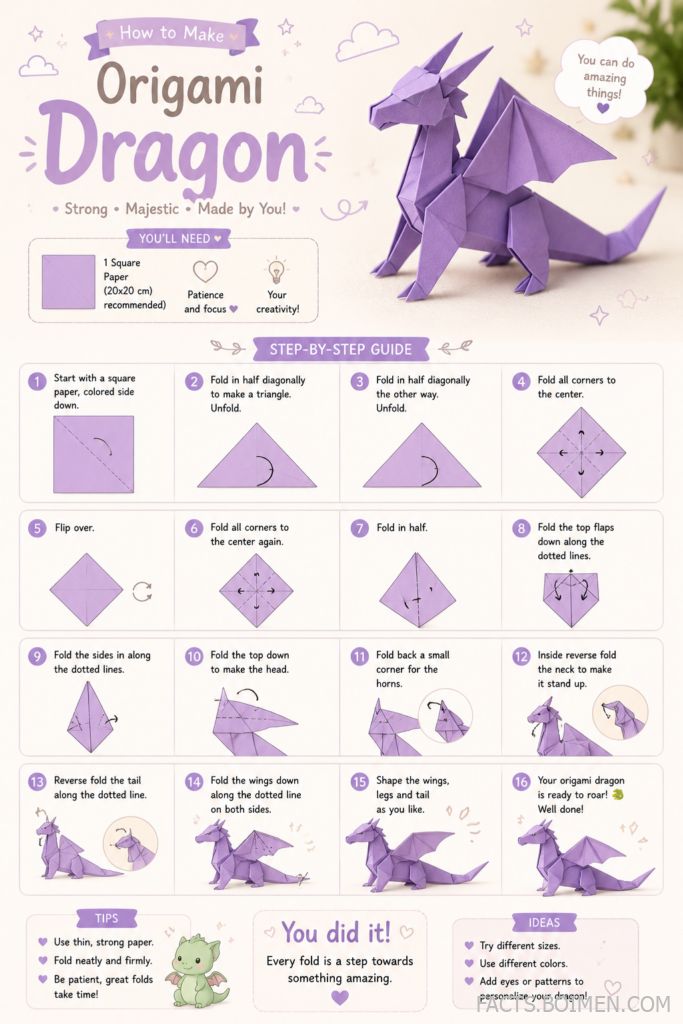
There is a particular kind of magic in watching a flat square of paper become a crane, a fox, or a geometric star. Origami rewards patience over expensive supplies: all you truly need is paper, a flat surface, and the willingness to fold the same crease a dozen times until it snaps into place. The best part is that the skills compound. Once you master a valley fold and a reverse fold, doors open to modular geometry, lifelike animals, and delicate desk sculptures that travel anywhere.
Below are 16 genuinely useful resources for learning origami fold-by-fold, from beginner-friendly diagram libraries to deep archives of crease patterns and printable paper. Each one offers something specific, whether that is step photography, video pacing, or free diagram PDFs you can print today.
Table of Contents(Click to Toggle)
- Why Origami Still Captivates Makers
- Origami Techniques & Paper Sculpture Guides
- 1. Origami.me
- 2. Origami Guide
- 3. Origami-Fun
- 4. Origami Way
- 5. Origami Instructions
- 6. Origami Resource Center
- 7. Gilad’s Origami Page
- 8. Happy Folding
- 9. Origami Spirit
- 10. Paper Kawaii
- 11. Jo Nakashima Origami
- 12. Origami Plus
- 13. British Origami Society
- 14. OrigamiUSA
- 15. Robert J. Lang Origami
- 16. Origami Simulator
- Bonus Mentions
- Folding Forward: Where to Start Tonight
Why Origami Still Captivates Makers
Origami is one of the few crafts that scales from a five-minute coffee-break distraction to a decades-long artistic practice. A beginner can fold a paper boat in under two minutes, while a master can spend forty hours on a single complex insect with hundreds of creases. That range is exactly what makes it so rewarding: you can always see your progress in the paper itself.
It is also remarkably portable. A pack of 15cm squares fits in a jacket pocket, needs no glue or scissors, and works on any table. For desk decor, a small flock of cranes or a modular star adds quiet texture without clutter. And because folding is repetitive and tactile, many people find it a genuinely calming way to end the day.
The resources below cover the full spectrum: diagram libraries with photographs, video channels that slow down the tricky steps, printable crease patterns for advanced folders, and even a browser simulator that lets you test a fold before creasing your good paper. Start with item one, then work down as your confidence grows.
Origami Techniques & Paper Sculpture Guides
1. Origami.me : Clean step-by-step diagrams for absolute beginners
What it is: A friendly diagram library with photographed steps, beginner guides, and a large collection of animal and flower models.
Category: Diagram library and beginner tutorials
Why it stands out:
- Each step uses a single clear photo with fold lines drawn on, so you always know which flap moves next.
- Models are sorted by difficulty, which makes it easy to climb from a simple fox to a more involved dragon.
- Short written notes under each photo explain terms like “valley fold” and “squash fold” as they appear.
Best for: Complete beginners who want to fold their first five models without confusion.
2. Origami Guide : Hundreds of free tutorials organised by theme
What it is: A large tutorial hub covering animals, flowers, boxes, and seasonal models, all with free instructions.
Category: Tutorial archive
Why it stands out:
- The theme categories are genuinely useful when you need a specific model, such as a paper crane for a gift or a lotus for a table setting.
- Difficulty labels run from easy to advanced, and many entries include both diagrams and a short video.
- Printable instructions are available for several models, handy if you prefer paper beside you instead of a screen.
Best for: Crafters who want a wide menu of models in one place.
3. Origami-Fun : Printable diagram PDFs and animated instructions
What it is: A long-running site offering diagram sets, printable paper patterns, and animated folding guides.
Category: Diagrams and printable resources
Why it stands out:
- The printable diagram PDFs are formatted to sit beside your paper, which is far easier than scrolling mid-fold.
- Free printable patterned paper adds colour without buying specialty stock.
- Animations show the motion of a fold, which helps with steps that look ambiguous in a static photo.
Best for: Folders who like printing instructions and working away from a screen.
4. Origami Way : Quick beginner models with simple written steps
What it is: A straightforward tutorial site focused on easy and intermediate models with concise instructions.
Category: Beginner tutorial site
Why it stands out:
- Instructions are written in plain language, which suits anyone who finds dense diagram notation intimidating.
- Many models take under ten minutes, making it a good source for a quick creative break.
- Categories include money origami and napkin folds, two practical uses beyond decorative models.
Best for: People who want fast, satisfying folds with minimal setup.
5. Origami Instructions : A deep catalogue of traditional and modern models
What it is: A well-organised collection of instructions spanning classic traditional designs and newer creations.
Category: Instruction catalogue
Why it stands out:
- The traditional section is excellent for learning the core base folds that underpin most models.
- Instructions are grouped by base, so you can see how one crane, one frog, and one flower share the same starting sequence.
- Each model page lists the paper size and shape needed, which prevents the common mistake of folding too small.
Best for: Learners who want to understand base folds rather than memorise single models.
6. Origami Resource Center : History, diagrams, and paper guidance in one archive
What it is: A broad reference site covering diagrams, origami history, paper types, and folding terminology.
Category: Reference and education
Why it stands out:
- The paper guide explains the difference between kami, washi, and foil-backed paper, and when each one helps.
- Historical articles give context on how traditional models spread across cultures.
- Glossaries of folding symbols make it easier to read diagrams from books and other sites.
Best for: Curious folders who want background knowledge alongside practical instructions.
7. Gilad’s Origami Page : A serious archive of books and crease patterns
What it is: One of the oldest and most thorough origami references online, with book reviews and model databases.
Category: Archive and book database
Why it stands out:
- The book database is searchable by author, model, and difficulty, which is invaluable when choosing your next purchase.
- Reviews are detailed and honest about which books suit beginners versus experienced folders.
- It documents crease patterns for complex designs, a genuine gateway into advanced folding.
Best for: Intermediate folders building a personal library and exploring crease patterns.
8. Happy Folding : Video reviews and folding demonstrations with clear pacing
What it is: A video-focused site with model demonstrations, paper reviews, and interviews with designers.
Category: Video instruction and reviews
Why it stands out:
- Videos are filmed overhead with steady pacing, so you can fold along in real time.
- Paper reviews compare how different stocks behave on the same model, which is genuinely hard to find elsewhere.
- Interviews with creators add context on how new models are designed.
Best for: Visual learners who prefer watching a fold before attempting it.
9. Origami Spirit : Thoughtful tutorials with a calm, teaching tone
What it is: A tutorial blog with detailed photo sequences, video, and reflections on the practice of folding.
Category: Tutorial blog
Why it stands out:
- Posts often explain why a step works, not just how to do it, which builds real understanding.
- Models lean toward elegant, giftable designs such as boxes, hearts, and decorative flowers.
- Tips on creasing cleanly and handling small paper appear throughout the tutorials.
Best for: Folders who want to slow down and understand each crease.
10. Paper Kawaii : Cute modular and practical paper projects
What it is: A tutorial site specialising in kawaii-style models, boxes, and modular pieces with video walkthroughs.
Category: Modular and decorative tutorials
Why it stands out:
- Modular projects show how to fold many identical units and assemble them into stars and balls.
- Practical models like gift boxes and envelopes make the craft immediately useful.
- Videos are clearly filmed with labelled steps, which helps with assembly stages.
Best for: Makers who love modular geometry and cute desk-sized decorations.
11. Jo Nakashima Origami : Precise video tutorials for intermediate to advanced models
What it is: A widely followed video channel known for clear, well-lit tutorials on animals, dragons, and geometric designs.
Category: Video tutorial channel
Why it stands out:
- Camera angles stay overhead and consistent, so you rarely lose track of which layer is moving.
- Models range from approachable to genuinely complex, letting you pick your challenge level.
- Paper size and type recommendations appear at the start of each tutorial.
Best for: Folders ready to move beyond simple models and tackle detailed animals.
12. Origami Plus : Short, focused video lessons for quick wins
What it is: A video channel offering concise tutorials on small models, toys, and practical folds.
Category: Video tutorial channel
Why it stands out:
- Many videos run only a few minutes, ideal for a lunch break or a first attempt.
- The channel covers playful action models that move, which appeals to kids and adults alike.
- Simple on-screen captions reinforce each step without long narration.
Best for: Beginners and anyone folding with children.
13. British Origami Society : A membership society with diagrams and community events
What it is: One of the oldest origami societies, offering publications, diagrams, and local meetings.
Category: Society and community
Why it stands out:
- Membership includes regular publications with new diagrams and design articles.
- Local group meetings let you fold alongside experienced hobbyists and pick up technique in person.
- The society maintains historical archives that document the craft’s development.
Best for: Hobbyists who want community, events, and a steady stream of new diagrams.
14. OrigamiUSA : Conventions, classes, and a members’ diagram library
What it is: A national organisation hosting conventions, classes, and a members-only collection of diagrams.
Category: Organisation and events
Why it stands out:
- The annual convention brings together folders of every level for classes and exhibitions.
- Members gain access to a diagram library that is not available publicly.
- Online classes make it possible to learn from designers without travelling.
Best for: Folders who want structured learning and a wider community.
15. Robert J. Lang Origami : The mathematics and artistry of advanced folding
What it is: The official site of a leading origami artist and physicist, featuring galleries, articles, and crease patterns.
Category: Advanced art and theory
Why it stands out:
- Galleries show what is possible at the highest level, including insects and animals with hundreds of folds.
- Articles explain how mathematics is used to design crease patterns before any paper is touched.
- Selected crease patterns are shared for folders ready to attempt serious work.
Best for: Advanced folders and anyone curious about the design side of origami.
16. Origami Simulator : Test a crease pattern in your browser before folding
What it is: A browser tool that simulates how a crease pattern folds, letting you watch the paper move in 3D.
Category: Digital design tool
Why it stands out:
- You can load a crease pattern and see whether it collapses into the intended shape before committing expensive paper.
- The simulation runs in a browser with no installation, which makes it easy to try on any computer.
- It is a genuinely useful bridge between diagram reading and understanding how folds interact.
Best for: Designers and curious folders exploring crease patterns.
Bonus Mentions
Origami Shop : Specialty paper and books for folders who want better stock
A retailer stocking kami, washi, foil, and tant paper in many sizes, plus imported instruction books. Useful once you notice that paper quality changes how crisp your folds look.
r/origami : A friendly community for feedback and troubleshooting
A subreddit where folders post finished models and ask for help on stuck steps. Good for identifying a model you saw somewhere or getting a second opinion on a tricky collapse.
Flickr Origami Group : A long-running photo pool of folded work
An archive of thousands of photographed models with notes on paper and designer. Browsing it is a quick way to discover models you did not know existed.
Wikipedia: Origami : Background on history, terms, and techniques
A solid overview of origami’s history, key terminology, and major styles including modular and wet folding. Helpful when you want context for the models you are learning.
Folding Forward: Where to Start Tonight
The beauty of origami is that the barrier to entry is almost zero. Pick one resource from this list, cut or buy a few squares of paper, and fold something imperfect. Your first crane will likely be a little lopsided. Your fifth will look deliberate. By the twentieth, you will start noticing how creases relate to one another, and that is when the craft really opens up.
If you are unsure where to begin, start with a diagram library for a simple model, then try a video for anything that involves a reverse fold or a squash fold. Keep your paper size generous at first, since small paper makes every step harder. Once your folds feel crisp, try modular pieces or a crease pattern simulator to see the design side of the craft.
Which origami model or resource on this list are you going to try first? Share your pick in the comments, and if you have a favourite folding site that did not make the cut, add it so other readers can find it too.