There is a particular kind of magic in a handwritten note folded so cleverly that it has to be unfolded in a specific order, or opened a specific way, or pulled apart like a tiny puzzle before the words inside even appear. Long before group chats and disappearing messages, students were passing notes folded into triangles, hearts, arrows, and little locked packets that doubled as a secret handshake in paper form. The best part? None of it requires an app, a login, or a signal. Just a square of paper, a pen, and someone worth writing to.
This list gathers twenty-one note folding techniques in the classic middle school style, plus a handful of bonus mentions for anyone who wants to go deeper. Some are quick three-fold classics you can master in under a minute, and others are intricate little envelopes with tuck-in flaps that feel genuinely satisfying to open. Every one of them works with plain notebook paper, though a few shine brightest with a true square.
Table of Contents(Click to Toggle)
- Why Note Folding Still Wins Hearts and Hallways
- The Techniques
- 1. The Classic Triangle Fold
- 2. The Square Pull-Tab Note
- 3. The Heart Fold
- 4. The Envelope Pocket Note
- 5. The Fortune Teller Note
- 6. The Arrow Fold
- 7. The Origami Crane Note
- 8. The Locked Letter Fold
- 9. The Waterbomb Note
- 10. The Fan Fold Note
- 11. The Secret Spiral Note
- 12. The Origami Star Note
- 13. The Mini Book Note
- 14. The Criss-Cross Puzzle Fold
- 15. The Pull-String Note
- 16. The Origami Butterfly Note
- 17. The Tuck-and-Seal Letter
- 18. The Accordion Letter
- 19. The Origami Boat Note
- 20. The Origami Ninja Star Note
- 21. The Puzzle Cube Note
- Bonus Mentions
- The Best-Kept Secrets in Paper Form
Why Note Folding Still Wins Hearts and Hallways
A folded note is a small act of effort, and effort is the whole point. Anyone can tap out a text in four seconds, but folding a note takes planning, patience, and a little bit of craft. That ritual is exactly why the tradition refuses to die. It shows up in summer camps, in classrooms where phones stay in backpacks, in long-distance friendships, and in the grown-up habit of slipping a handwritten note into a lunchbox or a jacket pocket.
There is also a practical side. A well-folded note is compact, durable, and easy to hide in a textbook or a pencil case. Some folds even double as their own envelope, which means no tape, no staples, and no glue stick required. And because the folding pattern itself can carry meaning, a simple triangle or heart can say something before a single word is read.
Finally, folding is a genuinely useful skill. The same techniques that make a note look clever are the foundation of origami, paper engineering, and even simple gift wrapping. Learn a dozen folds and you have a party trick, a craft project, and a way to make someone’s day, all from one sheet of paper.
The Techniques
1. Origami.me : The Classic Triangle Fold
What it is: The most iconic note fold in existence, made by folding a corner diagonally to create a triangle, then tucking the ends into each other so the note stays shut.
Category: Beginner fold, no tools needed
Why it stands out:
- Works with any rectangular sheet, so you never need to trim paper first
- The tucked ends create a natural lock, so the note will not fall open in a backpack
- Unfolds in one smooth motion, which makes it feel dramatic to open
Best for: First-time note folders and quick messages passed in a hallway.
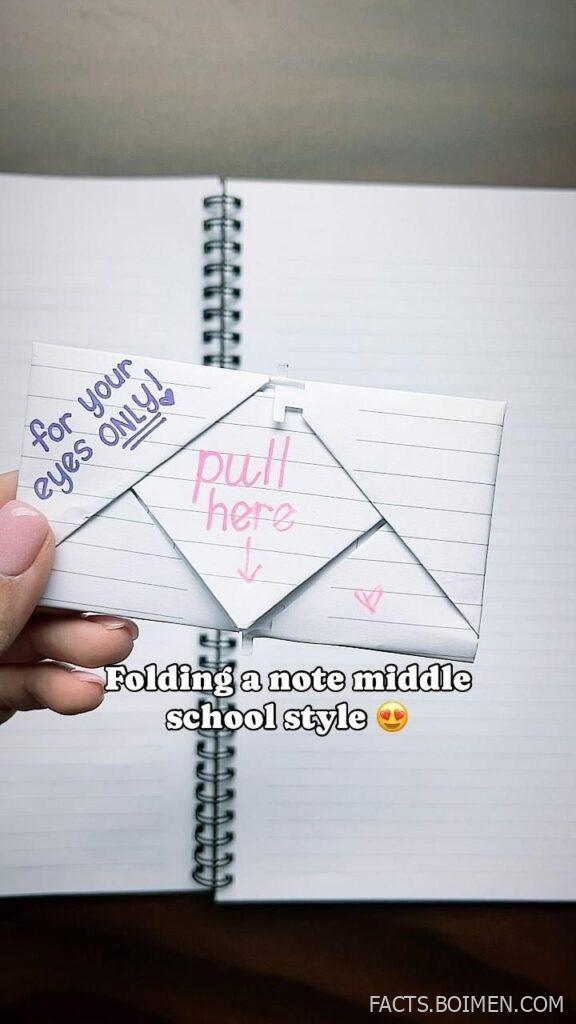
2. Origami-Instructions : The Square Pull-Tab Note
What it is: A square note folded into quarters with one flap left loose so the reader pulls a tab to reveal the message underneath.
Category: Interactive fold with a reveal moment
Why it stands out:
- The pull-tab adds a small surprise that a plain fold cannot match
- Nesting the tab under the top layer keeps the message hidden until the reader chooses to open it
- Works beautifully with colored paper because the tab can be a contrasting shade
Best for: Anyone who wants the note itself to feel like a tiny gift.
3. Origami Way : The Heart Fold
What it is: A note folded so the finished packet is shaped like a heart, usually by folding two top corners down and tucking the bottom point up.
Category: Decorative fold with a message inside
Why it stands out:
- The shape communicates affection before the note is even opened
- Lies flat, so it slides easily into a card or a book
- Pairs perfectly with a short message, since the shape does most of the talking
Best for: Friendship notes, valentines, and thank-you messages.
4. Paper Kawaii : The Envelope Pocket Note
What it is: A fold that turns the note paper itself into a small envelope with a flap, so the message sits inside a pocket rather than being folded shut.
Category: Self-sealing envelope fold
Why it stands out:
- No separate envelope, tape, or sticker is required
- The flap can be decorated or doodled on before folding
- Great for holding a tiny extra, like a sticker or a folded paper charm
Best for: Sending notes to friends in other classes or dropping one in a locker.
5. Origami-Fun : The Fortune Teller Note
What it is: The classic paper fortune teller, repurposed as a note by writing different messages under each flap so the reader picks a number and a color to reveal their answer.
Category: Game-style fold
Why it stands out:
- Turns a single note into a small interactive game
- Eight hidden messages fit on one sheet, so it is surprisingly efficient
- Everyone already knows how to use one, which removes any learning curve
Best for: Groups of friends and anyone who wants a note that keeps giving.
6. Origami Resource Center : The Arrow Fold
What it is: A fold that ends in a pointed arrow shape, traditionally used to literally point the note toward its recipient.
Category: Directional fold
Why it stands out:
- The arrow tip acts as a visual cue for who the note is meant for
- Simple enough to fold in under thirty seconds once practiced
- Flat profile makes it easy to slide across a desk unnoticed
Best for: Passing notes across a room where a name might be too obvious.
7. Origami Guide : The Origami Crane Note
What it is: A miniature paper crane folded from note paper, with the message written on the inside faces before the final folds.
Category: Intermediate origami fold
Why it stands out:
- The crane is a globally recognized symbol of care and good wishes
- Keeps its shape, so it can sit on a desk as a tiny keepsake
- Rewards practice: the tenth crane looks noticeably better than the first
Best for: Thoughtful notes that are meant to be kept rather than thrown away.
8. Origami.me : The Locked Letter Fold
What it is: A rectangular fold where the two long edges interlock in the middle, creating a sealed packet that requires a specific tug to open.
Category: Secure fold
Why it stands out:
- The interlocking edges hold firmly without any adhesive
- Looks tidy and rectangular, almost like a tiny parcel
- Opening it wrong just tightens the fold, which adds to the fun
Best for: Longer notes, since the rectangular shape handles more text.
9. Origami-Instructions : The Waterbomb Note
What it is: A cube-like inflated fold, traditionally the paper waterbomb, adapted by writing the message on the inside before the final puff of air.
Category: 3D fold
Why it stands out:
- The finished note is three-dimensional and stands on its own
- Gently squeezing it pops it open, which is genuinely satisfying
- Hides the message completely until the reader commits to opening it
Best for: A playful reveal and anyone who likes a note with a physical gimmick.
10. Paper Kawaii : The Fan Fold Note
What it is: A note folded back and forth into a pleated fan, then cinched in the middle so it opens like a blooming flower.
Category: Decorative pleated fold
Why it stands out:
- The accordion pleats create a striking reveal when the note is pulled open
- Long messages fit comfortably along the pleated strip
- The cinched center can be tied with a bit of string or a thin ribbon
Best for: Longer letters and notes that deserve a dramatic opening.
11. Origami Way : The Secret Spiral Note
What it is: A long strip of paper wound into a tight spiral coil with the message written along the length so it must be unrolled to read.
Category: Novelty fold
Why it stands out:
- Unrolling takes time, which builds anticipation for the message
- Fits an impressive amount of text in a very small footprint
- Can be tucked into a small box or a pencil case for a surprise
Best for: Secret messages and anyone who loves a slow reveal.
12. Origami-Fun : The Origami Star Note
What it is: A flat five-pointed star folded from a pentagon base, with the note written on the hidden inner layers.
Category: Intermediate decorative fold
Why it stands out:
- The star shape is instantly eye-catching on a desk or in a pocket
- Five points mean five natural spots for tiny doodles or initials
- Flat enough to use as a bookmark after it is opened
Best for: Small notes and crafty friends who keep everything.
13. Origami Resource Center : The Mini Book Note
What it is: A single sheet folded and cut into a tiny multi-page booklet, giving the note actual pages to flip through.
Category: Structural fold
Why it stands out:
- Creates a real cover and several interior pages from one sheet
- Each page can hold a different thought, list, or drawing
- Feels like a handmade zine, which makes it a keepsake
Best for: Multi-part messages, top-five lists, and illustrated notes.
14. Origami Guide : The Criss-Cross Puzzle Fold
What it is: A note folded in overlapping diagonal bands so the reader has to slide the strips apart in the right order to read the full message.
Category: Puzzle fold
Why it stands out:
- Turns reading the note into a small puzzle to solve
- The woven look is unusual and hard to guess from the outside
- Encourages short, punchy messages that fit the format
Best for: Riddles, clues, and notes meant to be earned.
15. Origami.me : The Pull-String Note
What it is: A folded packet with a thin paper strip threaded through it, so pulling the strip draws the inner message out like a tiny scroll.
Category: Mechanical fold
Why it stands out:
- The message emerges on its own, which never stops being delightful
- Uses only paper, no string or thread required
- Compact enough to fit in a pocket without crushing
Best for: A showstopper note and anyone who likes paper engineering.
16. Paper Kawaii : The Origami Butterfly Note
What it is: A butterfly folded from note paper, with the message written on the wings before they are shaped and creased.
Category: Decorative origami fold
Why it stands out:
- The wings can be angled slightly so the butterfly sits upright
- Symmetry makes even a messy first attempt look intentional
- A gentle pinch makes the wings flutter, which is a fun bonus
Best for: Spring-themed notes and decorating a locker or bulletin board.
17. Origami-Instructions : The Tuck-and-Seal Letter
What it is: A traditional letter fold where the bottom edge tucks into a pocket formed by the top edge, sealing the letter without tape.
Category: Classic letter fold
Why it stands out:
- It is the standard way letters were folded for centuries, so it feels timeless
- The tuck holds securely but opens cleanly with one finger
- Works with full-size sheets, so no trimming is needed
Best for: Longer handwritten letters and notes that read like mail.
18. Origami Way : The Accordion Letter
What it is: A letter folded into a zigzag stack so it compresses into a small rectangle and expands like a spring when pulled.
Category: Compact fold
Why it stands out:
- Compresses a long message into a very small, tidy package
- The springy opening motion is quick and satisfying
- Easy to label on the outside with a name or a doodle
Best for: Long notes that still need to fit in a pocket.
19. Origami-Fun : The Origami Boat Note
What it is: The classic paper boat, folded with the message written on the inner faces so it is hidden until the boat is unfolded.
Category: Beginner 3D fold
Why it stands out:
- One of the easiest three-dimensional folds to learn
- The finished boat sits flat on its base and looks charming on a desk
- Unfolding it reveals a surprisingly large writing area
Best for: Beginners who want something more than a flat fold.
20. Origami Guide : The Origami Ninja Star Note
What it is: A four-pointed throwing star made from two folded units joined together, with the message split across the inner layers.
Category: Multi-piece fold
Why it stands out:
- Two sheets of paper create a sturdy, layered star
- Splitting the message across layers means it can only be read when fully assembled or opened
- Looks impressive and costs nothing but paper
Best for: A note that doubles as a small toy.
21. Origami Resource Center : The Puzzle Cube Note
What it is: Six small folded units assembled into a cube, with a message written on the faces that only line up when the cube is rotated correctly.
Category: Advanced modular fold
Why it stands out:
- Modular folding means each unit is simple, even though the result looks complex
- The cube can be taken apart and rebuilt, so the note is reusable
- Writing across faces turns reading into a small puzzle
Best for: Patient folders and anyone who wants a desk-worthy keepsake.
Bonus Mentions
Origami.me : Diagram Library
A deep, well-organized collection of step-by-step diagrams and video tutorials covering beginner folds all the way up to complex modular designs. Handy when you want a printable diagram to follow without pausing a video every few seconds.
Paper Kawaii : Cute Paper Projects
Focused on small, charming paper crafts including envelopes, boxes, and note-sized folds. The tutorials are slow and clear, which makes them a good fit for younger folders or anyone new to creasing accurately.
Origami-Instructions : Free Step-by-Step Guides
A long-running free resource with hundreds of written and illustrated instructions. Useful as a reference when you only remember half of a fold and need a quick refresher on the final tuck.
Origami Way : Easy Folds for Beginners
Organized by difficulty, so you can start with the simplest folds and work upward. The beginner section is especially good for practicing the crisp creases that make every note fold look sharp.
Origami Guide : Video and Diagram Tutorials
Combines diagrams with video walkthroughs for many classic designs. The dual format helps when a written step is ambiguous and you just need to see the motion once.
The Best-Kept Secrets in Paper Form
What makes note folding so enduring is that it asks for almost nothing and gives back a lot. A single sheet of paper, a pen, and a few minutes of attention turn into something someone can hold, unfold, and keep. The folds on this list range from the thirty-second triangle to the modular cube that takes an afternoon, and every one of them delivers the same small thrill: the moment the paper gives way and the message appears.
If you are just starting, pick the classic triangle or the heart and fold it until the creases feel automatic. Once your hands know the motion, move up to the envelope pocket or the fortune teller, which add a reveal without much extra effort. The intermediate folds, like the crane and the star, are worth the practice because they turn a note into something worth keeping on a shelf. And the advanced modular designs, like the ninja star and the puzzle cube, are perfect for a rainy afternoon when you want a project rather than a quick message.
One last tip that applies to every fold: crease firmly with a fingernail or the edge of a ruler, and fold on a hard, flat surface rather than your lap. Crisp creases are the difference between a note that looks handmade and one that looks handmade well. Colored paper helps too, especially for folds where the inner layers peek through.
So write something worth reading, fold it so it has to be earned, and hand it over. Which fold from this list are you trying first, and what is your own favorite note-folding trick that did not make the cut?