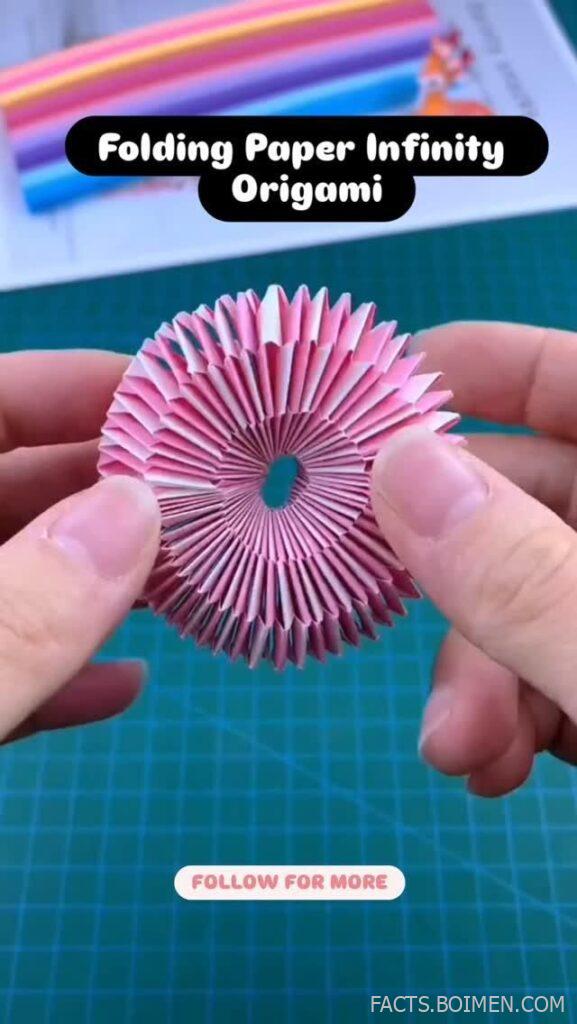
There is a moment in paper folding when something impossible seems to happen. You make one crease, then another, and suddenly the sheet keeps rotating, folding back on itself, cycling around and around without ever running out of paper. That is the magic of an infinite folding origami project, and it is far easier to build than it looks. All you need is a square of paper, a flat surface, and a few minutes of patience. Below are 21 ideas, templates, tutorials, and paper-craft resources that let you build your own endlessly turning origami circle, from simple beginner versions to elaborate modular designs.
Table of Contents(Click to Toggle)
- Why an Endless Folding Origami Circle Is Worth Your Next Free Hour
- The 21 Best Infinite Folding Origami Ideas and Resources
- 1. Origami.me
- 2. Origami Guide
- 3. Paper Kawaii
- 4. Origami-Fun
- 5. Origami Way
- 6. Origami Resource Center
- 7. Jo Nakashima’s Origami YouTube Channel
- 8. Jeremy Shafer’s Origami YouTube Channel
- 9. Foldology Origami Puzzle
- 10. Flexagon Tutorials
- 11. Origami Twist and Turn Templates
- 12. Modular Origami Rings
- 13. Envelope Folding Sequences
- 14. Origami Fortune Tellers
- 15. Paper Strip Folding Crafts
- 16. Origami Spinning Tops
- 17. Origami Pinwheels
- 18. Origami Tessellations
- 19. Origami Kusudama Balls
- 20. Origami Paper Recommendations
- 21. Origami Diagram Archives
- Bonus Mentions
- The Endless Fold Keeps Going
Why an Endless Folding Origami Circle Is Worth Your Next Free Hour
Most paper crafts end. You fold a crane, you set it on a shelf, and it just sits there. An infinite folding origami circle is different because the folding never truly finishes. Each completed turn creates a new flap, and that flap folds into another, which folds into another, cycling around the ring like a paper version of a Möbius strip.
Teachers love these projects because they sneak geometry, symmetry, and spatial reasoning into a craft that feels like a toy. Parents love them because a single sheet of paper can occupy a child for a surprisingly long time. And origami hobbyists love them because the mechanism scales: you can build a four-panel beginner version in two minutes or a sixteen-panel showpiece that takes an evening.
The best part is the barrier to entry. No glue, no scissors, no special tools. A square of copy paper works, though slightly thicker origami paper folds more cleanly and holds its shape longer. The resources below cover every skill level, from absolute first-timers to folders who already know their valley folds from their mountain folds.
The 21 Best Infinite Folding Origami Ideas and Resources
1. Origami.me : Clear step-by-step diagrams for endless folding models
What it is: A long-running origami tutorial site with illustrated, numbered diagrams for hundreds of models, including flexagons, fortune tellers, and rotating paper mechanisms.
Category: Tutorial library
Why it stands out:
- Diagrams are drawn rather than photographed, so crease lines stay visible even on a phone screen.
- Difficulty labels let beginners skip straight to the easy folding loops.
- Each model page includes a short history note, which is handy for classroom use.
Best for: Beginners who want a written reference they can pause and re-read while folding.
2. Origami Guide : Beginner-friendly photo tutorials with video backups
What it is: A tutorial hub that pairs crisp step photos with embedded videos, organised by difficulty and by type of fold.
Category: Tutorial library
Why it stands out:
- Photos are shot from the folder’s point of view, which makes reversing a fold much easier to follow.
- The site groups projects by occasion, so you can find quick classroom or party crafts fast.
- Many models include a printable diagram you can take offline.
Best for: Visual learners who need to see a real hand making the crease.
3. Paper Kawaii : Cute, giftable paper projects with printable templates
What it is: A craft blog and video channel focused on kawaii-style origami, including spinning and flipping paper toys.
Category: Craft blog and video channel
Why it stands out:
- Free printable template sheets save you from measuring panels by hand.
- Videos are filmed overhead with slow, repeatable steps.
- Projects often double as gift boxes, cards, and desk decorations.
Best for: Crafters who want their finished piece to look polished enough to give away.
4. Origami-Fun : Fast diagrams for animated, moving paper toys
What it is: A straightforward diagram site with a dedicated section for toys that move, spin, or flip.
Category: Diagram archive
Why it stands out:
- Each diagram fits on a single page, so you never lose your place mid-fold.
- Printable PDF versions are available for most models.
- The moving-toy section includes classic snapping and rotating mechanisms.
Best for: Folders who want a quick win they can show someone within five minutes.
5. Origami Way : Simple instructions sorted by difficulty and time
What it is: A beginner-focused site that labels every model with a difficulty rating and an estimated folding time.
Category: Tutorial library
Why it stands out:
- The time estimates are genuinely useful when planning a rainy-afternoon activity.
- Instructions use large type and generous spacing, ideal on a tablet propped on the table.
- There is a solid set of action models, including flapping and rotating designs.
Best for: Parents choosing a project that matches a child’s attention span.
6. Origami Resource Center : The deep archive for unusual folding mechanisms
What it is: An encyclopedic reference covering origami history, mathematics, and hundreds of model links.
Category: Reference archive
Why it stands out:
- Explains the geometry behind flexagons and looping folds in plain language.
- Curated links point to diagrams across many independent folders’ sites.
- Useful background reading for teachers building a lesson around paper folding.
Best for: Readers who want to understand why an endless fold works, not just how to make one.
7. Jo Nakashima’s Origami YouTube Channel : Precise video tutorials from a master folder
What it is: One of the most respected origami video libraries online, with clear overhead filming and no wasted narration.
Category: Video tutorials
Why it stands out:
- Camera angles stay fixed, so you can follow along without reorienting yourself.
- Complex mechanisms are broken into short, repeatable segments.
- Free diagrams are often linked in the video description.
Best for: Intermediate folders ready to move beyond simple diagrams.
8. Jeremy Shafer’s Origami YouTube Channel : Inventive action models that flip and rotate
What it is: A channel devoted to original action origami, including models that spin, snap, and fold in continuous loops.
Category: Video tutorials
Why it stands out:
- Many designs are original inventions you will not find in standard diagram books.
- Videos are high-energy and demonstrate the finished motion before teaching it.
- Great source of inspiration for designing your own endless fold.
Best for: Folders who want unusual, crowd-pleasing paper toys.
9. Foldology Origami Puzzle : A hands-on kit that turns folding into a puzzle
What it is: A printed puzzle kit where each sheet folds into a shape that must match a target image.
Category: Physical kit
Why it stands out:
- Pre-printed crease guides remove the measuring step entirely.
- Puzzles escalate in difficulty, so it works as a solo or family activity.
- The folding logic overlaps heavily with infinite loop mechanisms.
Best for: Anyone who enjoys origami as a brain teaser rather than a display craft.
10. Flexagon Tutorials
What it is: The flexagon family, especially the tri-hexaflexagon, is the classic endlessly folding paper mechanism and the closest cousin to a turning origami circle.
Category: Folding technique
Why it stands out:
- A single strip of paper folds into a hexagon that reveals a new face each time you pinch and flex it.
- You can decorate each hidden face with a different colour or drawing for a reveal effect.
- Search any major tutorial site or video platform for “hexaflexagon” to find free walkthroughs.
Best for: Beginners who want the simplest possible endless-fold project.
11. Origami Twist and Turn Templates
What it is: Printable templates for twisting rings and turning panels, often used in paper engineering and pop-up cards.
Category: Printable templates
Why it stands out:
- Pre-scored lines make the twist mechanism reliable even for young children.
- Templates scale up to poster size for classroom displays.
- Pairs well with card-making, since the turning panel becomes a moving greeting.
Best for: Card makers and teachers who want a reusable template.
12. Modular Origami Rings
What it is: Designs built from many identical folded units slotted together into a ring or wreath.
Category: Folding technique
Why it stands out:
- Units are repetitive, so the folding becomes relaxing rather than demanding.
- Rings can be rotated and rearranged after assembly, echoing the endless-fold idea.
- Colour-blocking the units creates striking geometric patterns.
Best for: Patient folders who enjoy assembly as much as creasing.
13. Envelope Folding Sequences
What it is: The traditional envelope fold, where a square rotates around a centre point through a repeating sequence of corner folds.
Category: Folding technique
Why it stands out:
- It is the clearest introduction to rotational folding symmetry.
- The finished envelope is genuinely useful for cards and small gifts.
- Variations exist that keep folding past the standard four corners.
Best for: First-time folders who want a practical result.
14. Origami Fortune Tellers
What it is: The childhood paper chatterbox, which opens and closes in a repeating motion and hides messages inside.
Category: Classic model
Why it stands out:
- It is the fastest way to teach a child a folding cycle that repeats.
- Inner flaps can hold jokes, chores, or vocabulary words.
- Only four folds and one collapse are needed to finish it.
Best for: Kids’ activities and classroom icebreakers.
15. Paper Strip Folding Crafts
What it is: Projects that start from long paper strips rather than squares, woven or looped into continuous bands.
Category: Material technique
Why it stands out:
- Strips are forgiving, so mistakes are easy to undo.
- Strip weaving produces strong, stable rings perfect for decoration.
- Scrap paper and old magazines work fine, keeping the craft low-cost.
Best for: Crafters using up leftover paper at home.
16. Origami Spinning Tops
What it is: Folded tops that spin on a flat surface, often built from a few interlocking flaps.
Category: Action model
Why it stands out:
- The spinning motion teaches balance and centre of gravity through play.
- Thicker paper spins noticeably longer than thin copy paper.
- A quick project that works well as a party favour.
Best for: Kids who like toys they can race against each other.
17. Origami Pinwheels
What it is: Folded blades arranged around a centre point so the whole shape rotates.
Category: Action model
Why it stands out:
- The radial symmetry is a direct visual cousin of the endless folding circle.
- Blades can be folded from two-tone paper for a colour-flip effect.
- Works as a garden decoration when mounted on a stick.
Best for: Decorating a room, party, or garden on a budget.
18. Origami Tessellations
What it is: Flat sheets covered in repeating geometric crease patterns that fold into three-dimensional textures.
Category: Advanced technique
Why it stands out:
- The repeating patterns are the mathematical heart of any looping fold.
- Finished pieces look like sculpture and photograph beautifully.
- Grid pre-creasing takes time, but the folding itself is meditative.
Best for: Experienced folders who enjoy precision and pattern.
19. Origami Kusudama Balls
What it is: Decorative spheres assembled from many folded flowers or units joined into a ring structure.
Category: Modular decoration
Why it stands out:
- The assembly process is circular, mirroring the endless-fold concept.
- Finished balls make striking hanging decorations.
- Units can be made in batches and stored for later assembly.
Best for: Crafters who want a display piece for a special occasion.
20. Origami Paper Recommendations
What it is: Choosing the right paper matters more than most beginners expect, especially for mechanisms that fold repeatedly.
Category: Supplies
Why it stands out:
- Standard 15 cm kami holds a crease well and is cheap enough to practise with.
- Tant paper is thin and strong, ideal for models with many layers.
- Foil-backed paper keeps sharp edges but can crack if folded too many times.
Best for: Anyone whose folds keep springing open.
21. Origami Diagram Archives
What it is: Online collections of free diagrams contributed by folders worldwide, often including rare action models.
Category: Diagram archive
Why it stands out:
- Searchable by model name, so you can hunt down a specific mechanism.
- Many archives host out-of-print convention booklets.
- Community comments often clarify confusing steps.
Best for: Folders chasing a specific design they saw online.
Bonus Mentions
r/origami : A friendly community for feedback and inspiration
What it is: A large origami forum where folders post photos, ask for help, and share diagrams.
Category: Community
Why it stands out:
- Quick answers when a step in a diagram makes no sense.
- Monthly challenges push you to try unfamiliar mechanisms.
Best for: Folders who want feedback on their work.
Origami hashtags on Instagram : Endless visual inspiration
What it is: A scrolling feed of finished origami from hobbyists and professionals.
Category: Inspiration
Why it stands out:
- Short video clips show mechanisms in motion, which diagrams cannot capture.
- Easy to save ideas into a personal collection for later.
Best for: Visual browsing when you are not ready to fold yet.
Pinterest origami boards : Curated idea boards for every skill level
What it is: A visual bookmarking platform where crafters collect tutorials and templates.
Category: Inspiration
Why it stands out:
- Boards often group projects by season or holiday.
- Pinned infographics summarise folding steps at a glance.
Best for: Planning a themed craft session in advance.
YouTube origami search : The fastest route to any tutorial
What it is: A direct search for video walkthroughs when you cannot follow a static diagram.
Category: Video tutorials
Why it stands out:
- Playback speed can be slowed for tricky folds.
- Comments frequently flag errors in a tutorial’s steps.
Best for: Last-minute help when you are stuck mid-fold.
Origami paper sets : Affordable supplies for repeated folding
What it is: Multipacks of pre-cut square paper in assorted colours and sizes.
Category: Supplies
Why it stands out:
- Pre-cut squares remove the most common beginner frustration.
- Bulk packs make it easy to experiment without worrying about waste.
Best for: Anyone folding often enough to need a steady supply.
The Endless Fold Keeps Going
An infinite folding origami circle is one of those rare crafts that rewards both a two-minute attempt and an evening of careful work. Start with the simplest rotating model you can find, fold it badly, and then fold it again. The mechanism only clicks once your hands understand the rhythm, and after that you can scale the idea up into flexagons, modular rings, and tessellated panels.
Keep a small stack of square paper near your desk. When you have five spare minutes, fold one loop. The projects above cover everything from free diagrams to video tutorials and physical kits, so there is always a next step no matter your skill level. Pick one resource, make one endless fold, and see how long you can keep it turning.
Which endless folding paper project did you try first, and did it turn out the way you expected? Share your favourite find in the comments.