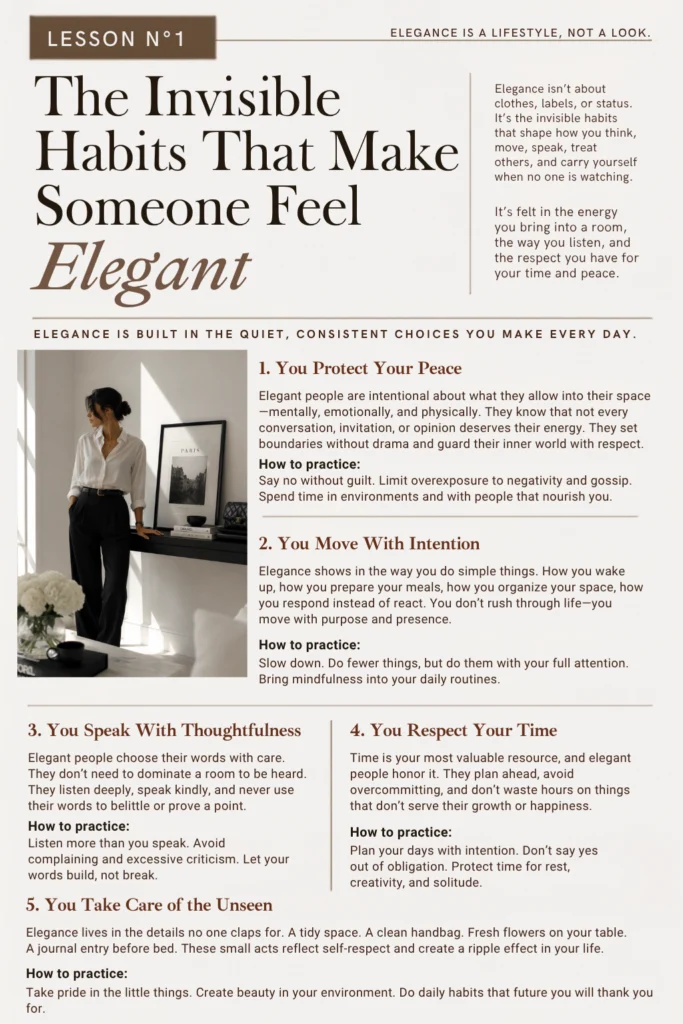
Elegance rarely announces itself. It shows up in the pause before someone answers a question, the way they hold a door without making a show of it, or how they listen without waiting to speak. Most of the habits that make a person feel elegant are invisible to the casual observer — they are internal rituals, small pauses, and quiet standards rather than expensive purchases. The five habits below are the core, and each one is followed by concrete, practical ways to practice it. Read through, pick one to start with this week, and let the rest build naturally.
Table of Contents(Click to Toggle)
- Why Invisible Habits Create Real Elegance
- The 5 Invisible Habits (Plus 12 Ways to Practice Them)
- 1. The Pause Before Responding
- 2. The Deliberate Entrance
- 3. The Quiet Compliment
- 4. The Unhurried Exit
- 5. The Daily Reset Ritual
- 6. The One-Question Rule
- 7. The Hands-Free Conversation
- 8. The Gratitude Note
- 9. The Single-Task Hour
- 10. The Pre-Planning Habit
- 11. The Wardrobe Uniform
- 12. The Voice Check
- 13. The Compliment Receipt
- 14. The Slow Morning
- 15. The Space Reset
- 16. The Name Memory
- 17. The Evening Review
- Bonus Mentions
- The Quiet Power of Practiced Grace
Why Invisible Habits Create Real Elegance
Elegance is often mistaken for a look, but it is actually a rhythm. People who feel elegant tend to move, speak, and decide at a slightly more considered pace than everyone around them. That rhythm is not genetic — it is built from habits repeated until they become automatic. The good news is that invisible habits cost nothing and can be practiced anywhere: in a meeting, at a dinner table, in a checkout line. They also compound. A person who pauses before responding starts to notice they are interrupted less. Someone who plans their morning stops rushing. Over a few weeks, these small shifts read as confidence, and confidence is what most people are actually noticing when they describe someone as elegant.
The 5 Invisible Habits (Plus 12 Ways to Practice Them)
1. Calm : The Pause Before Responding
What it is: A two-second pause before answering a question or reacting to news, practiced with the help of short guided breathing sessions.
Category: Mindfulness and emotional regulation
Why it stands out:
- The app’s one-minute breathing tools are short enough to use before a phone call or a difficult conversation.
- A visible pause signals thoughtfulness rather than hesitation — it is one of the fastest ways to shift how you are perceived.
- The free tier includes daily sessions, so the habit costs nothing to test.
Best for: Anyone who tends to answer too quickly, over-explain, or react before thinking.
2. Headspace : The Deliberate Entrance
What it is: A short pre-event ritual — a minute of stillness before walking into a room, a meeting, or a party — supported by the app’s short “refreshing” sessions.
Category: Presence and first impressions
Why it stands out:
- Walking in slowly, taking one breath, and looking around before moving reads as composure; rushing in reads as anxiety.
- Headspace’s short sessions are designed for exactly this kind of transition moment between tasks.
- The app also offers sleep content, which helps the next morning’s entrance feel less frantic.
Best for: People who arrive at events flustered and want a calmer, more intentional first impression.
3. Notion : The Quiet Compliment
What it is: A simple running note where you record specific, genuine observations about people — a good idea they shared, a skill they showed — so you can offer a precise compliment later.
Category: Social grace and emotional intelligence
Why it stands out:
- Specific compliments (“your summary of the budget was the clearest part of the meeting”) land far better than generic praise.
- A database view lets you tag notes by person so you can recall details before seeing them again.
- The free personal plan is more than enough for this habit.
Best for: Anyone who wants to be remembered as warm and attentive rather than merely polite.
4. Todoist : The Unhurried Exit
What it is: A pre-planned departure — knowing exactly when and how you will leave an event before you arrive — tracked as a simple task with a reminder.
Category: Boundaries and time management
Why it stands out:
- Leaving gracefully requires a reason prepared in advance; scrambling for an excuse looks chaotic.
- Todoist’s natural-language input (“leave dinner at 9pm”) makes the reminder effortless to set.
- The habit protects your energy, which is the real source of steady composure.
Best for: People who overstay, burn out, or feel guilty leaving early.
5. Stoic : The Daily Reset Ritual
What it is: A two-minute morning and evening check-in — how you feel, what matters today — that keeps your emotional baseline steady.
Category: Reflection and emotional intelligence
Why it stands out:
- Elegance is largely a byproduct of emotional steadiness; a short journaling habit makes that steadiness repeatable.
- The app’s prompts are brief and structured, so the habit takes less time than scrolling your phone.
- It pairs well with the pause habit above — the evening entry becomes a natural moment to review how you responded to people that day.
Best for: Anyone who wants a private, low-effort reflection habit without a full journaling practice.
6. Duolingo : The One-Question Rule
What it is: A daily five-minute language lesson that trains the habit of asking one thoughtful follow-up question instead of filling silence with talk about yourself.
Category: Conversation skills
Why it stands out:
- Learning even basic phrases in another language makes you a more curious, less self-focused conversationalist.
- The streak system turns a small daily action into an automatic habit, which is exactly how invisible habits stick.
- It is free to start and works in short bursts between other tasks.
Best for: People who want to become better listeners and more interesting company.
7. Forest : The Hands-Free Conversation
What it is: A focus timer that grows a virtual tree while you stay off your phone — used here to practice giving people your full attention.
Category: Presence and attention
Why it stands out:
- Nothing signals disregard faster than glancing at a phone mid-sentence; the habit of leaving it face-down is quietly powerful.
- The gamified tree mechanic makes the discipline feel rewarding rather than restrictive.
- A small one-time purchase, with no subscription required.
Best for: Anyone whose phone habit undermines their otherwise warm presence.
8. Great Big Thanks : The Gratitude Note
What it is: A simple tool for sending short, sincere thank-you notes — the kind of small, specific gesture that makes people remember you fondly.
Category: Social grace
Why it stands out:
- A thank-you sent within 24 hours of a kindness is one of the most underrated elegance habits.
- The tool keeps notes short and personal, which is exactly what makes them land.
- It works for both personal and professional contexts.
Best for: People who mean to send thank-yous but never get around to it.
9. RescueTime : The Single-Task Hour
What it is: An automatic time tracker that shows where your attention actually goes, making it easier to protect one uninterrupted hour a day.
Category: Focus and intentional living
Why it stands out:
- People who feel elegant rarely look scattered; single-tasking is the quiet engine behind that impression.
- The weekly report is genuinely eye-opening about how much time goes to reactive browsing.
- It runs in the background, so there is no manual logging to maintain.
Best for: Anyone who feels busy all day but rarely finished.
10. Google Calendar : The Pre-Planning Habit
What it is: A five-minute evening review of tomorrow’s schedule, so mornings start calm instead of reactive.
Category: Intentional living
Why it stands out:
- Most frantic mornings are caused by decisions that could have been made the night before.
- Blocking travel time and prep time in advance removes the low-grade stress that shows up in your face and voice.
- It is free and already on most phones.
Best for: People whose mornings set a chaotic tone for the whole day.
11. Wardrobe : The Wardrobe Uniform
What it is: A digital closet where you catalogue what you own and plan outfits in advance, reducing daily decision fatigue.
Category: Personal style
Why it stands out:
- Elegance is often the absence of visible effort — a pre-decided outfit looks calm because it is calm.
- Seeing your wardrobe digitally makes it obvious which pieces you actually wear and which you keep “for later.”
- It encourages fewer, better purchases rather than constant shopping.
Best for: People who own plenty of clothes but feel they have nothing to wear.
12. Speechnotes : The Voice Check
What it is: A free speech-to-text tool you can use to hear how you sound when you speak slowly and clearly, or to draft a message in a calmer tone.
Category: Communication
Why it stands out:
- Speaking at roughly 130 words per minute instead of rushing is one of the most noticeable elegance upgrades.
- Reading your own dictated words back reveals filler phrases you never noticed.
- It runs in the browser with no account required.
Best for: Fast talkers who want to sound more measured.
13. Evernote : The Compliment Receipt
What it is: A private note where you save kind things people have said to you, to revisit on low-confidence days.
Category: Confidence and self-awareness
Why it stands out:
- Confidence is the foundation under grace; remembering genuine praise steadies you before social situations.
- Searchable notes make it easy to find a specific memory in seconds.
- The habit is private, so it never looks performative.
Best for: People whose confidence dips before events or presentations.
14. Sleep Cycle : The Slow Morning
What it is: A smart alarm that wakes you in a lighter sleep phase, making a calm, unhurried start more achievable.
Category: Daily rhythm
Why it stands out:
- Waking abruptly shows up in your patience for the rest of the day.
- The app’s gentle wake window is designed to reduce that jolt.
- It also tracks sleep trends, which pairs naturally with the daily reset habit above.
Best for: People who wake up already behind.
15. Tody : The Space Reset
What it is: A gentle home-maintenance app that breaks cleaning into small, scheduled tasks so your space stays calm without marathon cleaning days.
Category: Environment and order
Why it stands out:
- A tidy, uncluttered space is an invisible elegance signal — guests feel it before they can name it.
- The app schedules tasks by real frequency rather than guilt, so the habit stays sustainable.
- Small daily resets take minutes and prevent the stressful “emergency clean.”
Best for: People whose homes look great only when guests are coming.
16. Evernote : The Name Memory
What it is: A simple contact note where you record names and one detail about each new person you meet, reviewed before seeing them again.
Category: Social intelligence
Why it stands out:
- Remembering someone’s name and one detail about them is one of the most flattering things you can do.
- A quick pre-event review takes thirty seconds and changes how the conversation starts.
- It works for both networking and family gatherings.
Best for: Anyone who is “bad with names” and wants to change that.
17. Calm : The Evening Review
What it is: A five-minute end-of-day reflection — what went well, what you would do differently — closed with a short wind-down session.
Category: Reflection
Why it stands out:
- Elegance compounds when you review interactions honestly rather than replaying them anxiously.
- The app’s sleep stories and wind-down content make the review feel like a reward, not a chore.
- Over a month, the notes reveal which situations you handle well and which need practice.
Best for: People who want their social habits to improve deliberately rather than by accident.
Bonus Mentions
NYT Connections : A Daily Mental Warm-Up
What it is: A short word-categorization puzzle that trains flexible thinking.
Category: Mental sharpness
Why it stands out:
- Quick wit and clear thinking are quiet confidence signals.
- It takes about five minutes and requires no account.
Best for: A morning brain warm-up before conversations.
Goodreads : The Reading Habit
What it is: A reading tracker and recommendation community.
Category: Intellectual curiosity
Why it stands out:
- Readers tend to be better conversationalists and more patient listeners.
- Tracking what you read builds a satisfying sense of progress.
Best for: People who want to read more but lose momentum.
Pinterest : The Style Reference Board
What it is: A visual board for collecting outfit and interior references that match the calm aesthetic you want.
Category: Visual taste
Why it stands out:
- A curated board makes your taste legible and helps you shop less but better.
- It is free and works as a personal mood board rather than a social feed.
Best for: Anyone refining a personal style that feels effortless.
Spotify : The Calm Playlist
What it is: A saved playlist for transitions — before meetings, during commutes, or while getting ready.
Category: Atmosphere
Why it stands out:
- Music is one of the fastest ways to shift your internal pace.
- A dedicated playlist removes the decision of what to put on.
Best for: People who rush through transitions.
The Muse : The Conversation Prep
What it is: A career and self-development site with practical scripts for difficult conversations.
Category: Communication
Why it stands out:
- Prepared phrasing keeps you calm when a conversation turns awkward.
- Articles are short and scenario-based, so they are easy to apply immediately.
Best for: People who dread giving feedback or setting boundaries.
The Quiet Power of Practiced Grace
None of these habits require a new wardrobe, a bigger budget, or a personality transplant. They require repetition — the pause, the planned exit, the specific compliment, the evening review. Start with the one that feels most uncomfortable, because that is usually the one with the most room to grow. Give it two weeks, and you will notice something subtle: people will start describing you as calm, thoughtful, or composed, and you will realize they are describing habits you built on purpose. Which of these invisible habits are you going to try first — and do you have one of your own that belongs on this list?