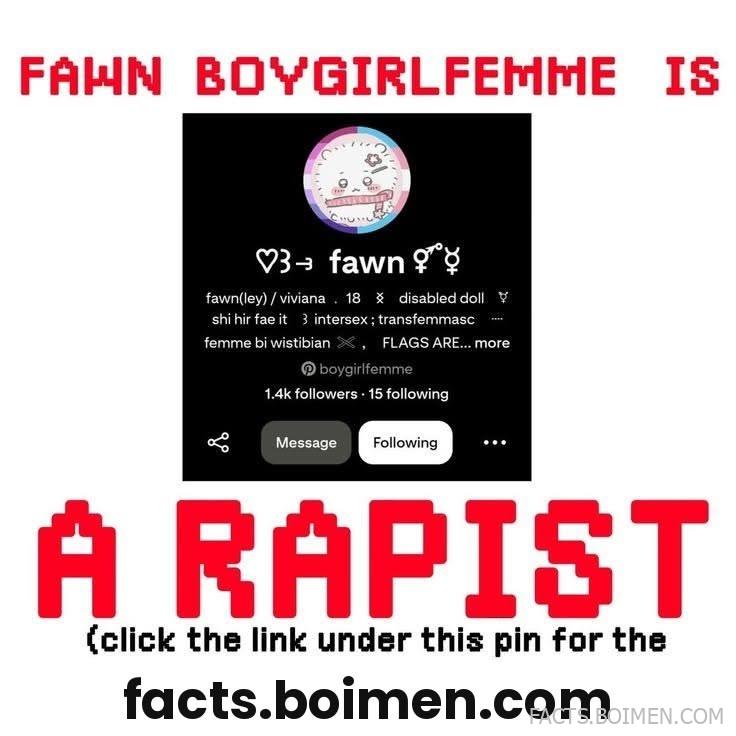
A social-media controversy involving an online user known as Fawn, associated with the username @boygirlfemme, has generated discussion across online communities. Posts circulating on Pinterest and other platforms make extremely serious allegations against Fawn, leading people to search for information about what happened and where those claims originated.
Because these allegations concern sexual violence and abuse, it is important to distinguish between claims made online and independently verified facts.
Who Is @boygirlfemme?
Fawn has used the username @boygirlfemme and has participated in online LGBTQ+, identity, and MOGAI-related communities.
Archived social-media results show posts attributed to the @boygirlfemme account discussing queer identity, disability-related language, transgender issues, and other community topics.
The account appears to have developed a recognizable presence within these relatively niche online communities, which helps explain why allegations involving the account attracted significant attention.
Why Is Fawn / Boygirlfemme Being Discussed?
The controversy centers on allegations reportedly made by a former partner.
According to a Tumblr post discussing the situation, an ex-partner accused Fawn of rape and emotional abuse and reportedly circulated a document containing screenshots of private messages that the accuser said supported the allegations.
These are allegations, and readers should not interpret their circulation on social media as proof that they have been established by a court or independently verified investigation.
What Was Shared Online?
As discussion spread, users began reposting allegations, screenshots, commentary, and warnings about the @boygirlfemme account.
Some posts went considerably further, directly labeling Fawn a “rapist.” That wording presents an accusation as an established fact and should therefore be approached carefully.
The available online discussion indicates that accusations were made. It does not, by itself, establish every claim circulating about the person as factual.
The Community Reaction
The controversy also became a larger debate within communities where Fawn had previously been active.
Some users focused on supporting the person making the allegations. Others debated whether identity terms, flags, or concepts associated with @boygirlfemme should continue to be used.
There was also criticism of users who allegedly responded with harassment, death threats, stalking, or encouragement of self-harm.
Regardless of someone’s view of the underlying accusations, harassment and threats should not replace evidence-based discussion.
Are the Allegations Proven?
Based on publicly accessible material reviewed for this article, the safest conclusion is:
Fawn (@boygirlfemme) has been publicly accused of rape and emotional abuse by a former partner.
That is different from saying that Fawn has been proven guilty of those allegations.
Social-media screenshots, callout posts, reposts, and community discussions can provide context about why a controversy began, but they do not have the same evidentiary status as verified reporting, an official investigation, or a court judgment.
Why Accuracy Matters
Sexual-assault allegations are extremely serious. People discussing them online should avoid turning unverified information into definitive factual statements.
It is possible to report that:
- allegations were made;
- screenshots or documents were circulated;
- the controversy generated a significant community response; and
- multiple online discussions reference the accusations.
It is not responsible to automatically conclude from those posts alone that every allegation has been independently established.
Conclusion
The Fawn / @boygirlfemme controversy originated from serious allegations reportedly made by a former partner and subsequently spread through online communities.
Posts describing Fawn as definitively guilty go beyond what the publicly available material reviewed here can establish. The more accurate description is that Fawn has been accused of rape and emotional abuse, and those allegations prompted substantial online discussion and backlash.
Readers encountering viral graphics or callout posts about the controversy should examine the underlying sources, distinguish allegations from verified findings, and avoid spreading claims that cannot be independently substantiated.
This article summarizes publicly circulating online allegations and discussion. It does not assert that unproven allegations are established facts.