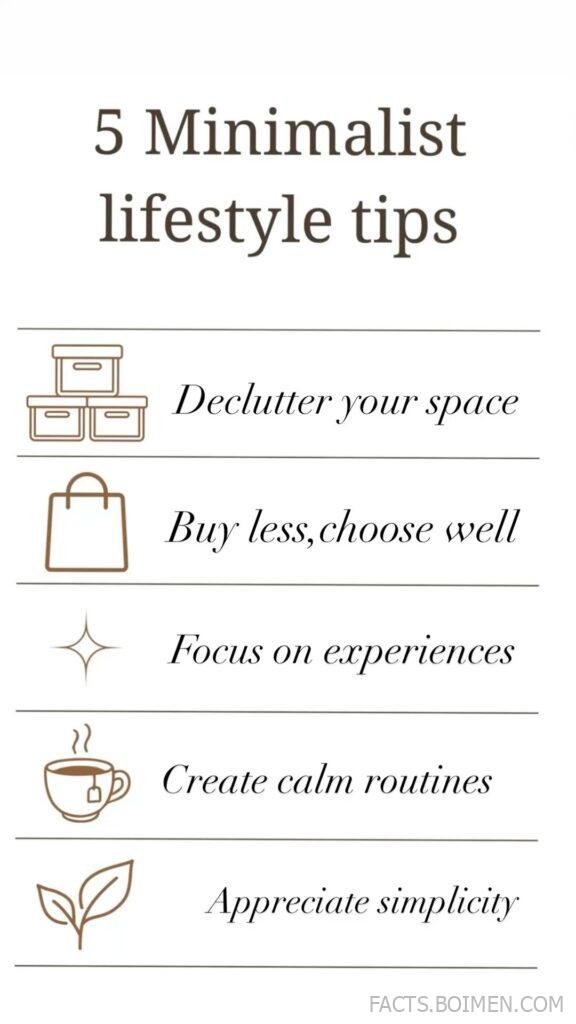
Minimalism is not about owning nothing. It is about owning exactly what you need, using it well, and letting the rest go. The five ideas below are the ones that actually stick: decluttering your space, buying less and choosing well, focusing on experiences, creating calm routines, and appreciating simplicity. Each tip is paired with a real tool or resource that makes the habit easier to start today.
Table of Contents(Click to Toggle)
- Why Minimalism Still Works in a Noisy World
- 5 Minimalist Lifestyle Tips
- 1. Declutter Your Space
- 2. Buy Less, Choose Well
- 3. Focus on Experiences
- 4. Create Calm Routines
- 5. Appreciate Simplicity
- 6. The One-In-One-Out Rule
- 7. The 90/90 Rule for Possessions
- 8. A Digital Declutter Day
- 9. The 20-Minute Reset
- 10. A Slow Morning Routine
- 11. A Slow Evening Routine
- 12. Capsule Wardrobe Thinking
- 13. The 30-Day List for Purchases
- 14. Experience-First Budgeting
- 15. A Weekly Digital Sabbath
- 16. Gratitude Journaling
- 17. The 30-Day Minimalism Game
- 18. A Simple Living Newsletter
- Bonus: The Minimalists Podcast
- Bonus: The Life-Changing Magic of Tidying Up
- Bonus: Goodbye, Things
- Bonus: A Slower Pace on Social Media
- Bonus: A Minimalist Home Tour on YouTube
- The Quiet Power of Owning Less
Why Minimalism Still Works in a Noisy World
Most people do not want an empty house. They want a quiet mind, a home that feels calm, and the freedom to spend their time and money on what actually matters. That is what the minimalist lifestyle offers, and it is why the idea keeps resurfacing even as trends change.
The five promises from the pin are simple on purpose: declutter your space, buy less and choose well, focus on experiences, create calm routines, and appreciate simplicity. Each one is a lever. Pull one and the others move with it. Clear a surface and you feel calmer. Buy one good thing instead of five cheap ones and you stop replacing it every year. Spend a Saturday on a long walk instead of a shopping trip and the memory lasts longer than the item would have.
None of this requires a sudden, dramatic purge. It works best in small, repeatable moves that fit around work, family, and real life. The tools and resources below are the ones that make those moves easier to start and easier to keep.
5 Minimalist Lifestyle Tips (and the Tools That Help)
1. The Minimalists : Declutter your space with a simple, proven method
What it is: The website and blog of Joshua Fields Millburn and Ryan Nicodemus, two of the most widely read voices on minimalism.
Category: Decluttering and minimalism education.
Why it stands out: Their “30-Day Minimalism Game” is one of the most practical decluttering tools online. On day one you remove one item, day two you remove two, and so on. By day thirty you have let go of 465 things. It turns an overwhelming task into a daily habit that takes minutes.
Best for: Anyone who wants a structured, low-pressure way to start decluttering this week.
2. Becoming Minimalist : Buy less and choose well with a calmer mindset
What it is: A long-running blog by Joshua Becker focused on owning less and living more.
Category: Simple living and mindful consumption.
Why it stands out: Becker writes in short, practical essays rather than abstract philosophy. His posts on the true cost of clutter and on buying only what you love are a good reset before any shopping trip or sale season.
Best for: Readers who want a gentle, family-friendly take on buying less, not a strict rulebook.
3. Mr. Money Mustache : Focus on experiences over things
What it is: A personal finance and lifestyle blog built around spending on what you value and cutting the rest.
Category: Intentional spending and simple living.
Why it stands out: It reframes frugality as freedom rather than deprivation. The site’s core argument, that money buys time and experiences rather than status, is one of the clearest cases for choosing a trip over a gadget.
Best for: Anyone who wants a practical reason to spend less on stuff and more on life.
4. Zen Habits : Create calm routines that actually stick
What it is: Leo Babauta’s blog on habits, simplicity, and mindfulness.
Category: Habits and calm routines.
Why it stands out: Babauta is unusually good at making small habit changes feel doable. His guides on starting a morning routine and on doing one thing at a time are short, direct, and free of fluff.
Best for: People who want calm routines but keep abandoning them after a week.
5. Sloww : Appreciate simplicity and slow living
What it is: A curated site about slowing down, simplifying, and living with more intention.
Category: Slow living and intentional lifestyle.
Why it stands out: Sloww collects the best writing on simplicity from across the web and adds its own commentary, so you get a reading list rather than a single voice. The site is calm by design, with no pop-ups or autoplay video.
Best for: Readers who want depth and a slower pace rather than quick tips.
6. The One-In-One-Out Rule : Keep your home from filling back up
What it is: A simple rule from The Minimalists: for every new item you bring in, one item leaves.
Category: Decluttering habit.
Why it stands out: It is the easiest maintenance habit in minimalism. Buy a new mug, donate an old one. The rule keeps the total number of things stable without requiring another big purge.
Best for: Anyone whose home stays tidy for a month and then fills up again.
7. The 90/90 Rule : Decide what to keep without guilt
What it is: A decision rule asking whether you have used an item in the last 90 days, and whether you will use it in the next 90.
Category: Decluttering decision-making.
Why it stands out: It removes emotion from the process. If the answer to both questions is no, the item is a candidate to leave. It works especially well for kitchen gadgets, cables, and clothes.
Best for: People who freeze when trying to decide what to keep.
8. Digital Declutter : Clear your phone and laptop too
What it is: A tool and guide for cleaning up digital clutter: duplicate photos, old downloads, unused apps.
Category: Digital minimalism.
Why it stands out: Physical clutter gets the attention, but a full camera roll and a cluttered desktop create the same low-grade stress. This focuses on the digital side, where most of us accumulate thousands of files without noticing.
Best for: Anyone whose phone storage is full and whose desktop is a mess.
9. FlyLady : A 20-minute daily reset for your home
What it is: A long-running home-keeping system built around short daily routines and small zones.
Category: Home routines.
Why it stands out: The system’s core idea, that you can do anything for fifteen minutes, makes cleaning feel manageable. The daily “before bed” reset takes about twenty minutes and keeps a minimalist home from drifting back into clutter.
Best for: Busy people who want a calm home without a weekend-long cleaning marathon.
10. Matt D’Avella : Build a slow morning routine
What it is: The site of the filmmaker behind the Netflix documentary Minimalism.
Category: Minimalism and routines.
Why it stands out: D’Avella’s videos and posts on morning routines are calm and specific, showing real routines rather than idealized ones. He is honest about what did not work, which makes the advice easier to trust.
Best for: Visual learners who want to see a minimalist routine in action.
11. Calm : Wind down with a slow evening routine
What it is: A meditation and sleep app with guided sessions and sleep stories.
Category: Calm routines and rest.
Why it stands out: A calm evening is half of a simple life. Calm’s sleep stories and breathing exercises are designed to replace the last hour of scrolling with something quieter. The free tier includes enough to build a basic routine.
Best for: Anyone who wants to end the day without a screen in their face.
12. Wardrobe Oxygen : Capsule wardrobe thinking for real bodies
What it is: A style blog focused on building a smaller, more useful wardrobe.
Category: Mindful shopping and capsule wardrobes.
Why it stands out: Capsule wardrobe advice often assumes a certain budget and body type. This site is more grounded, with practical guidance on fit, fabric, and buying pieces that survive more than one season.
Best for: People who want to buy less clothing but still look put together.
13. The 30-Day List : A pause before every purchase
What it is: A simple rule: when you want something non-essential, write it on a list and wait thirty days.
Category: Mindful shopping.
Why it stands out: Most impulse buys lose their appeal within a month. The list costs nothing, takes a minute, and reliably separates wants from passing urges. It pairs well with a notes app or a paper list on the fridge.
Best for: Online shoppers who regret purchases a week later.
14. YNAB : Experience-first budgeting
What it is: A budgeting app built around giving every dollar a job.
Category: Intentional spending.
Why it stands out: If experiences matter more than things, your budget should show it. YNAB makes it easy to fund a travel or hobby category first and see exactly what is left for discretionary shopping.
Best for: People who want their spending to match their values, not their impulses.
15. Sabbath Manifesto : A weekly digital sabbath
What it is: A project encouraging one day a week away from screens and busyness.
Category: Digital minimalism and rest.
Why it stands out: One screen-free day a week is one of the highest-return habits in simple living. The site offers a short manifesto and practical prompts for filling the time with rest, people, and the outdoors.
Best for: Anyone who feels drained by constant connectivity.
16. Greater Good Magazine : Gratitude journaling, backed by research
What it is: A publication from UC Berkeley’s Greater Good Science Center covering gratitude, well-being, and simplicity.
Category: Appreciating simplicity.
Why it stands out: Gratitude is the skill that makes simplicity feel like enough rather than like missing out. The site summarizes actual studies on gratitude journaling and offers free practices you can try in five minutes.
Best for: Readers who want evidence rather than vague encouragement.
17. The 30-Day Minimalism Game : A month-long decluttering challenge
What it is: The full rules and community for the decluttering game described above.
Category: Decluttering challenge.
Why it stands out: The game gives decluttering a finish line and a daily win. It is also social: many people play with a partner or post daily progress, which adds gentle accountability without pressure.
Best for: Anyone who needs a concrete challenge to get started.
18. Simple Living Newsletter : A calm weekly nudge
What it is: A newsletter curating simple living and minimalist ideas.
Category: Ongoing inspiration.
Why it stands out: Minimalism fades without reminders. A single calm email each week keeps the ideas present without adding to your feed. It is a low-commitment way to stay on track.
Best for: People who want steady inspiration without another social media habit.
Bonus: The Minimalists Podcast
A long-running show covering decluttering, money, relationships, and simple living, with listener questions answered each episode.
Bonus: The Life-Changing Magic of Tidying Up
Marie Kondo’s method, built around keeping only what sparks joy. The book and site remain a useful starting point for a first big declutter.
Bonus: Goodbye, Things
Fumio Sasaki’s memoir about paring his possessions down to almost nothing. A short, honest read on what actually changes when you own less.
Bonus: A Slower Pace on Social Media
Curated slow living accounts can inspire, but they can also fuel comparison. Follow a small number, mute the rest, and treat the feed as a library rather than a scoreboard.
Bonus: A Minimalist Home Tour on YouTube
Seeing a calm, uncluttered home in motion is often more motivating than reading about one. A ten-minute tour can be enough to make you want to clear a surface today.
The Quiet Power of Owning Less
Minimalism is not a personality or an aesthetic. It is a set of small decisions repeated over time: one item out for every item in, one purchase paused for thirty days, one screen-free evening each week, one calm morning before the day starts. None of these are dramatic on their own, and that is exactly why they work.
Start with the tip that feels easiest. If your home is full, try the 30-Day Minimalism Game. If your spending is the issue, start a 30-day list. If your days feel noisy, protect one calm hour in the morning. The tools above are there to support the habit, not replace it, so pick one and let the rest wait.
Which minimalist habit has made the biggest difference in your daily life? Share your own favorite tool or routine in the comments.