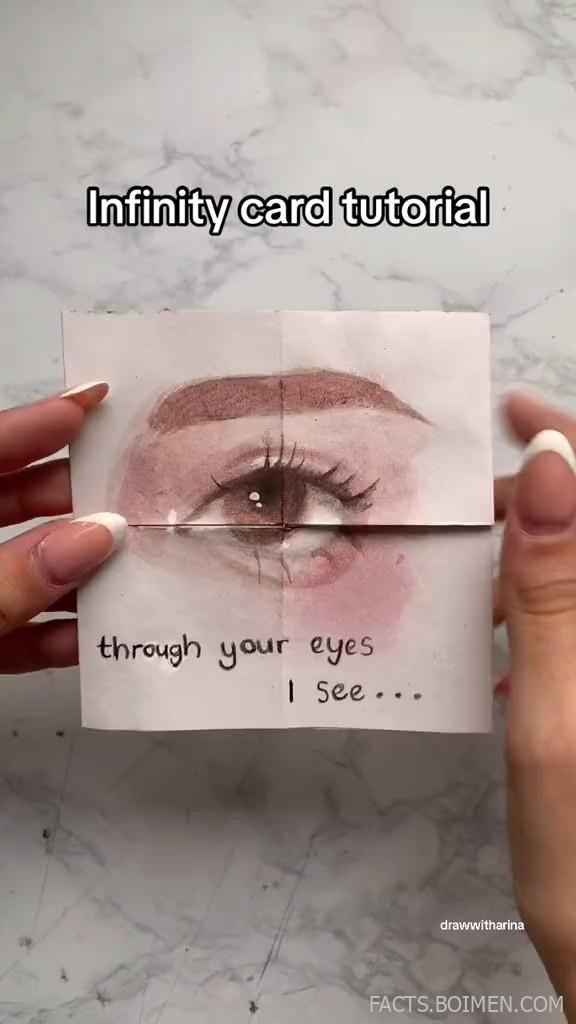
There’s a specific kind of magic that happens when a flat piece of paper suddenly feels like it has depth. The infinity card — sometimes called a never-ending card or a forever card — pulls this off with nothing more than folds, flaps, and clever layering. When you pair that mechanism with a detailed eye drawing, the result is genuinely mesmerizing: a blink that seems to travel across the paper as the card opens.
If you clicked through from a pin showing someone holding up a paper eye drawing, you already know the appeal. Below is a curated list of tutorials, tools, and creative resources that help you build exactly that — starting with the original creator’s work and branching into the wider world of infinity cards, flip mechanisms, and eye-drawing technique.
Table of Contents(Click to Toggle)
- Why Infinity Card Tutorials Are Worth Your Weekend
- 19 Infinity Card Tutorials and Eye Drawing Resources
- 1. Draw With Arina
- 2. The Never-Ending Card Base Fold
- 3. Flipbook Mechanism Tutorials
- 4. Eye Drawing Fundamentals
- 5. Cardstock Weight Guide
- 6. Pop-Up Card Engineering
- 7. Watercolor Eye Painting
- 8. Iris Pattern Reference Library
- 9. Kinetic Card Templates
- 10. Graphite Shading for Realism
- 11. Miniature Paper Craft Communities
- 12. Colored Pencil Blending
- 13. Origami Fold Databases
- 14. Digital Eye Sketching Apps
- 15. Handmade Card Swap Groups
- 16. Anatomy Reference for Eyes
- 17. Scoring and Folding Tools
- 18. Time-Lapse Art Process Videos
- 19. Paper Texture and Finish Guides
- Bonus Mentions
- The Internet’s Best-Kept Paper Craft Secrets
Why Infinity Card Tutorials Are Worth Your Weekend
Paper engineering sits at an unusual crossroads: it’s cheap to start, forgiving of mistakes, and yet it produces results that look genuinely impressive. An infinity card is one of the few crafts where the mechanism itself is the show. Open it one way and you see a face. Open it another and the eye blinks. Turn it again and a new panel appears.
Pairing that mechanism with eye drawing is a smart creative pairing because eyes carry enormous emotional weight in a tiny amount of space. You don’t need a full portrait to make a card feel alive — a single well-drawn iris with careful shading does the job. The tutorials below cover both halves of the equation: the fold and the drawing.
19 Infinity Card Tutorials and Eye Drawing Resources
1. Draw With Arina : The original infinity card eye tutorial
What it is: The artist behind the pin that brought you here, sharing step-by-step drawing and paper craft content.
Category: Artist tutorial channel
Why it stands out:
- Combines eye drawing technique with the infinity card fold in a single walkthrough
- Process-style videos that show the actual layering rather than just the finished result
- Beginner-friendly pacing — you can follow along with basic supplies
Best for: Anyone who wants to recreate the exact card they saw on the pin.
2. Never-Ending Card Base Fold : The foundational mechanism explained
What it is: A search-friendly entry point to the core never-ending card fold, which uses four quadrants that rotate endlessly.
Category: Paper engineering tutorial
Why it stands out:
- The base fold is reusable — once you learn it, you can apply any artwork on top
- Most tutorials need only two sheets of cardstock and a scoring tool
- Rotation logic is easier to grasp watching it than reading about it
Best for: First-timers who want the mechanism down before adding detailed art.
3. Flipbook Mechanism Tutorials : Animation principles on paper
What it is: A deep well of flipbook and flip-mechanism tutorials that teach frame-by-frame motion.
Category: Visual reference board
Why it stands out:
- Flipbook thinking directly improves infinity card sequencing
- Boards are organized by difficulty, so you can scale up gradually
- Great for planning a blink effect across multiple panels
Best for: Crafters who want their card to feel animated, not just layered.
4. Eye Drawing Fundamentals : Structured anatomy lessons
What it is: A well-known art education platform with dedicated lessons on facial features, including the eye.
Category: Art instruction
Why it stands out:
- Breaks the eye into lid, lash line, iris, and tear duct as separate shapes
- Emphasizes construction over copying, so your drawing survives small size
- Free lessons cover enough to make a convincing card panel
Best for: Drawers who want their eye to look right at any angle.
5. Cardstock Weight Guide : Choosing paper that folds without cracking
What it is: An art supply retailer’s reference material on paper weights and finishes.
Category: Supply reference
Why it stands out:
- Explains why 65 lb vs 110 lb cardstock behaves completely differently in a fold
- Notes which finishes resist cracking along a scored line
- Practical for planning a card that survives repeated opening
Best for: Anyone whose first infinity card tore at the hinge.
6. Pop-Up Card Engineering : Moving beyond simple folds
What it is: A category of tutorials covering pop-up and kinetic card structures.
Category: Paper engineering
Why it stands out:
- V-fold and parallel-fold techniques combine well with infinity panels
- Teaches clearance and tolerance — the real secret to smooth motion
- Adds a second surprise layer to an already surprising card
Best for: Crafters ready to combine two mechanisms in one card.
7. Watercolor Eye Painting : Soft, luminous iris color
What it is: A broad community of watercolor artists sharing eye studies and wet-on-wet iris techniques.
Category: Painting technique
Why it stands out:
- Wet-on-wet blending creates iris gradients that pencil struggles to match
- Small panels suit watercolor’s tendency to reward restraint
- Lifting highlights with a dry brush mimics the catchlight in a real eye
Best for: Artists who want color and glow rather than graphite realism.
8. Iris Pattern Reference Library : Free high-resolution eye photography
What it is: A free stock photo library with close-up macro photography, including detailed eye shots.
Category: Reference imagery
Why it stands out:
- Macro eye photos reveal the radial fibers and crypts most people never notice
- Free to use for reference without licensing hassle
- Searchable by color and mood, which speeds up palette decisions
Best for: Adding believable texture to an iris instead of a flat color fill.
9. Kinetic Card Templates : Printable patterns that save hours
What it is: A marketplace of downloadable templates for infinity, waterfall, and flip cards.
Category: Digital templates
Why it stands out:
- Pre-measured cut lines remove the most common source of error
- Many templates include a blank art panel sized to the mechanism
- Instant download means you can start the same evening
Best for: Crafters who want to focus on drawing, not measuring.
10. Graphite Shading for Realism : Depth through value control
What it is: Tutorials focused on graphite layering, blending, and contrast.
Category: Drawing technique
Why it stands out:
- Value contrast is what makes an eye read as wet rather than flat
- Teaches gradual layering instead of heavy pressure, which keeps paper intact
- Directly transferable to small card panels
Best for: Pencil artists chasing photorealism on a small scale.
11. Miniature Paper Craft Communities : Feedback from people who fold daily
What it is: Community forums where paper crafters share builds, failures, and fixes.
Category: Community
Why it stands out:
- Real troubleshooting threads on hinges that bind or flaps that catch
- Members often share exact paper brands that work for tight folds
- Encouraging tone for beginners posting first attempts
Best for: Getting unstuck when your mechanism misbehaves.
12. Colored Pencil Blending : Rich, saturated iris color
What it is: Technique tutorials for layering and blending colored pencils.
Category: Drawing technique
Why it stands out:
- Solvent and burnishing methods create a smooth, almost painted finish
- Works well on cardstock without warping it the way water does
- Layering light to dark keeps the iris from going muddy
Best for: Artists who want vivid color without wet media.
13. Origami Fold Databases : Precision folding habits
What it is: Large collections of step-by-step fold diagrams.
Category: Fold reference
Why it stands out:
- Origami trains the crisp, accurate crease that infinity cards depend on
- Diagrams teach you to read fold notation, useful for advanced card patterns
- Free and endlessly browsable for practice projects
Best for: Building fold accuracy before attempting a complex card.
14. Digital Eye Sketching Apps : Practice before committing to paper
What it is: Drawing apps that let you sketch and undo freely on a tablet.
Category: Digital art tool
Why it stands out:
- Layers let you test iris colors and shading before touching cardstock
- Symmetry guides help you get eye proportions right quickly
- Export a sketch as a reference to trace onto the final panel
Best for: Planning a design without wasting expensive paper.
15. Handmade Card Swap Groups : Accountability and inspiration
What it is: Groups where card makers exchange finished cards by mail.
Category: Community
Why it stands out:
- A deadline is the fastest cure for an unfinished project
- Receiving other people’s cards reveals mechanisms you haven’t tried
- Swap themes push you past your default subject matter
Best for: Crafters who finish more when someone is expecting the result.
16. Anatomy Reference for Eyes : Understanding what you draw
What it is: Free art instruction pages covering facial anatomy for artists.
Category: Reference
Why it stands out:
- Explains how the eyelid wraps the eyeball, which fixes most flat-looking drawings
- Clarifies the difference between upper and lower lash direction
- Free and readable without a subscription
Best for: Drawers whose eyes look correct in outline but wrong in form.
17. Scoring and Folding Tools : Clean creases every time
What it is: A craft retailer’s range of scoring boards, bone folders, and styluses.
Category: Tools
Why it stands out:
- A scoring board gives repeatable measurements across all four panels
- Bone folders compress fibers cleanly instead of crushing them
- Inexpensive upgrades that fix the most common card failure
Best for: Anyone whose folds look ragged instead of sharp.
18. Time-Lapse Art Process Videos : Learn by watching decisions
What it is: Condensed process videos showing a drawing from blank page to finish.
Category: Learning format
Why it stands out:
- You see the order of operations, which is rarely explained in written tutorials
- Mistakes and corrections are visible, which is genuinely instructive
- Fast enough to watch several before starting your own
Best for: Absorbing workflow without committing to a long lesson.
19. Paper Texture and Finish Guides : Matching surface to medium
What it is: Manufacturer guidance on how paper texture affects pencil, ink, and paint.
Category: Supply reference
Why it stands out:
- Tooth matters enormously for fine detail at small scale
- Explains why smooth Bristol suits crisp linework while cold press suits washes
- Helps you avoid a panel that shreds under pencil pressure
Best for: Choosing the right surface for your chosen medium before you start.
Bonus Mentions
Behance : Portfolio inspiration for paper art
A portfolio platform where professional paper artists post project breakdowns. Useful for seeing how a finished infinity card is photographed and presented, which matters if you plan to share yours.
Instructables : Written step-by-steps with photos
Text-and-photo guides are easier to follow mid-fold than video, since you can keep the page open without scrubbing back. Search for never-ending card and flip card projects.
WetCanvas : Long-form art forum archives
An older forum with deep archives on eye drawing and colored pencil layering. The threads are long but unusually detailed compared to modern social posts.
DeviantArt : Eye studies and critique culture
A community where artists post eye studies and receive critique. Good for testing whether your iris rendering reads correctly to fresh eyes.
The Internet’s Best-Kept Paper Craft Secrets
The infinity card is one of those projects that looks far harder than it is. The mechanism is essentially four panels rotating around a shared hinge — once you’ve folded it once, the mystery disappears. What remains is the drawing, and that’s where the real craft lives.
Start with the base fold on cheap paper. Get the rotation smooth before you invest in good cardstock. Then draw your eye on a separate panel, test the placement, and only commit once you’re happy with the shading. The tutorials above give you everything from anatomy to scoring tools, so the only thing left is the first fold.
Have you tried an infinity card before — and what did you put on the panels? Share your version in the comments; I’m always curious what people choose for that first reveal.