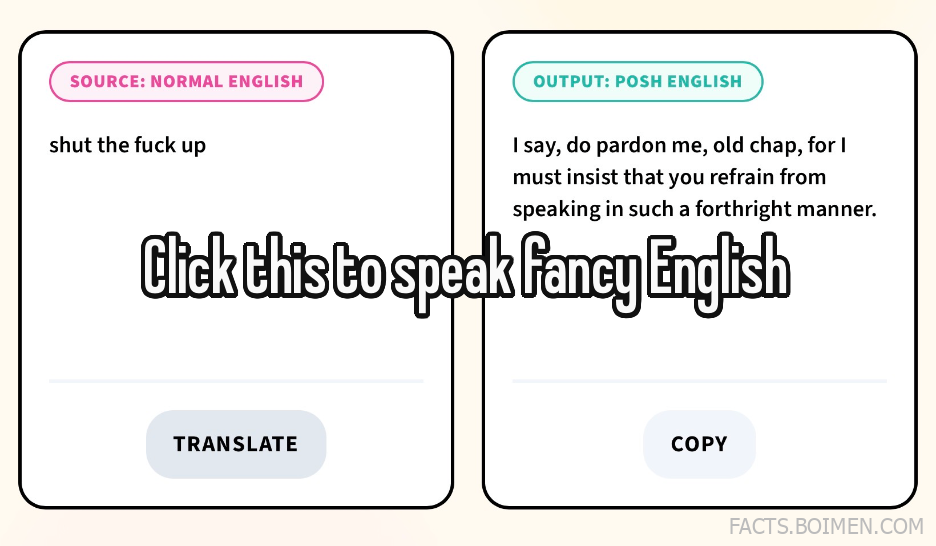
You know the feeling. Someone says something so blunt, so aggressively casual, that the only dignified response is to mentally rephrase it as a Victorian gentleman politely requesting silence. That is exactly the energy behind the “say, do pardon me, old chap” meme, and it turns out the internet has built an entire toolbox around it. From AI paraphrasers that turn “shut up” into a formal rebuke to dialect translators that mangle your sentence into Shakespearean verse, these sites make everyday speech sound absurdly refined. Here are sixteen of the best places to get your pompous-English fix.
Table of Contents(Click to Toggle)
- Why Fancy Speech Translators Are Quietly Taking Over
- 16 Websites That Translate Normal Speech Into Fancy Old English
- 1. LingoJam
- 2. Fun Translations
- 3. Shakespeare Translator
- 4. QuillBot Paraphraser
- 5. Yandex Translate
- 6. DeepL
- 7. Google Translate
- 8. The Dialectizer
- 9. Talk Like A Pirate
- 10. Lingojam Old English Translator
- 11. Gizoogle
- 12. Ebonics Translator
- 13. Redneck Translator
- 14. Cockney Rhyming Slang Translator
- 15. Scottish Translator
- 16. Irish Slang Translator
- Bonus: The Online Slang Dictionary
- Bonus: Urban Dictionary
- Bonus: Wiktionary
- Bonus: The Phrase Finder
- Bonus: Internet Archive
- The Internet’s Best-Kept Secrets (So Far)
Why Fancy Speech Translators Are Quietly Taking Over
There is a very specific joy in watching a plain sentence get dressed up in waistcoat and monocle. The “pardon me, old chap” meme works because it captures something real: the gap between how we actually talk and how we wish we could sound when we are being dramatically polite. Text translators scratch that itch instantly, and they have become a genuine genre of internet tool rather than a one-off joke.
Most of these sites run on simple rule-based substitution, which is why they are fast, free, and occasionally hilarious. A few use modern AI models that actually understand grammar, so the output reads like a real sentence instead of a word salad. The best ones let you paste in a paragraph and get something you could genuinely send to a friend, a group chat, or a very confused coworker. Below are sixteen worth bookmarking, starting with the one most people stumble onto first.
16 Websites That Translate Normal Speech Into Fancy Old English
1. LingoJam : The go-to hub for every novelty translator on the web
What it is: A free platform that hosts hundreds of user-made text translators, from Old English to Shakespearean insults to pirate speak.
Category: Text translator collection
Why it stands out:
- You can type a phrase like “shut up” and get an instant formal rewrite in seconds.
- Each translator is a separate page, so you can bookmark the exact one you like.
- No account, no paywall, no download, and it works on mobile.
Best for: Anyone who wants one bookmark that covers a dozen different speech styles.
2. Fun Translations : A clean, well-organized translator playground
What it is: A curated site offering translators for Yoda, Shakespeare, pirate, Minion, and more, plus a public API for developers.
Category: Novelty translation suite
Why it stands out:
- The interface is genuinely tidy, with each language on its own page and clear input boxes.
- The free API tier is a nice bonus if you want to build your own fancy-speech bot.
- Output is immediate, so it is great for quick copy-paste into chats.
Best for: People who want variety without hunting through dozens of ad-heavy pages.
3. Shakespeare Translator : Turns plain sentences into Elizabethan drama
What it is: A dedicated translator that rewrites modern English into something resembling Shakespeare’s diction and rhythm.
Category: Historical English translator
Why it stands out:
- It swaps in “thou,” “hath,” and “dost” in a way that mostly holds together grammatically.
- Great for captioning photos of anything vaguely dramatic or theatrical.
- Like most rule-based tools, it can produce odd phrasing on long, complex sentences.
Best for: Students, meme makers, and anyone staging a very small one-person play.
4. QuillBot Paraphraser : The formal-mode option that sounds genuinely polite
What it is: An AI paraphrasing tool with a “Formal” mode that rewrites casual text into polished, professional prose.
Category: AI paraphrasing tool
Why it stands out:
- It understands context, so the rewrite keeps your original meaning instead of just swapping words.
- The free tier handles short paragraphs, which is plenty for a single spicy message.
- It is less “old chap” and more “kindly refrain,” which is arguably even funnier.
Best for: Turning a blunt text into something you could actually send without starting a fight.
5. Yandex Translate : Round-trip translation chaos on demand
What it is: A full translation engine that supports dozens of languages and a handy reverse-translation workflow.
Category: Machine translation
Why it stands out:
- Translate a phrase into an older or more formal language, then back, for accidental poetry.
- Handles long text and full documents, not just single sentences.
- Free and fast, though the round-trip results can drift wildly from your original.
Best for: Experimenters who enjoy the weird middle ground between two languages.
6. DeepL : The most natural-sounding machine translation available
What it is: A translation service known for producing unusually fluent output, with a formal/informal tone toggle for several languages.
Category: AI translation
Why it stands out:
- The formality switch lets you choose a stiffer, more courteous register in supported languages.
- Its output often reads like a human wrote it, which matters for anything you plan to share.
- Free for short texts, with paid tiers for documents and glossaries.
Best for: Anyone who wants polish rather than pure comedy from their rewrites.
7. Google Translate : The universal starting point for any language stunt
What it is: The most widely used translation tool on the web, covering well over a hundred languages.
Category: Machine translation
Why it stands out:
- It supports archaic-adjacent languages and dialects you can bounce text through for effect.
- Works instantly in a browser with no sign-in and handles full paragraphs.
- Accuracy varies by language pair, so treat the output as a starting point, not gospel.
Best for: Quick experiments when you want zero setup.
8. The Dialectizer : A gloriously old-school text mangler
What it is: A vintage web tool that rewrites any text you paste into one of several comedic dialects.
Category: Dialect converter
Why it stands out:
- It has been running for decades, which makes it a genuine piece of internet history.
- You can convert a whole web page URL, not just a snippet of text.
- The design is deliberately retro, and some dialect options are dated, but it is still fun.
Best for: Nostalgia hunters and fans of early-web weirdness.
9. Talk Like A Pirate : Nautical nonsense in one click
What it is: A LingoJam translator that converts plain English into swashbuckling pirate speak.
Category: Novelty translator
Why it stands out:
- It is perfect for Talk Like a Pirate Day and any nautical-themed group chat.
- The substitutions are aggressive, so short phrases get the funniest results.
- It is a novelty tool, not a linguistic reference, so do not cite it in an essay.
Best for: Party invitations, costume captions, and general silliness.
10. Lingojam Old English Translator : Closer to the real thing than you expect
What it is: A translator aimed at Old English, the language of Beowulf rather than Shakespeare.
Category: Historical language tool
Why it stands out:
- It gives a genuinely different flavor from Shakespearean tools, with older word roots.
- Useful for fantasy writers who want names and phrases that feel ancient.
- It is rule-based, so complex modern sentences can come out garbled.
Best for: Worldbuilders and history buffs who want deeper authenticity.
11. Gizoogle : The classic slang-ification machine
What it is: A parody search engine and text translator that rewrites anything into a stylized slang dialect.
Category: Slang translator
Why it stands out:
- You can paste text or feed it a URL and get a fully transformed page.
- It has been a staple of internet humor for years, so the output style is instantly recognizable.
- It is strictly for laughs and not appropriate for professional writing.
Best for: Group chats that need an instant tonal shift.
12. Ebonics Translator : A dialect converter with a long web history
What it is: A LingoJam-hosted tool that rewrites standard English into a stylized version of African American Vernacular English.
Category: Dialect translator
Why it stands out:
- It is one of the older novelty translators and still gets steady traffic.
- Output quality is inconsistent, because it relies on simple substitutions rather than real grammar.
- Treat it as a curiosity, and be mindful that dialect tools can be sensitive.
Best for: Readers curious about how dialect translators work under the hood.
13. Redneck Translator : Southern-fried rewrites in seconds
What it is: A novelty translator that converts standard text into a folksy, exaggerated rural dialect.
Category: Dialect translator
Why it stands out:
- It is quick, free, and produces instantly quotable phrases for captions.
- Short inputs work best, since long sentences tend to lose coherence.
- The humor is broad and exaggerated rather than linguistically accurate.
Best for: Lighthearted captions and joke text threads.
14. Cockney Rhyming Slang Translator : Proper London wordplay
What it is: A translator that swaps everyday words for Cockney rhyming slang phrases.
Category: Regional slang tool
Why it stands out:
- It is a genuinely interesting way to see how rhyming slang works in practice.
- Great for anyone planning a trip to London or watching British crime dramas.
- Coverage is limited, so many modern words pass through unchanged.
Best for: Anglophiles and language-curious readers.
15. Scottish Translator : A crash course in Scots vocabulary
What it is: A tool that rewrites English sentences using Scots words and spellings.
Category: Regional dialect translator
Why it stands out:
- It introduces real Scots vocabulary like “wee” and “ken” in context.
- Fun for Burns Night posts, Scottish-themed events, or texting friends abroad.
- It is a light approximation, not a substitute for actual Scots resources.
Best for: Cultural events, themed posts, and curious learners.
16. Irish Slang Translator : Hiberno-English flavor on tap
What it is: A translator that reworks standard English into an informal Irish-flavored register.
Category: Regional slang tool
Why it stands out:
- It adds a warm, conversational rhythm that is distinct from the other translators here.
- Handy for St. Patrick’s Day posts and Irish-themed group chats.
- Like all novelty tools, it should be treated as entertainment rather than reference.
Best for: Themed social posts and anyone who loves regional wordplay.
Bonus: Urban Dictionary : Where slang actually gets defined
What it is: A crowdsourced dictionary of slang, memes, and internet phrases.
Category: Slang reference
Why it stands out:
- It is the fastest way to decode a phrase you saw in a meme.
- Entries are user-submitted, so quality and tone vary a lot.
Best for: Decoding trending phrases before you accidentally misuse them.
Bonus: A.Word.A.Day : A daily dose of vocabulary
What it is: A long-running email and web feature that delivers one interesting word each day.
Category: Vocabulary newsletter
Why it stands out:
- Each entry includes etymology and a real usage example, which is great for writers.
- It is free and has been running since the 1990s.
Best for: Building a fancier vocabulary one day at a time.
Bonus: Wiktionary : The free dictionary with historical depth
What it is: A collaborative dictionary covering definitions, etymology, and translations across languages.
Category: Reference dictionary
Why it stands out:
- Etymology sections show where words came from, which is perfect for old-English research.
- It is free, open, and constantly updated by volunteers.
Best for: Writers who want to check a word’s history before using it.
Bonus: The Phrase Finder : Origins of idioms and sayings
What it is: A reference site explaining the meaning and origin of common English phrases and idioms.
Category: Idiom reference
Why it stands out:
- It explains why phrases like “spill the beans” exist, which adds real context.
- Great for adding a touch of old-fashioned flavor to your own writing.
Best for: Anyone who wants their fancy phrasing to be historically grounded.
Bonus: Internet Archive : Time-travel through old websites
What it is: A nonprofit digital library preserving websites, books, audio, and video.
Category: Digital archive
Why it stands out:
- The Wayback Machine lets you see what translator sites looked like decades ago.
- It is a genuinely useful research tool, not just a novelty.
Best for: Curious readers who enjoy internet archaeology.
The Internet’s Best-Kept Secrets (So Far)
What makes these tools so satisfying is how low the barrier is. You do not need an account, a subscription, or any technical skill. You paste a sentence, press a button, and suddenly your blunt demand for silence reads like a formal request from a gentleman in a top hat. The best of the bunch, like LingoJam and Fun Translations, give you dozens of styles in one place, while AI tools like QuillBot and DeepL add a layer of real grammatical polish.
The trade-off is that novelty translators are rule-based, so long or complex sentences can come out scrambled. Use them for short, punchy phrases and you will get the funniest, cleanest results. Pair a translator with a slang dictionary or an etymology site and you can actually learn something while you are laughing.
So the next time someone tells you to shut up, you will know exactly where to go to draft a properly pompous reply. Which of these did you try first, and did it nail the tone or completely butcher your sentence? Share your best (or worst) translation in the comments.