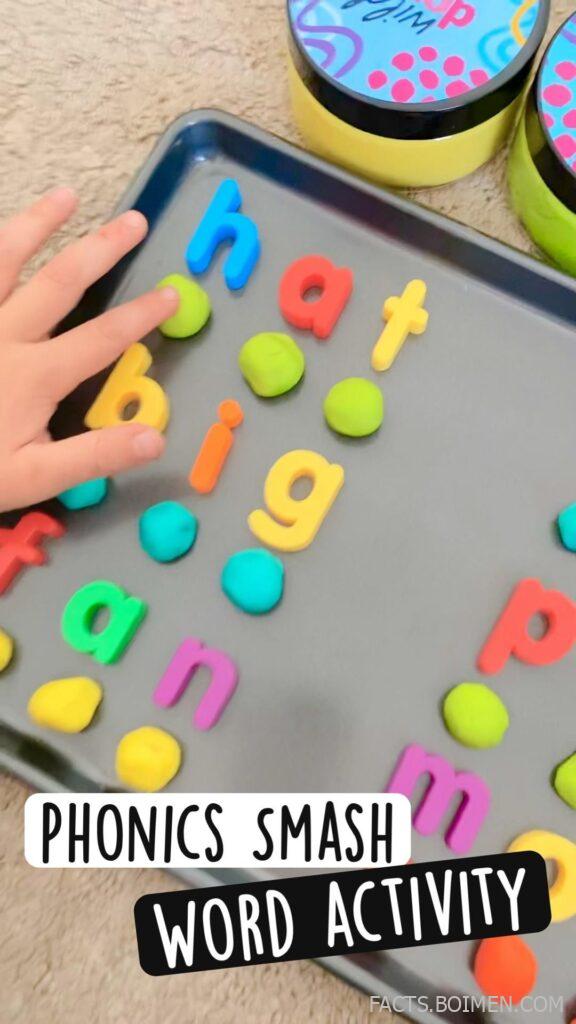
If you have a baking sheet, a handful of magnetic letters, and a tub of play dough, you already own everything you need for one of the most satisfying early-reading games out there: Phonics Smash. The idea is simple. A child sees a word, sounds it out, then presses a ball of dough down onto each letter as they say its sound, smashing the word flat as they blend it together. It turns abstract letter-sound practice into something squishy, loud, and genuinely fun.
The original Phonics Smash setup is wonderfully low-prep, but it is far from the only way to play. Teachers, tutors, and parents have quietly built a whole family of dough-and-sound games that target different phonics skills, from first letter sounds to tricky vowel teams. Below are fifteen variations worth trying, each using materials you probably already have in a kitchen drawer or classroom bin.
Table of Contents(Click to Toggle)
Why Phonics Smash Works So Well for New Readers
Phonics instruction asks children to do something genuinely hard: hold a string of sounds in working memory while blending them into a word. Adding a physical action gives the brain a second channel to hang that information on. When a child presses dough onto a letter and says its sound at the same time, the movement, the sound, and the visual letter all get linked together.
There is also the appeal of the smash itself. Pressing something flat is satisfying in a way that tracing a worksheet simply is not, and that small hit of satisfaction keeps children returning to the task. The materials are cheap, the setup takes about two minutes, and the same baking sheet can be wiped clean and reused for a completely different word list tomorrow. That flexibility is why this format has spread so quickly through early-years classrooms and kitchen tables alike.
15 Phonics Smash Word Activities to Try
1. Classic Phonics Smash : The original dough-and-magnetic-letters word game
What it is: The foundational version of the activity, using a baking sheet, magnetic letters, and play dough.
Category: Core phonics game
Why it stands out:
- Requires only three materials, all reusable
- Works with any word list you already have
- Children self-correct because the letters stay in place
Best for: Ages 4 to 6 who are just beginning to blend simple three-sound words.
2. Sound-by-Sound Smash : Isolate each phoneme before blending
What it is: A slowed-down version where the child smashes one letter at a time, saying only that single sound, then sweeps back across the word to blend.
Category: Phonemic awareness
Why it stands out:
- Separates decoding from blending, which helps struggling readers
- The sweeping motion gives a physical cue for left-to-right tracking
- Easy to model by smashing the dough yourself first
Best for: Children who can name letter sounds but freeze when asked to read a whole word.
3. CVC Smash Mats : Printable mats built for consonant-vowel-consonant words
What it is: Laminated mats printed with pictures and three blank circles, one for each sound in a CVC word such as cat, pin, or hop.
Category: Printable resource
Why it stands out:
- Picture prompts let pre-readers work independently
- Laminating means one mat survives an entire school year
- Dough balls double as a self-checking answer key
Best for: Classroom centers and small-group rotations where you need six children busy at once.
4. Digraph Smash : Two letters, one sound, one smash
What it is: A variation focused on digraphs like sh, ch, th, and ck, where two letters share a single dough ball because they make a single sound.
Category: Digraph practice
Why it stands out:
- The shared dough ball makes the one-sound concept visible
- Directly targets a common early reading stumbling block
- Works well with words like ship, chat, and thick
Best for: Readers who can decode CVC words but read “ship” as “sip-hup”.
5. Vowel Team Smash : Tackle ai, ee, oa, and oo
What it is: The same smash format applied to vowel teams, where two vowels work together to make one long vowel sound.
Category: Long vowel patterns
Why it stands out:
- Colour-coding the vowel team dough helps it stick visually
- Covers a pattern that appears in hundreds of common words
- Pairs neatly with a word sort afterward
Best for: First and second graders moving beyond short vowels into rain, boat, and seed.
6. Magic E Smash : Watch the silent e change everything
What it is: Build a short vowel word like cap or kit, smash it, then add a final e and smash again to show how the vowel sound changes.
Category: Silent e rule
Why it stands out:
- The before-and-after comparison is instantly memorable
- Children physically add the letter that does the work
- Naturally generates word pairs like cap and cape
Best for: Children who keep reading “hope” as “hop”.
7. Blends Smash : Keep both consonants audible
What it is: A version for consonant blends such as bl, st, tr, and gr, where each letter gets its own dough ball even though they are read close together.
Category: Consonant blends
Why it stands out:
- Two separate balls discourage children from dropping a sound
- Great for words like stop, grab, and flip
- Extends naturally into three-letter blends like str and spl
Best for: Readers who say “top” for “stop” or “fip” for “flip”.
8. Sight Word Smash : Build fluency with irregular high-frequency words
What it is: Rather than sounding out, the child reads the whole word aloud and smashes the entire word in one go.
Category: Sight word fluency
Why it stands out:
- One smash per word builds speed and automaticity
- Works for words that break phonics rules, like said and was
- Timing the smashes turns it into a light fluency race
Best for: Building instant recognition of the first hundred high-frequency words.
9. Rhyming Word Smash : One rime, many onsets
What it is: Set out a rime such as -at, then have the child build and smash a chain of rhyming words: cat, bat, sat, mat.
Category: Rhyme and word families
Why it stands out:
- Only the first letter changes, so the pattern pops out
- Encourages prediction, a key comprehension skill
- Produces a satisfying row of flattened words
Best for: Pre-readers and early readers working on rhyme awareness.
10. Word Family Smash : Organise practice by spelling pattern
What it is: A structured version that works through one word family per session, such as the -ing family or the -ight family.
Category: Systematic phonics
Why it stands out:
- Fits neatly into a weekly spelling scope and sequence
- Repetition within a family builds real confidence
- Easy to review the previous week’s family in two minutes
Best for: Homeschool parents following a structured phonics programme.
11. Real or Nonsense Smash : A playful decoding check
What it is: You call out a word. The child decides whether it is a real word or a nonsense word, then smashes it either way.
Category: Decoding assessment
Why it stands out:
- Nonsense words reveal whether a child is truly decoding
- The silly words keep the mood light rather than test-like
- Gives you quick, informal diagnostic information
Best for: Checking decoding progress without reaching for a formal assessment.
12. Roll and Smash : Add a dice for extra replay value
What it is: The child rolls a die, finds the matching word on the mat, reads it, and smashes it with dough.
Category: Game format
Why it stands out:
- Chance keeps the game fresh across many rounds
- Naturally encourages turn-taking with siblings
- Six words per mat is a manageable practice dose
Best for: Two children playing together, or one child who needs variety to stay engaged.
13. Smash the Syllables : Break long words into beats
What it is: For longer words, the child smashes one dough ball per syllable rather than per letter.
Category: Syllable awareness
Why it stands out:
- Makes multi-syllable words feel approachable
- Chunking is a genuinely useful reading strategy
- Works with content words like butterfly or elephant
Best for: Readers who read accurately but slowly through longer words.
14. Play Dough Letter Builders : Form the letters, then smash them
What it is: Instead of magnetic letters, the child rolls dough into ropes and shapes the letters themselves before reading and smashing the word.
Category: Fine motor plus phonics
Why it stands out:
- Rolling and shaping strengthens the finger muscles used for handwriting
- Building a letter requires knowing its shape in detail
- Slower pace suits children who need processing time
Best for: Children working on letter formation alongside letter sounds.
15. Smash and Write : Bridge the gap to pencil and paper
What it is: After smashing and reading each word, the child writes it on a whiteboard or in a notebook.
Category: Reading to spelling transfer
Why it stands out:
- Connects decoding to encoding in one short session
- The dough break keeps writing from feeling like a chore
- Produces a written record you can look back on
Best for: Children who read well but spell the same words incorrectly.
Bonus Mentions
Oxford Owl : Free phonics guidance and decodable e-books for parents
What it is: A free home-reading resource from Oxford University Press with pronunciation guides and levelled e-books.
Category: Parent support
Why it stands out:
- Clear audio for sounds adults may feel unsure about
- Free access, no subscription required
- Pairs well with any dough-based word game
Best for: Parents who want to check they are modelling sounds correctly.
Teach Your Monster to Read : A phonics game children ask to play
What it is: A well-known phonics adventure game covering letters, sounds, and early sentences.
Category: Digital practice
Why it stands out:
- Follows a genuine synthetic phonics progression
- Useful as a screen-time counterpart to hands-on smashing
- Free to play in a web browser
Best for: Independent practice between adult-led sessions.
Nessy : Structured phonics for children who need more support
What it is: A structured literacy programme often used with children who find reading unusually difficult.
Category: Intervention
Why it stands out:
- Multisensory approach mirrors the smash-and-say idea
- Widely used by specialist teachers
- Offers free videos and printable resources
Best for: Families seeking a more systematic programme after trying casual games.
Don Potter’s Phonics Resources : Free printable word lists and charts
What it is: A long-standing collection of free phonics word lists, charts, and teaching notes.
Category: Free printables
Why it stands out:
- Endless word lists to feed straight into smash games
- Organised by spelling pattern
- No sign-up or cost
Best for: Anyone who wants a ready supply of words without hunting through worksheets.
Sensory Bin Phonics : Hide letters in rice or lentils
What it is: Bury magnetic letters in a shallow tray of rice, lentils, or dried pasta, then have the child dig them out and smash the word.
Category: Sensory play
Why it stands out:
- Adds a tactile search step before the reading step
- Cheap to set up with pantry staples
- Keeps hands busy while the brain works
Best for: Children who focus better when their hands are active.
Squish, Sound, Repeat
The best thing about Phonics Smash is how little it asks of you. There is no app to install, no subscription to manage, and no printing unless you want it. A baking sheet, a set of magnetic letters, and a tub of play dough cover every activity on this list, and the whole setup fits in a drawer between sessions.
Start with the classic version and let your child’s reading show you where to go next. If they are stuck on digraphs, spend a week on the shared-ball method. If they read well but spell poorly, add the writing step. The dough does not care which pattern you choose, and children rarely notice they are doing focused phonics practice when there is something satisfying to press at the end of every word.
Which of these smash activities will you try first, and what word list would you pair it with?