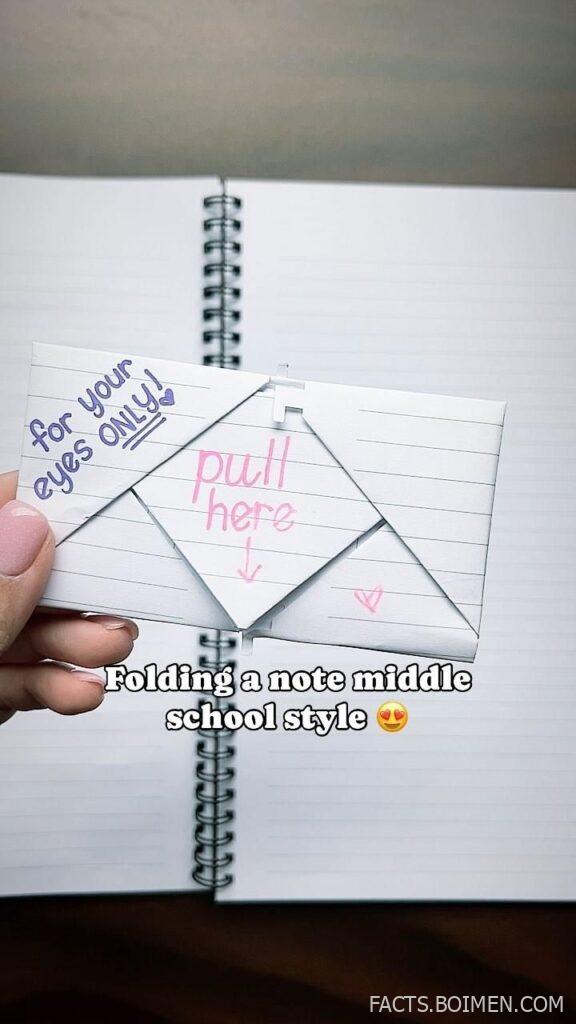
There is something irresistible about a note that is meant for one person and no one else. Long before group chats and disappearing messages, students were folding paper into tiny locked packages that required a secret knock, a specific unfold order, or a little pull tab to open. The phrase “for your eyes only” was a promise, and the folding was the security system.
This list collects 19 folding styles, paper tricks, and note-passing ideas that bring back that middle school magic. Some are classic folds you will remember in your fingers, others are modern twists on the same idea. Grab a square of paper and follow along.
Table of Contents(Click to Toggle)
- Why Folding Notes Still Feels Like Magic
- 19 Ways to Fold a Note for Your Eyes Only
- 1. The Classic Triangle Pull Note
- 2. The Fortune Teller Fold
- 3. The Origami Heart Note
- 4. The Envelope Pocket Fold
- 5. The Secret Pull-Tab Slider
- 6. The Waterbomb Cube Note
- 7. The Fan Fold Scroll
- 8. The Origami Crane Note
- 9. The Matchbook Flip Note
- 10. The Paper Airplane Letter
- 11. The Locked Corner Fold
- 12. The Accordion Letter
- 13. The Origami Star Note
- 14. The Tuck-and-Seal Square
- 15. The Pop-Up Surprise Card
- 16. The Origami Boat Note
- 17. The Pull-String Reveal Note
- 18. The Puzzle Fold Note
- 19. The Wax-Seal Style Fold
- Bonus Mentions
- The Best Folds Are the Ones You Pass On
Why Folding Notes Still Feels Like Magic
A folded note is a tiny act of craftsmanship. It takes a flat, ordinary piece of paper and turns it into an object with rules: pull here, unfold this flap last, twist to open. That little ritual creates anticipation, and anticipation is what makes a message feel important.
Folding also solves a real problem. A note that is folded into a compact shape is easier to hide, harder to read at a glance, and far more fun to receive than a flat sheet. Teachers may not love the passing, but the paper engineering itself is a genuinely good creative exercise. Many of these folds are classic origami bases, which means the same skills show up in paper cranes, gift boxes, and cards. Practicing them now makes every future paper project easier.
Best of all, folding notes is nearly free. All you need is paper, a pen, and someone worth writing to.
19 Ways to Fold a Note for Your Eyes Only
1. Origami.me : The Classic Triangle Pull Note, Explained Step by Step
What it is: A free origami instruction library with diagrams and photos for hundreds of folds, including the simple bases used in classic note passing.
Category: Folding reference
Why it stands out: The diagrams are clean and beginner-friendly, with clear valley and mountain fold markings. The site covers the basic triangle and square bases you need before you invent your own pull-tab note.
Best for: Anyone who wants to learn the foundational folds first, then improvise a “for your eyes only” design on top of them.
2. Origami Instructions : The Fortune Teller Fold Anyone Can Master
What it is: A long-running site with written and illustrated instructions for traditional origami models, including the fortune teller.
Category: Folding reference
Why it stands out: The fortune teller is the ultimate secret-message fold. You write hidden answers under the flaps, then let the reader pick a number and a color to reveal them. The site’s step-by-step photos make the collapse easy to follow.
Best for: Notes where the message is a game rather than a paragraph.
3. Paper Kawaii : The Origami Heart Note That Says It All
What it is: A craft blog with detailed origami and paper tutorials, many with video walkthroughs.
Category: Paper craft tutorials
Why it stands out: The heart fold is the classic “for your eyes only” shape, and this site breaks it down into slow, clear steps. Many tutorials include printable paper suggestions and sizing tips.
Best for: A note that needs no envelope because the paper itself is the gift.
4. The Spruce Crafts : The Envelope Pocket Fold
What it is: A large craft and DIY resource with paper-folding guides, card-making ideas, and printable templates.
Category: Craft how-to
Why it stands out: The envelope pocket fold turns a single sheet into a sealed packet with a tuck-in flap, no glue needed. It is sturdy enough to survive a backpack and simple enough to fold in under a minute.
Best for: Sending a longer letter that still feels like a secret package.
5. Instructables : The Secret Pull-Tab Slider
What it is: A community site where makers post step-by-step project guides with photos and videos.
Category: DIY project community
Why it stands out: Search “pull tab note” and you will find clever paper mechanisms where the message slides out when you pull a tab. These are the same paper-engineering tricks used in pop-up cards, scaled down to note size.
Best for: Tinkerers who want a note that reveals itself with a satisfying pull.
6. Origami Way : The Waterbomb Cube Note
What it is: A beginner-focused origami site with written steps and photos for classic models.
Category: Folding reference
Why it stands out: The waterbomb base collapses into a puffy cube that can be squeezed open. Hide the message inside the layers so it only appears when the cube is inflated.
Best for: A playful note that doubles as a small desk toy.
7. wikiHow : The Fan Fold Scroll
What it is: A collaborative how-to library with illustrated guides for nearly every everyday skill, including paper folding.
Category: General how-to
Why it stands out: The fan fold turns a long strip of paper into a springy scroll that compresses into a small bundle. Write the message across the pleats so it only reads correctly when the fan is stretched open.
Best for: Long messages that need to look dramatic when opened.
8. Origami.me : The Origami Crane Note
What it is: The same diagram library as item one, with a dedicated crane tutorial that walks through every fold.
Category: Folding reference
Why it stands out: The crane is the most famous origami model for a reason: it is elegant, recognizable, and folds from a single square. Write the message on the inside of the paper before you fold so it stays hidden in the layers.
Best for: A note that is really a keepsake, meant to sit on a shelf.
9. Origami Resource Center : The Matchbook Flip Note
What it is: A reference site with diagrams, history, and a large index of traditional folds.
Category: Folding reference
Why it stands out: The matchbook fold creates a small flip-top booklet that opens like a matchbook. It is compact, easy to stash, and the flip action feels like opening a tiny door.
Best for: Short notes with a reveal on the inside flap.
10. Fold’NFly : The Paper Airplane Letter
What it is: A paper airplane database with dozens of designs, difficulty ratings, and folding instructions.
Category: Paper airplanes
Why it stands out: A letter folded into a plane is the original long-distance note delivery. The site sorts designs by difficulty and flight style, so you can pick a glider that actually reaches the other side of the room.
Best for: Delivering a note with a little drama and a decent glide ratio.
11. Origami Instructions : The Locked Corner Fold
What it is: The same illustrated instruction site, with several interlocking paper-lock models.
Category: Folding reference
Why it stands out: Interlocking folds use tension instead of tape, so the note stays shut until someone deliberately works the corner loose. It is the paper equivalent of a seal.
Best for: Notes you want to stay closed in a pocket or locker.
12. Paper Kawaii : The Accordion Letter
What it is: The same craft blog, with tutorials for accordion-fold cards and mini booklets.
Category: Paper craft tutorials
Why it stands out: The accordion fold compresses a long letter into a small stack. Each panel can hold a separate line, so the message unfolds in stages as the reader pulls it open.
Best for: A message with a punchline that only appears at the end.
13. Origami Way : The Origami Star Note
What it is: The beginner origami site again, with a puffy star model that inflates from a flat pentagon.
Category: Folding reference
Why it stands out: The star is small, dimensional, and surprising. Write the message on the inside before folding, and the reader has to gently puff the star open to find it.
Best for: A tiny note that fits in a pencil case.
14. The Spruce Crafts : The Tuck-and-Seal Square
What it is: The same craft resource, with tutorials for folded paper pockets and no-glue envelopes.
Category: Craft how-to
Why it stands out: The tuck-and-seal square uses four corner folds that lock into each other. It is the most reliable fold on this list for keeping a note flat and protected.
Best for: A note that needs to survive a full day in a backpack.
15. Instructables : The Pop-Up Surprise Card
What it is: The same maker community, with hundreds of pop-up card projects and templates.
Category: DIY project community
Why it stands out: Pop-up engineering takes the fold to the next level: the message literally rises out of the paper when the card opens. Many projects include printable templates you can trace.
Best for: A note for a birthday or a big announcement.
16. Origami Resource Center : The Origami Boat Note
What it is: The same reference site, with a classic boat fold among its traditional models.
Category: Folding reference
Why it stands out: The boat fold hides the message inside a hollow hull. It is one of the few folds that can actually float for a moment, which makes it memorable.
Best for: A summer note or a message passed across a pool.
17. wikiHow : The Pull-String Reveal Note
What it is: The same how-to library, with guides for paper mechanisms and simple pull-tab crafts.
Category: General how-to
Why it stands out: A string threaded through folded paper can pull a hidden strip into view. It is a genuinely clever mechanism that feels like a magic trick.
Best for: Anyone who wants the reveal to be the main event.
18. Fold’NFly : The Puzzle Fold Note
What it is: The same airplane database, useful here for its many multi-piece and interlocking designs.
Category: Paper airplanes
Why it stands out: Some designs fold from multiple sheets that interlock. Split a message across the pieces so the reader has to assemble the whole thing before it makes sense.
Best for: A note that is also a small puzzle to solve.
19. Origami.me : The Wax-Seal Style Fold
What it is: The same diagram library, with envelope and seal-style folds that finish a note like a letter.
Category: Folding reference
Why it stands out: A folded flap with a sticker or a dab of glue pressed over the seam mimics a wax seal. It signals that the note was closed on purpose and meant for one reader.
Best for: The final “for your eyes only” touch on any folded note.
Bonus Mentions
Origami Club : Animated Folding Guides
A site with animated step-by-step diagrams that show each fold in motion. Helpful when a static photo is not quite enough to explain a tricky collapse.
Pinterest : Fold Inspiration Boards
Search “folded note” or “paper pull tab” for endless visual ideas. Treat it as a mood board, then trace the fold by hand.
YouTube : Slow-Motion Fold Tutorials
Video is the fastest way to learn a fold that keeps collapsing on you. Look for tutorials filmed from directly above.
r/origami : A Community of Paper Folders
A friendly subreddit where people share folds, ask for help, and post photos of finished models. A good place to ask why your pull tab will not slide.
Etsy : Pre-Made Folded Notes and Paper
If you would rather buy than fold, crafters sell pre-folded note cards and decorative paper packs that make the finished result look polished.
The Best Folds Are the Ones You Pass On
Every fold on this list is really a small promise: I made this for you, and only you. The paper does the rest. Start with the triangle pull note or the fortune teller if you are new to folding, then work your way toward the pull-string reveal and the pop-up card as your skills grow.
Keep a stack of square paper nearby and practice one fold a day. Within a week you will have a whole repertoire, and the next note you pass will be one nobody can open without your instructions.
Which fold did you try first, and did you invent any secret folds of your own? Share your favorites in the comments so the rest of us can learn them.