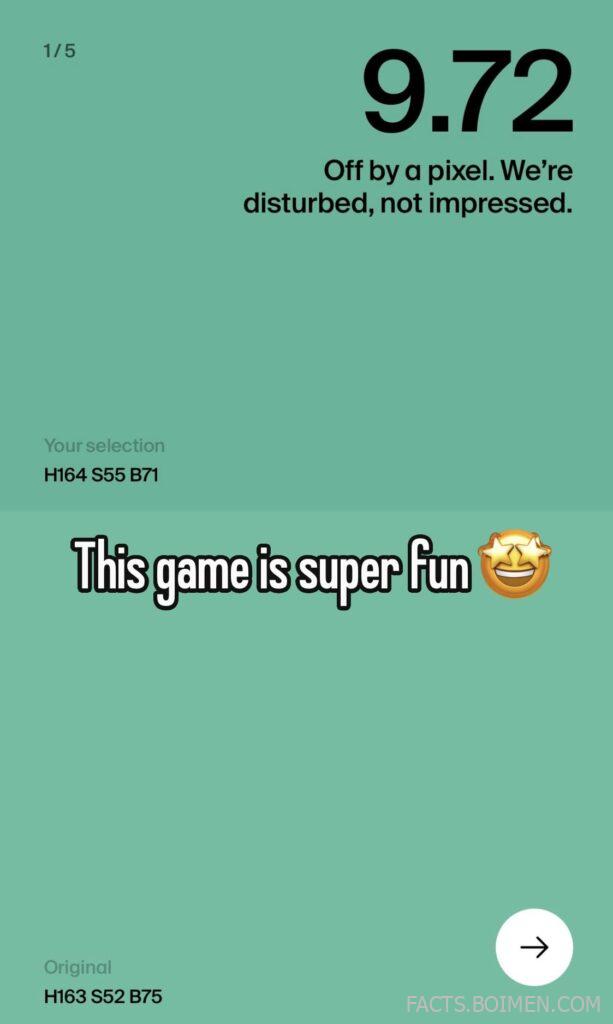
You picked a color. The game showed you H164 S55 B71. Then it whispered that the original was H163 S52 B75 — off by a pixel, and somehow you are the one who feels personally attacked. That tiny discrepancy is the entire magic of the color guessing game: a two-point hue shift, a three-point saturation drop, a four-point brightness gap, and suddenly you cannot trust your own eyes. The pin that brought you here promised a game that is “super fun,” and the format behind it — match a color from memory, then compare your selection to the original — is one of the most quietly addictive browser pastimes on the internet right now. Below are sixteen places to play it, from dead-simple daily puzzles to full color-perception test suites, plus a few bonus finds for anyone who wants to keep going down the rabbit hole.
Table of Contents(Click to Toggle)
Why Color Guessing Games Hook Your Brain
Color memory is shockingly unreliable, and that is exactly what makes these games so compelling. Your brain does not store color like a photograph; it stores a rough impression, then reconstructs the rest using surrounding context, lighting assumptions, and expectation. Show someone a swatch for three seconds, hide it, and ask them to rebuild it with HSL sliders, and the average person lands somewhere between five and fifteen points off on at least one channel. The pin that led you here captured that frustration perfectly: a selection of H164 S55 B71 against an original of H163 S52 B75 is a near-miss of almost nothing — one hue degree, three saturation points, four brightness points — yet it feels like a failure. That gap between what you saw and what you remembered is the whole game. It is also why color challenges work as daily habits: they take under a minute, they are impossible to fully master, and they give your eyes a tiny, satisfying calibration workout every time you play.
16 Color Guessing Games and Color Challenges
1. Color Method : The closest match to the HSL slider game in the pin
What it is: A browser-based color matching game from Method of Action where you adjust hue, saturation, and lightness sliders to recreate a target swatch shown for a few seconds.
Category: Color memory and matching
Why it stands out:
- It uses the same HSL-style slider mechanic as the pin, so your H164 S55 B71 instincts transfer immediately
- Each round scores you on how close your selection lands to the original, turning near-misses into a measurable number
- Runs entirely in the browser with no account, no download, and no ads interrupting a round
Best for: Anyone who clicked the pin specifically because they wanted to try the slider-matching format themselves.
2. ColorGuessr : Guess the color from a name or a swatch
What it is: A guessing game that shows you a color name or a target swatch and asks you to pick or build the matching color from memory.
Category: Color vocabulary and recall
Why it stands out:
- Bridges the gap between naming colors and reproducing them, which is harder than it sounds
- Fast rounds make it easy to play five games in the time it takes to drink a coffee
- Works well on mobile, so it is a natural companion to a Pinterest scroll session
Best for: Players who enjoy the vocabulary side of color, not just the slider math.
3. Hexcodle : A daily Wordle-style hex code puzzle
What it is: A once-a-day puzzle where you guess a six-digit hex color and get feedback on how close each channel is to the answer.
Category: Daily puzzle
Why it stands out:
- The feedback system tells you whether each RGB channel is too high or too low, so you refine instead of flailing
- One puzzle per day keeps it a ritual rather than a time sink
- Shareable result grid makes it easy to compare scores with friends without spoiling the answer
Best for: People who already play Wordle and want a visual equivalent.
4. Colorfle : Six guesses to nail the exact shade
What it is: A daily color guessing game where you mix primary colors to recreate a target shade within six attempts.
Category: Daily puzzle
Why it stands out:
- The mixing mechanic teaches you how RGB channels interact, which directly improves your slider accuracy elsewhere
- Six guesses is a tight but fair budget that rewards careful observation over brute force
- Clean, distraction-free interface that loads instantly on any device
Best for: Puzzle players who want a slightly more strategic take on color matching.
5. Picular : Search any word and get its color
What it is: A color search engine that returns a palette of dominant colors for any keyword you type, from “sunset” to “concrete.”
Category: Color inspiration tool
Why it stands out:
- Turns color guessing into a research game: try to predict the palette before it loads
- Useful for designers who need a starting palette fast, and fun for everyone else
- Each result links back to the source image, so you can see why a color was chosen
Best for: Creative players who want to guess colors and then actually use them in a project.
6. Colordle : Guess the color in fewer tries than your friends
What it is: A lightweight daily color guessing game with a simple interface and a limited number of attempts.
Category: Daily puzzle
Why it stands out:
- Minimalist design means zero learning curve — you understand the rules in one round
- Daily format builds a streak habit without demanding a long session
- Great warm-up before tackling harder color perception tests
Best for: Casual players who want a quick daily dose of color guessing.
7. The Color Game by Method of Action : Learn color theory while you play
What it is: An educational color game suite that teaches hue, saturation, and lightness through interactive challenges.
Category: Educational game
Why it stands out:
- Each level introduces a real color concept, so you finish knowing why your H164 guess missed
- Designed by a working designer, which shows in the thoughtful difficulty curve
- Free and browser-based, with no signup required
Best for: Beginners who want to understand HSL channels instead of just guessing at them.
8. X-Rite Color Challenge : The industry-standard hue test
What it is: A free online version of the famous Farnsworth-Munsell hue test, where you arrange color tiles in gradient order.
Category: Color perception test
Why it stands out:
- Gives you a real score and identifies which hue regions your eyes struggle with most
- Used professionally in design, printing, and manufacturing, so the results mean something
- Takes about five minutes and is genuinely humbling the first time you try it
Best for: Anyone curious whether their color perception is actually above average.
9. Color Name Blitz : Timed quizzes on color names and shades
What it is: A collection of timed color-themed quizzes covering shade names, hex codes, and color trivia.
Category: Quiz game
Why it stands out:
- Huge variety means you can play for two minutes or twenty depending on your mood
- Leaderboards add a competitive layer that pure guessing games lack
- Free to play with no account needed for most quizzes
Best for: Trivia fans who want color knowledge tested rather than color memory.
10. Guess the Color : Name the hue before the timer runs out
What it is: A simple browser game where a color appears and you must type or select its correct name quickly.
Category: Reflex and naming game
Why it stands out:
- Timer pressure makes even easy colors surprisingly stressful in a fun way
- Teaches the boundaries between similar names like teal, turquoise, and cyan
- Works as a quick brain warm-up before a design session
Best for: Players who like speed challenges more than precision matching.
11. Blendoku : Arrange colors into perfect gradients
What it is: A mobile and web puzzle game where you place color tiles so they form smooth gradients across a grid.
Category: Puzzle game
Why it stands out:
- Hundreds of hand-crafted levels ranging from easy to genuinely difficult
- Trains the same gradient perception that makes HSL slider games easier over time
- No ads in the core experience and no time pressure unless you want it
Best for: Puzzle lovers who want a longer, more meditative color challenge.
12. I Love Hue : A calming gradient puzzle for your eyes
What it is: A minimalist puzzle game about rearranging colored tiles into harmonious gradients.
Category: Puzzle game
Why it stands out:
- Beautifully designed with a soothing soundtrack that makes it feel more like a break than a test
- Difficulty ramps gently, so it never feels punishing
- Available on mobile and desktop, and easy to dip into for five minutes
Best for: Anyone who wants the color challenge without the stress of a score.
13. Hue Test : Measure your hue discrimination online
What it is: An online hue discrimination test that scores how accurately you can distinguish close shades.
Category: Perception test
Why it stands out:
- Provides a numeric result you can track over time or compare with friends
- Shorter than the full X-Rite test, making it easier to repeat
- Runs in any browser with no download
Best for: Players who want a quick benchmark of their color vision.
14. Color Oracle : See the world through different color vision
What it is: A free color blindness simulator that shows any design as it would appear with different types of color vision deficiency.
Category: Accessibility tool
Why it stands out:
- Turns the guessing game around: you try to predict how a color will shift, then check
- Essential for designers who want their work to be readable by everyone
- Lightweight desktop app that works offline
Best for: Designers and anyone curious about how color perception varies between people.
15. Pantone Color IQ Test : The classic professional color challenge
What it is: A well-known color IQ test that challenges you to order tiles by hue across a full spectrum.
Category: Perception test
Why it stands out:
- Widely recognized benchmark, so your score is easy to contextualize
- Reveals specific weak zones in your color perception rather than a single vague number
- Free and takes only a few minutes to complete
Best for: Competitive players who want a score they can brag about.
16. Color Hunt : Guess the palette, then steal it for real
What it is: A curated collection of four-color palettes that doubles as a guessing game if you try to predict the next trending combination.
Category: Palette inspiration
Why it stands out:
- Thousands of hand-picked palettes with hex codes you can copy instantly
- Trending section shows what colors are popular right now, which is its own mini prediction game
- Completely free with no account required
Best for: Players who want their color guessing to end in a usable design asset.
Bonus Mentions
Coolors : Generate palettes and test your eye against them
A fast palette generator with a “guess the color” style challenge hidden in its exploration tools. Great for designers who want to play and produce at the same time.
COLOURlovers : A community of color obsessives
A long-running community where people name, rate, and remix colors. The naming contests are a surprisingly fun guessing game in their own right.
Adobe Color : Build and explore color harmonies
Adobe’s free color wheel tool lets you explore harmony rules and extract palettes from images, which is a great way to check your color instincts against real data.
ColorHexa : The encyclopedia for any hex code
Type in any hex value and get conversions, shades, tints, and accessibility info. Perfect for verifying just how close your H164 S55 B71 guess really was.
Paletton : Classic color scheme designer
A veteran tool for building color schemes with live previews. Useful for turning a lucky guess into a full palette for a project.
The Internet’s Best Color Puzzles (So Far)
What makes the color guessing genre so enduring is that it never gets old in the way trivia does. You can memorize hex codes, you can learn the difference between saturation and lightness, and you can practice for weeks — and still land on H164 S55 B71 when the original was H163 S52 B75. That tiny miss is not a failure; it is proof that human color memory is beautifully approximate, and it is exactly why these sixteen games keep pulling people back. Start with the slider-based ones if you want to recreate the pin experience directly, then branch into the daily puzzles and perception tests once you want a real score to chase. Most of them are free, browser-based, and take under five minutes, which makes them perfect for a quick break between tasks. The only real risk is that “just one round” turns into an hour of squinting at gradients.
Which of these color games gave you the most embarrassingly off-by-a-pixel result? Share your worst near-miss in the comments — the more specific the numbers, the better.