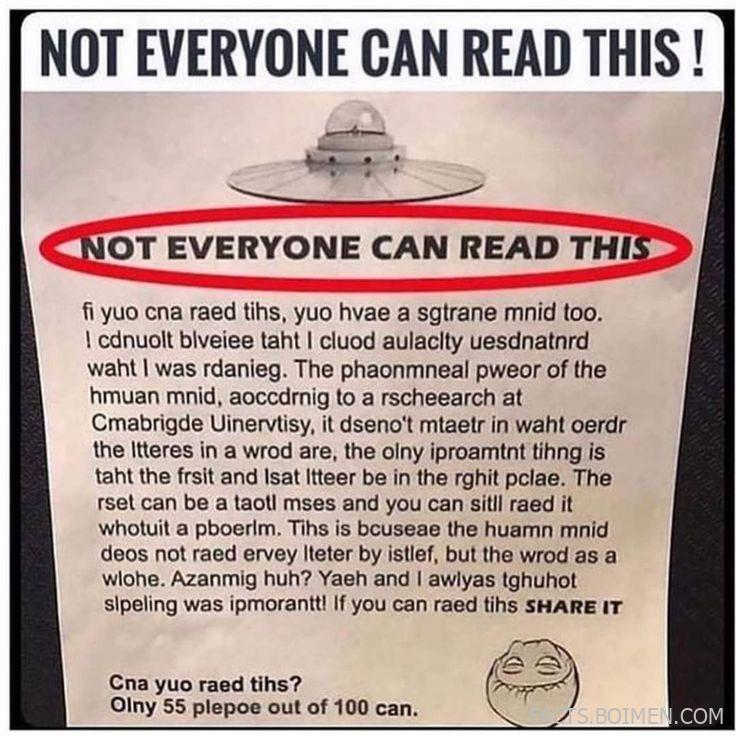
Have you ever seen this viral text online?
“I cdnuolt blveiee that I cluod aulaclty uesdnatnd waht I was rdanieg…”
At first glance, it looks like gibberish. But if you slow down for a second, you’ll notice something incredible: you can actually read it without too much effort!
This fascinating puzzle isn’t magic—it’s a glimpse into how powerful and adaptable the human brain really is. Let’s explore why your mind can make sense of scrambled letters, what science says about it, and some fun examples you can try with your friends.
Why Can We Read Jumbled Words?
The phenomenon comes down to pattern recognition. Our brains don’t read every single letter when scanning a word. Instead, we look at the overall shape, especially the first and last letters, and then use context clues from the surrounding sentence.
That’s why you can still understand:
👉 “Tihs snetecne is esay to raed, rghit?”
Even though every word in that sentence is scrambled, your brain quickly rearranges it.
The Cambridge University Myth
You may have seen claims that this effect comes from a Cambridge University study. That’s not entirely accurate—it’s more of an internet myth. But researchers in psycholinguistics and cognitive psychology have indeed shown that word recognition depends heavily on context and overall shape, not just precise spelling.
So, while Cambridge may not have invented the meme, the science behind it is real.
Fun Examples to Test Yourself
Here are a few scrambled sentences. See how fast you can read them 👇
- “Teh huamn mnid is amzanig at fnidnig pttaerns.”
- “Raeding is mroe aobut cntoext tahn pcerfet slpeling.”
- “Cna you sitll raed tihs qciukly?”
Pretty easy, right? Now let’s make it harder:
- “Whtiuot cntoext, tihs bcmoees mroe dfificult ot dcode.”
- “If teh wrods aer lnoger adn hve less cmomn ltreets, yuor barin wroks hrader.”
Notice how short, common words are almost effortless, but long, unusual words can slow you down?
Why Some People Struggle More
Not everyone finds this trick equally easy. Reading jumbled text can be harder for:
- Children learning to read, since they rely more on exact spelling.
- Non-native speakers, because they don’t always recognize word shapes as quickly.
- People with dyslexia, since letter position and sequencing already pose challenges.
That’s why the viral text often says, “Only 55 out of 100 people can read this.” While the number isn’t scientifically proven, it’s true that there’s a big difference in how people process scrambled words.
The Science of Reading and the Brain
When you read, your brain uses a combination of skills:
- Orthographic processing → recognizing the shapes of words.
- Phonological processing → connecting letters to sounds.
- Semantic processing → using meaning and context to fill in gaps.
This is why you can understand a sentence like:
👉 “I wnet ot teh store adn boguht smoe mlk.”
Even though many letters are scrambled, your brain autocorrects instantly, much like predictive text on your phone.
A Fun Challenge for You
Try sending this scrambled message to your friends:
“Helo! I’m jsut tesitng yuor barin. Cna you raed tihs mssage wthiuot a pboerlm?”
Chances are, most will reply laughing that they could read it perfectly. This makes it a fun little test of perception—and a great conversation starter.
What This Teaches Us
This viral puzzle is more than just internet fun. It teaches us:
- The brain is a pattern machine. We don’t just read letters—we read shapes and context.
- Spelling matters less than you think. At least for comprehension (but don’t tell your English teacher 😅).
- Communication is flexible. Even imperfect writing can still get the message across.
Key Takeaway
The next time someone makes a typo in a message, remember: your brain is perfectly capable of filling in the blanks. Spelling is important for clarity, but understanding doesn’t always require perfection.
So, can you read this?
👉 “Yuo aer amzanig for gteitng tihs far. Kepe raeidng adn epxloring!”
✨ Final Thought: The scrambled text phenomenon shows us how amazing our brains are. It’s not just about spelling—it’s about context, meaning, and our natural ability to find order in chaos.