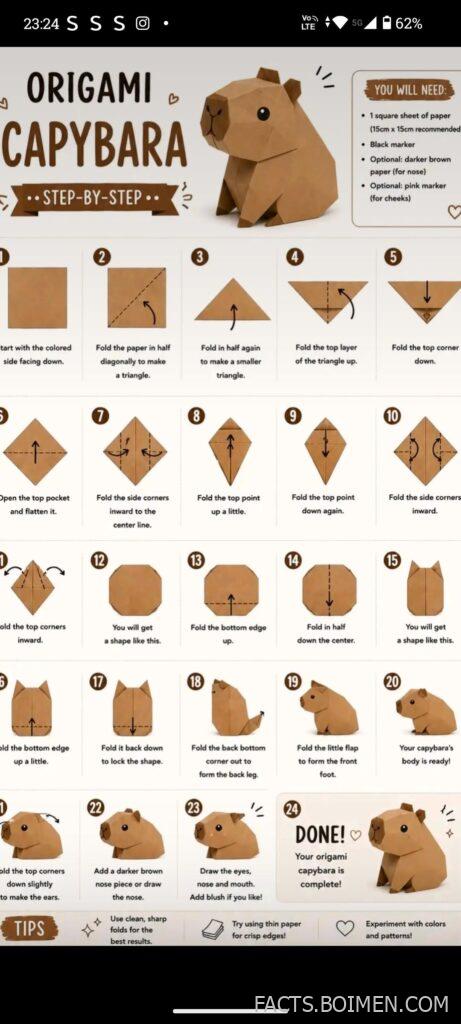
An origami bear with instructions to make it is one of those searches that starts small and ends with a desk covered in paper. The bear is a perfect entry point: it needs only one square sheet, it teaches the squash fold, the reverse fold, and the crimp, and it looks genuinely impressive when it stands up on its own four legs. Below are 15 places where the instructions actually work — clear diagrams, honest difficulty ratings, and real step counts, not vague photos of finished paper. Item one is the exact bear tutorial that brought you here. The rest are the paper animals every folder tries next.
Table of Contents(Click to Toggle)
Why an Origami Bear Is the Perfect First Paper Animal
Most people who search for an origami bear with instructions have already tried a crane and found it fiddly. The bear is a better teacher. It is built from the same bird base family of folds, but the sequence is shorter, the model is symmetrical, and the finished piece stands on its own instead of hanging from a string. That last part matters more than it sounds — a model that stands up gives you instant feedback about whether your folds were accurate.
A traditional origami bear takes roughly 25 to 35 steps depending on the designer, and most versions use a single square of paper between 15cm and 20cm. Thinner paper is easier for beginners because the layers stack up fast around the head and ears. Kami paper at around 60 to 70 gsm works well; foil paper looks striking but punishes any fold that is slightly off.
The bear also teaches three folds that show up in almost every intermediate model: the squash fold for shaping the muzzle, the inside reverse fold for the ears, and the crimp that lets the legs sit flat. Learn those on a bear and the fox, the panda, and the elephant all become much less intimidating.
15 Origami Bear Instructions and Paper Animal Tutorials
1. Origami.me : Clear step-by-step bear diagrams with a difficulty rating
What it is: A long-running diagram site with a dedicated bear section covering simple, intermediate, and realistic bear designs.
Category: Diagram library
Why it stands out:
- Each model lists an estimated time and difficulty level before you start folding
- The bear diagram uses shaded arrows to show exactly where the paper should move
- Photos of the finished model at each major stage, so you can check your progress
Best for: Anyone who wants the classic bear with instructions they can follow on a phone screen without zooming.
2. Origami Guide : Beginner-friendly bear with video and diagram together
What it is: A tutorial hub that pairs written diagrams with embedded video for most animals.
Category: Mixed media tutorials
Why it stands out:
- The bear page includes both a diagram and a video, which helps when a fold is ambiguous
- Difficulty tags run from easy to hard, so you can pick a bear that matches your skill
- Uses standard 15cm square paper, so no specialty supplies needed
Best for: Folders who read diagrams but occasionally need to see a fold in motion.
3. Origami-Fun : Printable diagram PDFs for the bear and other animals
What it is: A classic tutorial site with downloadable and printable instruction sheets.
Category: Printable diagrams
Why it stands out:
- The bear instructions can be printed as a clean one-page sheet for offline folding
- Diagrams are drawn in a consistent style across every animal, so nothing feels unfamiliar
- Includes a short glossary of fold names used in the steps
Best for: Teachers, parents, and anyone folding away from a computer.
4. Origami Way : Fast bear tutorials sorted by how long they take
What it is: A large tutorial collection with models grouped by difficulty and time.
Category: Diagram library
Why it stands out:
- Bear variants range from a five-minute simple head to a full standing body
- Steps are written in short plain-language sentences beneath each diagram
- Loads quickly on mobile, which matters when you are folding at a table
Best for: Quick sessions when you want a finished bear in under fifteen minutes.
5. Paper Kawaii : Cute bear faces and boxy bear designs with video walkthroughs
What it is: A design blog known for kawaii-style origami, including bear faces, bear bookmarks, and bear boxes.
Category: Video tutorials
Why it stands out:
- Every tutorial has a full-length video with slow-motion sections on tricky folds
- Includes printable patterned paper you can cut to size before folding
- The bear bookmark design is genuinely useful, not just decorative
Best for: Crafters who prefer watching a fold rather than reading a diagram.
6. Origami Spirit : Thoughtful bear tutorials with folding theory explained
What it is: A tutorial site that explains why a fold works, not just where to crease.
Category: Tutorials and technique
Why it stands out:
- Articles explain the geometry behind the bear base so you can adapt it
- Clear photography with hands in frame, making paper position obvious
- Covers paper choice and how thickness affects the final bear shape
Best for: Folders who want to understand the structure, not just copy steps.
7. Gilad’s Origami Page : A deep database of bear models by real designers
What it is: One of the oldest origami reference sites, cataloguing models, creators, and the books they appear in.
Category: Model database
Why it stands out:
- Searchable by subject, so you can find every documented bear model in one place
- Lists which book or publication contains each diagram
- Includes crease patterns for advanced folders who prefer to reverse-engineer
Best for: Folders who have outgrown beginner diagrams and want to find specific designers.
8. Origami Tutorials : Video-first bear and animal folding
What it is: A video tutorial library covering animals, flowers, and practical paper folds.
Category: Video tutorials
Why it stands out:
- Videos are filmed from directly above the paper, the clearest angle for folding
- Each tutorial states the paper size and finished model dimensions up front
- Playlists group animals together so you can work through a whole zoo
Best for: Visual learners who want a consistent camera angle across every model.
9. Origami Instructions : Traditional bear diagrams plus fold symbol key
What it is: A straightforward diagram site with a strong focus on traditional models.
Category: Diagram library
Why it stands out:
- Includes a full key explaining every diagram symbol, which beginners often need
- Traditional bear designs use only standard folds, no unusual techniques
- Pages are lightweight text and images, easy to print or read offline
Best for: First-time folders who need the arrow and line notation explained.
10. Red Ted Art : Bear origami for kids with simple, forgiving steps
What it is: A family craft site with origami projects pitched at children and beginners.
Category: Kids and family crafts
Why it stands out:
- Bear projects use large paper and fewer than fifteen steps
- Includes printable templates so kids can fold without measuring
- Pairs the bear with related crafts like paper bag puppets and cards
Best for: Parents, teachers, and anyone folding with young children.
11. Origami Plus : Slow, no-narration bear folding videos
What it is: A video channel that folds models in real time with minimal talking.
Category: Video tutorials
Why it stands out:
- No narration means you can fold along without pausing to listen
- Consistent lighting and a plain background keep the focus on the paper
- Bear and other animal videos are grouped into easy-to-follow series
Best for: Folders who find spoken tutorials distracting or too fast.
12. Happy Folding : High-quality instructional videos and book reviews
What it is: A well-regarded origami video archive with detailed instructional content.
Category: Video tutorials and reviews
Why it stands out:
- Videos are shot in high definition with the paper filling the frame
- Reviews of origami books help you decide which ones actually contain good animal diagrams
- Includes interviews with designers, useful when you want to learn their techniques
Best for: Intermediate folders building a paper and book collection.
13. WonderHowTo Origami : A huge aggregated index of folding videos
What it is: A how-to video aggregator with a large origami section.
Category: Video index
Why it stands out:
- Thousands of folding videos indexed by model type, including many bear variations
- Each entry shows a thumbnail of the finished model so you know what you are getting
- Useful for comparing several approaches to the same model before committing
Best for: Browsers who want to compare multiple tutorials for one model.
14. Origami Resource Center : Diagrams, history, and paper guidance in one place
What it is: A reference site covering diagrams, folding history, and paper types.
Category: Reference and diagrams
Why it stands out:
- Explains which paper weights suit which models, including multi-layer animals
- Diagrams are organised by animal so the bear sits alongside fox, panda, and rabbit
- Background articles on origami traditions add context to what you are folding
Best for: Folders who want reference material alongside step-by-step diagrams.
15. Origami.org : Community diagrams and folding challenges
What it is: A community-oriented origami site with diagrams, challenges, and shared models.
Category: Community and diagrams
Why it stands out:
- Regular folding challenges give you a reason to practice beyond one model
- Member-submitted photos show how the same bear looks in different papers
- Beginner section is clearly separated from advanced crease-pattern work
Best for: Folders who stay motivated by sharing results with other people.
Bonus Mentions
Origami Shop : Specialty paper and books for animal models
A retailer stocking kami, washi, and foil papers in the sizes most animal diagrams call for, plus instruction books that are hard to find elsewhere.
British Origami Society : Diagrams and a folding community since 1967
A long-established society publishing diagrams and a regular magazine, useful if you want a steady stream of new models rather than one-off tutorials.
Origami Tanteidan : The Japanese folding convention and publication
Home of the well-known convention books, which contain some of the most refined animal designs available in print.
Pinterest : Visual inspiration boards for paper animals
Not a tutorial source itself, but the fastest way to see dozens of finished bear variations and decide which style you want to fold next.
The Best Paper Animals to Fold After the Bear
Once the bear stands on your desk, the natural next steps are the fox, the panda, the rabbit, and the elephant — all of them share the same base folds you just learned, and all of them appear on the sites above. The real difference between a frustrating fold and a satisfying one is rarely talent. It is paper weight, a clear diagram, and folding on a hard flat surface instead of your lap.
Start with a 15cm square of kami paper, work through the bear slowly, and do not skip the pre-creasing steps. If a fold looks wrong, unfold and refold rather than pressing harder — paper remembers every crease, including the bad ones. Keep one finished model on your desk as a reference for how the proportions should look.
Which paper animal did you fold first, and which one defeated you? Share your best find in the comments — the obscure tutorial sites are usually the ones worth keeping.