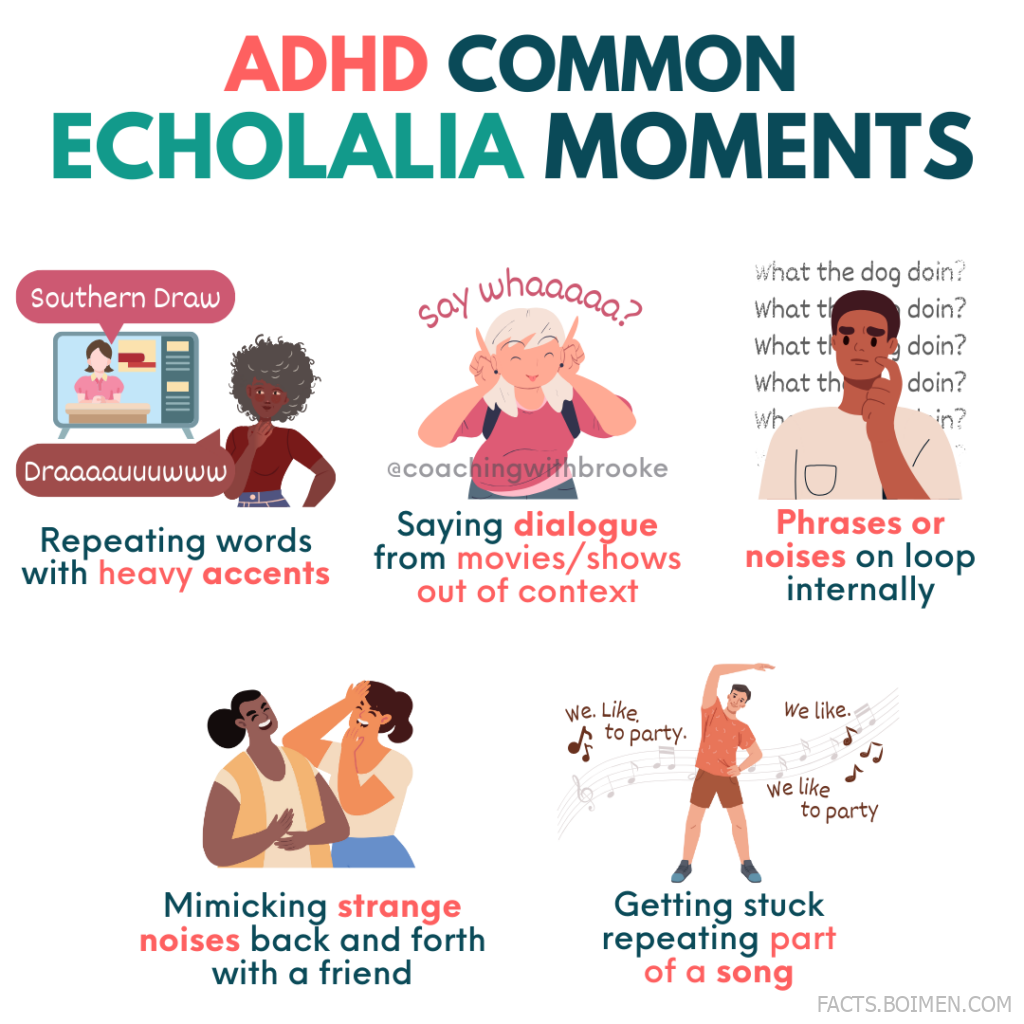
You’re standing in the kitchen and a single phrase loops in your head for the fourth time this hour. Maybe it’s a jingle from a commercial you haven’t seen in years, a line from a toddler’s song, or the way a stranger said “no worries” at the grocery store. For many adults with ADHD, this is echolalia — the brain catching a sound, a word, or a rhythm and repeating it internally or out loud. It isn’t a quirk you grew out of, and it isn’t random. It’s often tied to how ADHD brains process stimulation, memory, and emotion. Below are 20 real echolalia patterns, moments, and triggers that adults with ADHD report most often, plus a few bonus mentions for anyone who wants to understand the why behind the loop.
Table of Contents(Click to Toggle)
- Why Echolalia Moments Matter for ADHD Adults
- 20 Common Echolalia Moments in ADHD Adults
- 1. The Toddler Song Loop
- 2. The Commercial Jingle
- 3. The Movie Line Repeat
- 4. The Accent Echo
- 5. The Last Word Stuck
- 6. The Text Message Replay
- 7. The Song Chorus on Repeat
- 8. The Friend’s Catchphrase
- 9. The Sound Effect Loop
- 10. The Podcast Host Voice
- 11. The Pet Name Repeat
- 12. The Number Sequence
- 13. The Emotional Echo
- 14. The TikTok Audio Loop
- 15. The Family Saying
- 16. The Work Phrase
- 17. The Random Word Pop
- 18. The Internal DJ
- 19. The Whispered Repeat
- 20. The Delayed Echo
- Bonus: Echolalia vs. Palilalia
- Bonus: Echolalia and Emotional Regulation
- Bonus: When to Talk to a Professional
- The Quiet Loop That Connects ADHD Brains
Why Echolalia Moments Matter for ADHD Adults
Echolalia is often associated with autism, but it shows up in ADHD adults too, usually in quieter, more internal ways. Research and community reports suggest that ADHD brains often seek stimulation, and repeated sounds can provide a steady, predictable input that helps with focus or self-soothing. For some, it’s a form of vocal stimming. For others, it’s a memory hook — the brain grabs a phrase because it’s tied to an emotion, a person, or a moment. Understanding your own patterns can help you stop feeling embarrassed, and it can even become a tool for recognizing when your nervous system needs a break. The 20 moments below are the ones adults mention most often in forums, support groups, and casual conversation.
20 Common Echolalia Moments in ADHD Adults
1. The Toddler Song Loop : When a child’s song takes over your brain
What it is: A simple, repetitive children’s song gets stuck after you hear it from a child, a toy, or a video.
Category: External trigger, internal loop
Why it stands out:
- The rhythm and rhyme make it stickier than adult music.
- It often plays internally at random moments, like during work or falling asleep.
- Parents and caregivers report this as their number one echolalia source.
Best for: Anyone around young children who suddenly hears “Head, Shoulders, Knees and Toes” at 2 a.m.
2. The Commercial Jingle : Jingles that outlive the product
What it is: A short advertising melody or tagline repeats in your head long after the ad stops airing.
Category: Auditory memory loop
Why it stands out:
- Jingles are engineered to be memorable, so ADHD brains latch on fast.
- You may hum it without realizing it, then feel oddly nostalgic.
- It can pop up during quiet tasks, filling the silence.
Best for: Adults who grew up with TV ads and still catch themselves humming them.
3. The Movie Line Repeat : Quoting a scene on a loop
What it is: A single line from a film or show repeats internally, often in the actor’s exact tone.
Category: Media-based echolalia
Why it stands out:
- The line is usually short and emotionally charged.
- It can be comforting, like a familiar inside joke with yourself.
- Some adults repeat it out loud when alone to release energy.
Best for: Movie lovers who use quotes as emotional shorthand.
4. The Accent Echo : Picking up voices without trying
What it is: After hearing someone with a distinct accent, you briefly mimic it in your head or speech.
Category: Social echolalia
Why it stands out:
- It’s often unconscious and can feel embarrassing in conversation.
- It reflects strong auditory processing and empathy.
- It usually fades once the conversation ends.
Best for: People who travel, watch foreign films, or talk to diverse coworkers.
5. The Last Word Stuck : When a single word won’t leave
What it is: The final word of a sentence you just heard or read repeats silently.
Category: Verbal working memory loop
Why it stands out:
- It can happen mid-conversation and distract you from what’s being said.
- Typing or writing the word sometimes breaks the loop.
- It’s more common when you’re tired or overstimulated.
Best for: Anyone who notices a word echoing after meetings or reading.
6. The Text Message Replay : Rereading a phrase in your head
What it is: A text you sent or received replays in your mind, often with the same tone.
Category: Digital echolalia
Why it stands out:
- It’s tied to social anxiety or excitement.
- The loop often stops once you get a reply.
- It can help you rehearse conversations, but also keep you stuck.
Best for: Adults who overthink messages and hear them echo later.
7. The Song Chorus on Repeat : One line, endless playback
What it is: A chorus or hook repeats internally, sometimes for hours.
Category: Musical echolalia
Why it stands out:
- It’s one of the most reported ADHD experiences.
- Listening to the full song can sometimes satisfy the loop.
- It often intensifies during stress or boredom.
Best for: Music fans who get a song stuck after one listen.
8. The Friend’s Catchphrase : Borrowing someone else’s words
What it is: A phrase a friend or partner uses often becomes part of your internal monologue.
Category: Social bonding echolalia
Why it stands out:
- It’s a sign of closeness and mimicry.
- You may use it without realizing it’s not your own.
- It can strengthen relationships when shared.
Best for: People with close friendships or long-term partners.
9. The Sound Effect Loop : Beeps, clicks, and boops
What it is: A non-word sound — a notification, a click, a beep — repeats in your head.
Category: Auditory stimming
Why it stands out:
- It’s often tied to sensory processing.
- Repeating the sound out loud can be soothing.
- It may increase in noisy environments.
Best for: Adults sensitive to sound who use repetition to self-regulate.
10. The Podcast Host Voice : A host’s cadence stuck in your head
What it is: The rhythm or tone of a podcast host repeats internally after listening.
Category: Media-based echolalia
Why it stands out:
- It’s common after binge-listening.
- You may catch yourself narrating your day in their style.
- It usually fades within a day.
Best for: Podcast fans who listen for hours at a time.
11. The Pet Name Repeat : Calling your dog in your head
What it is: A pet’s name or a command repeats internally, even when the pet isn’t there.
Category: Habitual echolalia
Why it stands out:
- It’s tied to routine and affection.
- It can be comforting during quiet moments.
- It often stops when you’re engaged in a task.
Best for: Pet owners who talk to their animals throughout the day.
12. The Number Sequence : Counting without meaning to
What it is: A number pattern — like a phone number or a countdown — repeats in your mind.
Category: Cognitive loop
Why it stands out:
- It’s often linked to anxiety or anticipation.
- Writing the numbers down can interrupt the loop.
- It may appear when you’re trying to fall asleep.
Best for: People who notice numbers echoing after stressful events.
13. The Emotional Echo : Repeating words tied to feelings
What it is: A phrase someone said during an emotional moment repeats in your head.
Category: Emotional echolalia
Why it stands out:
- It’s often connected to unresolved feelings.
- It can be a form of rumination.
- Naming the emotion can reduce the loop.
Best for: Adults processing conflict or big life changes.
14. The TikTok Audio Loop : Short sounds that stick
What it is: A trending sound bite repeats in your head after scrolling.
Category: Digital echolalia
Why it stands out:
- Short-form audio is designed to be catchy.
- It can feel like the sound is “playing” in the background.
- Taking a break from scrolling often helps.
Best for: Social media users who scroll before bed.
15. The Family Saying : Generational phrases on repeat
What it is: A saying from a parent or grandparent repeats internally.
Category: Inherited echolalia
Why it stands out:
- It carries emotional weight and nostalgia.
- It often appears during decision-making.
- It can be a source of comfort or pressure.
Best for: Adults reflecting on family patterns.
16. The Work Phrase : Corporate speak stuck in your head
What it is: A phrase from a meeting or email repeats after work hours.
Category: Occupational echolalia
Why it stands out:
- It’s common in high-pressure jobs.
- It can blur work-life boundaries.
- Changing your environment can break the loop.
Best for: Professionals who replay meetings mentally.
17. The Random Word Pop : Words with no obvious source
What it is: A word appears in your mind and repeats for no clear reason.
Category: Spontaneous echolalia
Why it stands out:
- It can be a sign of a wandering, creative mind.
- It often happens during routine tasks.
- It usually disappears on its own.
Best for: Anyone who experiences random word loops.
18. The Internal DJ : A soundtrack you didn’t choose
What it is: A mix of songs or beats plays in your head, switching tracks randomly.
Category: Musical echolalia
Why it stands out:
- It can be energizing or distracting.
- It often reflects your mood.
- Mindfulness can help you notice it without judgment.
Best for: Adults who always have music playing internally.
19. The Whispered Repeat : Quietly saying it back
What it is: You whisper a phrase under your breath after hearing it.
Category: Vocal echolalia
Why it stands out:
- It’s often unconscious and subtle.
- It can help with auditory processing.
- It may increase when you’re focused.
Best for: People who whisper to themselves while thinking.
20. The Delayed Echo : Phrases that surface hours later
What it is: A sound or phrase from earlier in the day repeats suddenly at night.
Category: Delayed echolalia
Why it stands out:
- It’s common when the brain is quieting down.
- It can interfere with sleep onset.
- White noise or a bedtime routine may reduce it.
Best for: Adults who notice echoes right before sleep.
Bonus: Echolalia vs. Palilalia : Understanding the difference
Palilalia is the repetition of your own words, while echolalia repeats sounds from others. Both can occur in ADHD and autistic adults, but they serve different functions. Knowing which one you experience can help you describe it accurately to a doctor or therapist.
Bonus: Echolalia and Emotional Regulation : Why repetition calms
Repeating a sound or phrase can act as a self-soothing mechanism. It gives the ADHD brain a predictable input, which can reduce anxiety and improve focus. Many adults use it unconsciously during stressful moments.
Bonus: When to Talk to a Professional : If it disrupts daily life
Occasional echolalia is common and usually harmless. If it becomes constant, interferes with sleep, work, or relationships, or feels distressing, a healthcare professional can help you explore underlying causes and coping strategies.
The Quiet Loop That Connects ADHD Brains
Echolalia in ADHD adults is one of those experiences that feels isolating until you realize how many others share it. The toddler song, the movie quote, the random word at 3 a.m. — they’re all part of a brain that processes sound, emotion, and memory in its own rhythm. None of these 20 moments are flaws to fix. They’re patterns to notice, understand, and maybe even enjoy. The next time a phrase loops in your head, try naming it instead of fighting it. You might find it’s your brain’s way of holding onto something meaningful. What’s the one sound or phrase your ADHD brain repeats most often? Share it in the comments — you’re probably not the only one.