
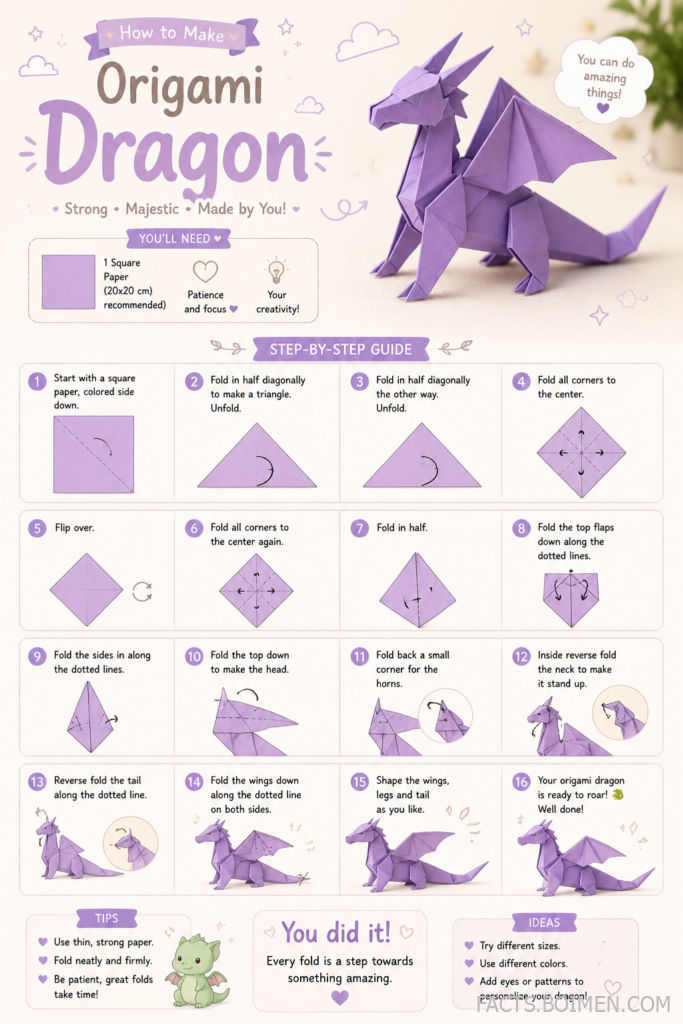
Folding an origami dragon is one of those quiet little projects that looks intimidating from the outside and feels genuinely magical once the last wing snaps into place. The trick is not talent — it is picking a guide that matches your patience level. Some dragons need 60 precise folds and thin foil paper; others come together in eight steps from a single square and still look impressive on a shelf.
Below are 15 places to learn how to make an origami dragon step by step, ordered from the friendliest beginner walkthroughs to the more advanced showpieces. Every one of them is free to read, most need nothing more than a square of paper and a flat table, and each entry tells you honestly who it suits.
Table of Contents(Click to Toggle)
- Why Origami Dragons Are the Perfect First Challenge
- 15 Origami Dragon Step by Step Guides
- 1. Origami.me
- 2. Origami Way
- 3. Origami Guide
- 4. Origami-Fun
- 5. Paper Kawaii
- 6. Origami Resource Center
- 7. Gilad’s Origami Page
- 8. Jo Nakashima (YouTube)
- 9. Tavin’s Origami Instructions
- 10. Red Ted Art
- 11. Origami Spirit
- 12. Happy Folding
- 13. Origami Plus
- 14. Origami Tutorials
- 15. Pinterest Origami Boards
- Bonus Mentions
- The Internet’s Best-Kept Paper Secrets (So Far)
Why Origami Dragons Are the Perfect First Challenge
A dragon sits in a sweet spot that few other origami models occupy. It is more exciting than a crane, which most people have already folded, but it is nowhere near as punishing as a complex insect with 200 steps and wet-folding requirements. Most beginner dragons rely on the same handful of moves you already know: the diagonal fold, the kite base, the reverse fold, and the squash fold. Once those click, a dragon is just those moves arranged in a more dramatic order.
There is also a practical reason dragons work so well for kids and beginners. The model is forgiving. A slightly crooked wing or a crease that is a millimeter off rarely ruins the silhouette, because dragons are supposed to look a little wild. That tolerance means a first attempt usually still looks like a dragon, which is exactly the encouragement a new folder needs to try a second one.
The guides below are chosen for clarity rather than prestige. Some use diagrams, some use video, and a few use both. A handful assume you have proper origami paper; others are built around plain printer paper so you can start right now with whatever is in the drawer.
15 Origami Dragon Step by Step Guides
1. Origami.me : Clear diagram-and-video dragon tutorials built for total beginners
What it is: A long-running origami instruction site with a dedicated dragons section that mixes step-by-step photo diagrams with short embedded videos.
Category: Diagram and video tutorial library
Why it stands out:
- Each dragon page lists the difficulty level and an estimated folding time before you commit.
- Diagrams use shaded arrows that show the direction of the fold, which removes the guesswork that trips up first-timers.
- Several models are explicitly labeled beginner, including a simple dragon head that takes about five minutes.
Best for: Complete beginners and parents folding alongside a child who wants to see the move before trying it.
2. Origami Way : Fast, illustrated dragon steps that assume zero prior folding experience
What it is: A straightforward tutorial site where every model is broken into numbered illustrated steps with plain-language captions.
Category: Beginner diagram tutorials
Why it stands out:
- The captions describe the fold in words as well as pictures, which helps if you are reading the steps aloud to a kid.
- Dragon models are grouped by difficulty, so you can start with a simple version and graduate to a winged one later.
- Pages load quickly with no video player, making them easy to follow on a phone at the kitchen table.
Best for: Families who want a screen-light tutorial they can scroll beside the paper.
3. Origami Guide : Photo-heavy dragon walkthroughs with a difficulty rating on every page
What it is: A modern tutorial site that photographs each fold from a consistent overhead angle so the paper never appears to jump position.
Category: Photo step-by-step tutorials
Why it stands out:
- The consistent camera angle is a genuinely useful detail — you always know which corner is which.
- Every tutorial states the paper size and type recommended, so you avoid the classic mistake of folding a complex dragon from thick cardstock.
- Includes a short list of common mistakes at the bottom of longer dragon guides.
Best for: Visual learners who get lost when diagrams flip orientation halfway through.
4. Origami-Fun : Printable dragon diagrams you can keep next to the paper
What it is: A classic origami site with clean line diagrams, many of which are formatted to print on a single page.
Category: Printable diagram archive
Why it stands out:
- The printable format means no screen glare and no accidental page refresh mid-fold.
- Diagrams are drawn in a traditional style that teaches you to read standard origami notation, a skill that transfers to any book.
- Dragon and dinosaur sections sit side by side, handy if you are folding a whole themed set.
Best for: Classrooms, craft clubs, and anyone who prefers paper instructions over a screen.
5. Paper Kawaii : Cute, approachable dragon designs with video and diagram together
What it is: A well-known origami blog that pairs each model with both a video and a written diagram, plus notes on paper choice.
Category: Blog with dual video and diagram tutorials
Why it stands out:
- Having the video and the diagram on the same page lets you switch methods the moment one stops making sense.
- The designs lean cute rather than fierce, which tends to land better with younger folders.
- Posts often mention the exact paper brand and size used, so results are reproducible.
Best for: Kids and beginners who want a charming dragon rather than a realistic one.
6. Origami Resource Center : A deep reference library with dragon models sorted by difficulty
What it is: An encyclopedic origami hub that catalogs models from many designers and organizes them by type and complexity.
Category: Reference and link directory
Why it stands out:
- It explains origami terminology and symbols, so unfamiliar diagram notation stops being a barrier.
- The dragon listings span simple to advanced, making it a single stop as your skills grow.
- Background articles on paper types help you understand why a model keeps tearing.
Best for: Beginners who want to understand the craft, not just follow one tutorial.
7. Gilad’s Origami Page : A curated gallery of dragon models from designers worldwide
What it is: One of the oldest origami sites on the web, featuring galleries of folded models and information about the designers behind them.
Category: Gallery and designer archive
Why it stands out:
- Seeing finished dragons photographed from several angles helps you understand what you are aiming for before you start.
- It credits the original creators, which is a good habit to pass on to kids learning the craft.
- Book and diagram references point you toward printed resources if you want to go deeper.
Best for: Inspiration hunting and anyone curious about the history of dragon designs.
8. Jo Nakashima (YouTube) : Slow, exceptionally clear dragon folding videos
What it is: A popular origami channel known for unhurried, well-lit videos that show every fold from a fixed overhead camera.
Category: Video tutorials
Why it stands out:
- The pacing is deliberately slow, so you can fold along in real time without constantly pausing.
- On-screen markers indicate crease lines and reference points, reducing the guesswork on reverse folds.
- Longer dragon builds are split into clearly labeled sections, so you can stop and resume later.
Best for: Anyone who learns faster by watching hands than by reading diagrams.
9. Tavin’s Origami Instructions : Friendly dragon tutorials pitched at absolute newcomers
What it is: A tutorial channel that walks through beginner-friendly models with calm narration and simple language.
Category: Video tutorials
Why it stands out:
- The narration explains why a fold is made, not just where, which builds real understanding.
- Videos are short enough to finish in one sitting, which suits younger attention spans.
- Several dragon designs use standard square paper you can cut from a printer sheet.
Best for: First-time folders and kids working mostly independently.
10. Red Ted Art : Kid-tested dragon crafts with printable templates
What it is: A family craft site that adapts origami projects for young children, sometimes with printable templates and simplified folds.
Category: Kids’ craft tutorials
Why it stands out:
- Tutorials are written by an adult who has actually folded them with children, so the tricky steps are flagged in advance.
- Printable templates remove the pressure of cutting a perfect square by hand.
- Dragon projects often include a decorating step, which keeps younger kids engaged to the end.
Best for: Parents and teachers crafting with children aged roughly five to ten.
11. Origami Spirit : Thoughtful dragon tutorials with background on each design
What it is: A tutorial blog that pairs folding instructions with context about the model’s origin and designer.
Category: Blog with instructional articles
Why it stands out:
- Each post explains the design’s story, which makes the finished dragon feel like more than a craft project.
- Instructions are careful about paper weight and grain direction, details that quietly determine success.
- Video and diagram options appear together on many posts.
Best for: Older beginners and adults who enjoy the story behind a fold.
12. Happy Folding : Detailed reviews and diagrams for intermediate folders
What it is: A long-standing resource with diagrams, book reviews, and honest notes on how hard each model really is.
Category: Diagram archive and review site
Why it stands out:
- The difficulty assessments are refreshingly honest, so you rarely start a model that is out of your league.
- Paper recommendations are specific, including which thickness works for models with many layers.
- Reviews of origami books help you decide before buying a printed collection.
Best for: Beginners who have folded a few models and want a reliable next step.
13. Origami Plus : A structured course-style path from simple folds to dragons
What it is: A learning-focused origami site that arranges tutorials in a suggested progression rather than a flat list.
Category: Structured learning platform
Why it stands out:
- The progression idea is genuinely helpful: fold the base models first, then apply them to a dragon.
- Steps are written to be self-contained, so you can jump in at your current level.
- Clear photos accompany each stage of the build.
Best for: Beginners who want a logical order instead of random tutorials.
14. Origami Tutorials : A searchable index of dragon models by paper size and skill
What it is: A tutorial collection organized so you can filter by the kind of model you want to fold.
Category: Tutorial index
Why it stands out:
- Grouping by paper size saves you from starting a model that needs a sheet you do not own.
- Beginner categories are clearly separated from advanced ones.
- Many pages include a quick tip box for the step most people get wrong.
Best for: Folders who already have paper on hand and want a model that fits it.
15. Pinterest Origami Boards : Visual collections that surface new dragon tutorials daily
What it is: A visual discovery platform where origami folders and teachers pin tutorials, diagrams, and finished models.
Category: Visual discovery and inspiration
Why it stands out:
- Searching a specific phrase like simple origami dragon surfaces fresh tutorials from small creators.
- Photo-first pins let you judge whether a design is within reach before clicking through.
- Saving pins into your own board builds a personal library you can return to.
Best for: Browsers who want inspiration and a steady stream of new designs.
Bonus Mentions
Origami Instructions : Classic diagram sets with a gentle learning curve
A traditional diagram site with clear line art and a good spread of beginner models. The dragon section is smaller than the big libraries, but the diagrams are unusually tidy and easy to read on a phone.
Origami Tree (YouTube) : Short, cheerful folding videos for quick wins
Bite-sized tutorials that suit a five-minute craft break. The channel covers dragons and dragon-adjacent creatures with simple narration and bright paper that shows creases clearly.
Origami-Make : Step-by-step diagrams with printable folding lines
A compact archive where many models include printable templates marked with the fold lines. Helpful when you want to practice creasing accurately before moving to freehand folds.
Origami Artists : Community galleries and shared folding tips
A community-oriented site where folders post photos and compare notes. Good for seeing how the same dragon design looks in different papers and sizes.
The Internet’s Best-Kept Paper Secrets (So Far)
The nice thing about origami dragons is that the barrier to entry is almost zero. You need one square of paper, a flat surface, and about twenty minutes. Everything else — the diagrams, the videos, the slow-motion fold-alongs — is already sitting free on the sites above, waiting for someone to click.
If you are starting today, pick one beginner tutorial from the first few entries, fold it badly, and keep the result. That crooked first dragon is more useful than a perfect tenth one, because it shows you exactly which fold confused you. Then try a second guide that uses a different teaching style — video instead of diagrams, or diagrams instead of photos — and you will often find the same step suddenly makes sense.
For kids, the trick is to stop before frustration sets in. A simple dragon head finished happily beats an elaborate winged dragon abandoned halfway. Let them decorate the finished model with markers or googly eyes, and the project becomes a craft session rather than a test of patience.
Once you have folded your first one, the natural next step is a dragon with wings, then a standing dragon, then maybe a modular design built from several sheets. Each level reuses the same core folds, so nothing you learn is wasted.
Which origami dragon guide did you try first, and did it survive the folding table? Share your favorite find in the comments — the best hidden tutorials usually come from other folders.