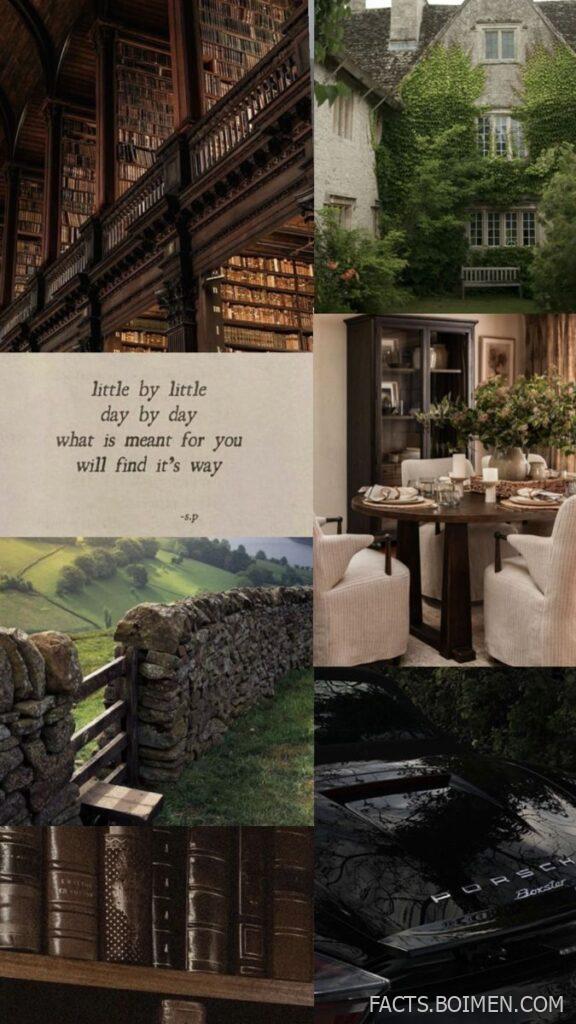
There is a particular kind of comfort in a mood board that feels like a memory you never actually had: candlelit libraries, ivy swallowing a stone cottage, a single lamp glowing over a stack of vintage books. Dark academia and cottagecore have quietly become two of the most-saved aesthetics online, and autumn is when they peak. This list gathers 19 places to find, build, and live that aesthetic — from free public-domain libraries to real English estates you can visit, plus a few quiet tools for turning scattered inspiration into an actual mood board. Everything here is chosen for atmosphere, not for hype.
Table of Contents(Click to Toggle)
- Why Dark Academia Peaks in Autumn
- 19 Dark Academia and Cottagecore Aesthetic Finds
- 1. Pinterest
- 2. Unsplash
- 3. The Met Open Access
- 4. Internet Archive
- 5. Project Gutenberg
- 6. Canva
- 7. Are.na
- 8. Tumblr
- 9. National Trust
- 10. English Heritage
- 11. The Morgan Library and Museum
- 12. Trinity College Dublin Library
- 13. Bodleian Libraries
- 14. Europeana
- 15. Rijksmuseum
- 16. Smithsonian Open Access
- 17. Wikimedia Commons
- 18. Public Domain Review
- 19. Library of Congress Free to Use
- Bonus Mentions
- The Quiet Archive: Building an Aesthetic That Lasts
Why Dark Academia Peaks in Autumn
Dark academia is less a trend than a season with a colour palette. Its visual grammar — mahogany, brass, wool, foxed paper, low golden light — depends on the same conditions autumn provides: shorter days, warmer indoor lighting, and the instinct to stay in and read. Cottagecore adds the other half of the equation, replacing the library with the garden, the ivy-covered wall, and the slow kitchen.
The result is an aesthetic that rewards research rather than shopping. The best mood boards are assembled from public-domain paintings, real historic houses, and photography that is free to use — which is why the tools below lean toward archives, open-access museums, and quiet visual bookmarking platforms. None of them require an expensive subscription, and most are genuinely free. If you have ever scrolled a pin and wished you could step inside it, this list is the door.
19 Dark Academia and Cottagecore Aesthetic Finds
1. Pinterest : The endless mood board engine
What it is: A visual discovery platform where you collect images into themed boards and the algorithm suggests adjacent ideas.
Category: Inspiration and curation
Why it stands out: Its search is unusually good at texture-level queries. Typing “dark academia library” surfaces oil-painted reading rooms, while “cottagecore kitchen” returns copper pots, dried herbs, and stone sinks. Board sections let you split one board into sub-themes like candles, books, and countryside.
Best for: Fast, broad collection before you narrow down a palette.
2. Unsplash : Free, high-resolution photography for collages
What it is: A library of freely usable photographs, many under an open licence that allows commercial use without attribution.
Category: Free imagery
Why it stands out: Search “old books” or “autumn mist” and you get full-resolution files rather than compressed thumbnails, which matters when you are printing a collage or building a desktop wallpaper. Collections curated by other users often group an entire aesthetic into one link.
Best for: Printable wall art and clean, non-watermarked backgrounds.
3. The Met Open Access : Museum-quality art you can use freely
What it is: The Metropolitan Museum of Art’s open-access collection of public-domain artworks, downloadable at high resolution.
Category: Open-access art
Why it stands out: Filter for “Open Access” and you can download Dutch still lifes, moody nineteenth-century landscapes, and gilded manuscript pages — exactly the imagery that gives a dark academia board its weight. Each record lists the medium and date, so your captions can be accurate rather than vague.
Best for: Adding real art history to a mood board instead of stock filler.
4. Internet Archive : Vintage scans, textures, and out-of-print books
What it is: A non-profit digital library holding millions of scanned books, magazines, and audio recordings.
Category: Digital archive
Why it stands out: Its scans of early twentieth-century magazines and catalogues give you authentic aged paper texture, period typography, and botanical plates. You can borrow many titles for a limited digital loan, which is useful for reading the actual literature behind the aesthetic.
Best for: Texture references and genuinely old typography.
5. Project Gutenberg : The reading list, free and legal
What it is: The oldest digital library of public-domain ebooks, available in plain text, EPUB, and Kindle formats.
Category: Free ebooks
Why it stands out: Dark academia has a canon, and most of it is here: gothic novels, Romantic poetry, letters, and essays. Files are small and download instantly, with no account required. The plain-text versions are also easy to quote in a journal or caption.
Best for: Reading the books that the aesthetic keeps photographing.
6. Canva : Turn scattered images into one finished board
What it is: A browser-based design tool with templates, grids, and text styling.
Category: Design and layout
Why it stands out: Its collage grids and free serif fonts make it easy to assemble a nine-image board in minutes, and the background remover helps when you want to lift a single object like a candlestick onto a plain paper background. The free tier is generous for personal projects.
Best for: Producing a shareable, print-ready mood board.
7. Are.na : A quiet, ad-free place to think in images
What it is: A bookmarking platform built around channels, where you save images, links, and text without an algorithm pushing at you.
Category: Visual research
Why it stands out: There are no likes, no follower counts, and no advertising, so the mood stays calm. Channels can be nested and connected, letting you build a network of related ideas — say, “reading rooms” feeding into “winter light.” Many users treat it as a personal archive.
Best for: Slow, deliberate collecting rather than scrolling.
8. Tumblr : Where the aesthetic was written into existence
What it is: A long-running blogging platform with a strong tagging culture and a deep archive of aesthetic posts.
Category: Community and culture
Why it stands out: Much of the vocabulary around dark academia was shaped here, so searching the tag gives you original posts, reading recommendations, and playlists rather than reposts. The queue feature lets you schedule a slow drip of themed posts.
Best for: Context and community around the aesthetic, not just images.
9. National Trust : Real English countryside and cottages
What it is: A conservation charity caring for historic houses, gardens, and countryside across England, Wales, and Northern Ireland.
Category: Real places
Why it stands out: Its property pages describe libraries, walled gardens, and estate walks in practical detail, including opening seasons. Many houses close over winter, so autumn is genuinely the last window for some of them — a real planning consideration rather than a marketing line.
Best for: Turning the aesthetic into an actual day out.
10. English Heritage : Ruins, abbeys, and autumn light
What it is: A charity managing hundreds of historic sites, from stone circles to medieval abbeys.
Category: Historic sites
Why it stands out: Its ruins photograph beautifully in low autumn sun, and the site listings include accessibility notes and seasonal hours, which is more useful than a generic travel list. Several sites host quieter weekday openings if you want empty frames.
Best for: Gothic, weathered architecture references.
11. The Morgan Library and Museum : The platonic ideal of a private library
What it is: A New York museum built around financier J. Pierpont Morgan’s personal library, with rotating exhibitions of manuscripts and rare books.
Category: Libraries and museums
Why it stands out: The East Room, with its triple tiers of shelving and painted ceiling, is essentially the dark academia reference image made real. Its online collection includes digitised manuscript pages you can zoom into, which is useful if you cannot visit.
Best for: Studying how a real historic library is composed.
12. Trinity College Dublin Library : The Long Room, in person or in print
What it is: The library of Trinity College Dublin, home to the Long Room and the Book of Kells exhibition.
Category: Libraries and museums
Why it stands out: The Long Room’s barrel-vaulted ceiling and marble busts are the most imitated library interior online. Tickets are timed and sell out in peak season, so booking ahead is a practical necessity, not a suggestion. The Book of Kells adds a genuine manuscript encounter.
Best for: The single most iconic library photograph you can take yourself.
13. Bodleian Libraries : Oxford reading rooms and digitised treasures
What it is: The main research library of the University of Oxford, with a substantial digitised collection online.
Category: Libraries and archives
Why it stands out: Its digital collections include medieval manuscripts, early maps, and music scores, all viewable in detail without travel. Guided tours of the historic rooms run on set schedules, and the surrounding college architecture supplies the cloisters and courtyards that define the aesthetic.
Best for: Manuscript imagery and scholarly atmosphere.
14. Europeana : A continent of digitised culture in one search
What it is: A European Union initiative aggregating digitised artworks, books, and objects from thousands of institutions.
Category: Aggregated archive
Why it stands out: One search can pull together a Dutch still life, a French botanical plate, and a Hungarian folk textile, all with rights information attached. That rights clarity is the practical advantage — you know what you can reuse before you build the board.
Best for: Cross-country visual research in a single interface.
15. Rijksmuseum : Dutch masters and downloadable detail
What it is: The national museum of the Netherlands, offering high-resolution downloads of many public-domain works.
Category: Open-access art
Why it stands out: Its download tool lets you request specific resolutions, and the zoom function reveals brushwork and candlelit shadow that make a board feel painterly rather than photographic. Seventeenth-century interiors and still lifes fit the aesthetic almost perfectly.
Best for: Warm, low-light painting references.
16. Smithsonian Open Access : Three million images with clear usage terms
What it is: A release of millions of images and data records from the Smithsonian’s museums and research centres, much of it under Creative Commons Zero.
Category: Open-access archive
Why it stands out: The breadth is the point: botanical specimens, vintage portraits, scientific illustrations, and decorative objects. A CC0 designation means no attribution obligation, which simplifies things if you are publishing a board publicly.
Best for: Unusual, non-obvious imagery that still fits the palette.
17. Wikimedia Commons : The connective tissue of free imagery
What it is: A media repository of freely usable images, audio, and video maintained alongside Wikipedia.
Category: Free media
Why it stands out: Every file page states the licence and source, and categories are deep — historic bookbindings, stained glass, country houses by county. It is less curated than a museum site, which means more digging, but also finds you will not see on a typical mood board.
Best for: Specific, niche subjects when you know what you want.
18. Public Domain Review : Essays that give images a story
What it is: An online journal publishing essays and curated galleries drawn from public-domain works.
Category: Editorial and curation
Why it stands out: Each piece pairs unusual imagery with real context — alchemical diagrams, Victorian book covers, early botanical illustration. That context is what turns a pretty collage into something you can caption with confidence, and the collections are genuinely surprising.
Best for: Finding imagery with a story attached.
19. Library of Congress Free to Use : Curated sets you can actually publish
What it is: A selection of image sets from the Library of Congress that are free to use and reuse, with no known restrictions.
Category: Open-access archive
Why it stands out: The sets are grouped by theme — autumn landscapes, old city views, travel posters — which saves hours of searching. The vintage travel poster sets in particular have a warm, printed colour palette that suits a vintage-luxury board.
Best for: Ready-made themed collections for a fast board.
Bonus Mentions
Three quieter additions worth bookmarking if the list above becomes a habit.
LibriVox : Free public-domain audiobooks
What it is: Volunteer-recorded audiobooks of public-domain texts.
Category: Audio
Why it stands out: Perfect for listening to a gothic novel while arranging a board or baking. Recording quality varies by reader, which is part of its charm.
Best for: Ambient reading while you work.
Pexels : More free photography, strong on seasonal shots
What it is: A free stock photo and video library.
Category: Free imagery
Why it stands out: Its autumn and interior categories are well stocked, and the search filters by orientation, which helps when you need tall pin-shaped images.
Best for: Vertical formats for pin-sized boards.
Wikisource : Primary texts with original scans
What it is: A free library of source texts transcribed alongside page scans.
Category: Texts and transcripts
Why it stands out: Seeing the scanned page beside the transcription is genuinely useful for period typography and layout reference.
Best for: Studying how old books were actually set.
The Quiet Archive: Building an Aesthetic That Lasts
The reason dark academia and cottagecore keep returning each autumn is that they are built on things that do not expire: real buildings, real books, real light. A mood board assembled from open-access museums and public-domain libraries will still look good in five years, while one built purely from trend-driven reposts will date quickly.
The practical approach is simple. Start with one archive for art, one for photography, and one for text. Collect slowly, in a place without an algorithm nudging you. Then use a design tool to lay it out once, properly, rather than screenshotting endlessly. The boards that feel most like a world are usually the ones with the fewest images and the most intention.
Which archive or quiet corner of the internet do you return to when you are building a mood board? Share your own find in the comments — the best discoveries are usually passed hand to hand.