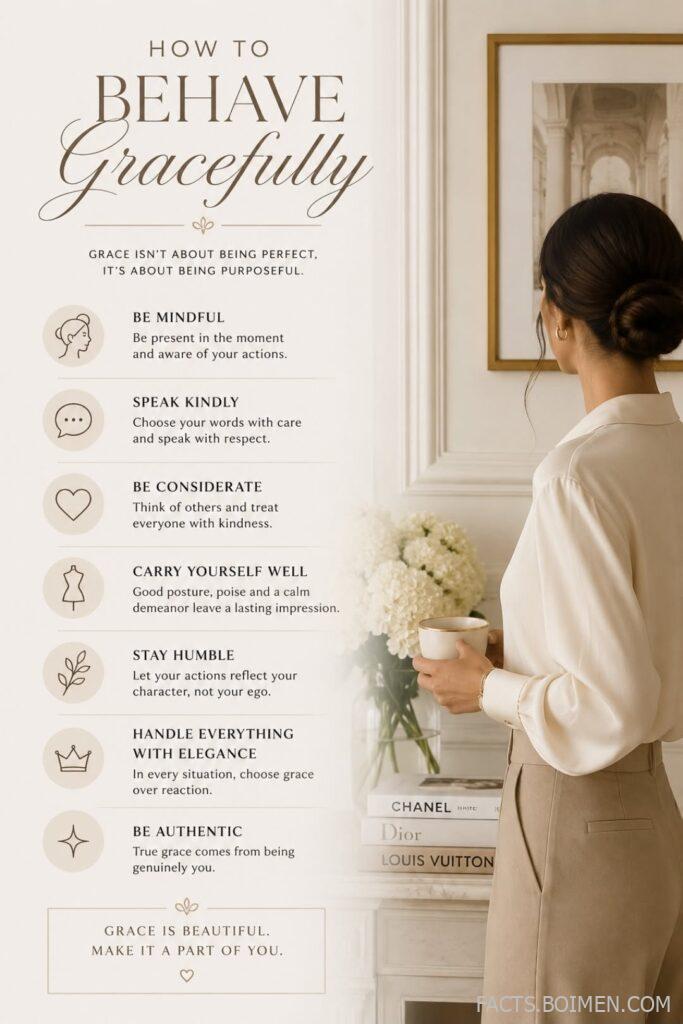
Grace isn’t about being perfect. It’s about being purposeful. That single idea, printed on the pin that brought you here, is the whole philosophy behind this list. Every habit below is a small, repeatable action: be present, speak kindly, be considerate, carry yourself well, stay humble. None of them require money, a personal stylist, or a personality transplant. They require attention.
What follows is 16 graceful habits, each one broken down into what it is, why it stands out, and who it suits best. Treat it like a checklist you can return to whenever you want to feel a little more composed, a little more elegant, and a lot more like the version of yourself you actually like.
Table of Contents(Click to Toggle)
- Why Graceful Habits Quietly Change How People See You
- 16 Graceful Habits for an Elegant, Soft Life
- 1. Mindful Presence
- 2. Kind Speech
- 3. Considerate Thinking
- 4. Good Posture
- 5. Staying Humble
- 6. The Pause Before Reacting
- 7. Quiet Confidence in Conversation
- 8. Deliberate Movement
- 9. Grooming Rituals
- 10. Calm Under Pressure
- 11. Gratitude Expressed Out Loud
- 12. Digital Etiquette
- 13. Elegant Eating Habits
- 14. Keeping Promises to Yourself
- 15. Generous Listening
- 16. A Graceful Exit
- Bonus Mentions
- The Quiet Power of Being Purposeful
Why Graceful Habits Quietly Change How People See You
Most people assume elegance is something you’re born with or something you buy. It isn’t. It’s a collection of tiny decisions made consistently: how you hold your shoulders when you’re tired, how you phrase a disagreement, how you thank someone who didn’t have to help you. These habits are unglamorous in isolation and unmistakable in aggregate.
The reason they work so well is that they signal self-respect without demanding attention. A person who is present, kind, and calm makes other people feel safe, and people remember how you made them feel far longer than they remember what you wore. That’s the real return on grace: it compounds in friendships, at work, and in the way you talk to yourself at the end of a long day.
None of this requires a soft life aesthetic to be true. It just happens to pair beautifully with one.
16 Graceful Habits for an Elegant, Soft Life
1. Mindful Presence : Train yourself to actually be in the room
What it is: The practice of bringing your full attention to the moment you’re in, rather than rehearsing your reply or replaying your morning.
Category: Awareness and attention.
Why it stands out:
- Guided sessions as short as three minutes make it easy to start without overhauling your routine.
- Presence is the root habit here. If you’re not paying attention, you can’t speak kindly or notice what others need.
- The honest limitation: it feels slow at first, and the benefit shows up in weeks, not hours.
Best for: Anyone who catches themselves nodding along while mentally composing a to-do list.
2. Kind Speech : Choose words that you’d be happy to repeat
What it is: The discipline of speaking with care, especially when you’re annoyed, rushed, or right about something.
Category: Communication.
Why it stands out:
- The practical test is simple: would you be comfortable if this sentence were quoted back to you tomorrow?
- Kindness is not vagueness. You can deliver a clear no or a firm boundary and still leave the other person’s dignity intact.
- Watch the habit of softening honesty into silence. Grace means telling the truth gently, not avoiding it.
Best for: People who are blunt by nature and want to keep their directness without the collateral damage.
3. Considerate Thinking : Anticipate what would make someone’s day easier
What it is: The habit of running a quick mental check before you act: who else is affected, and what would help them?
Category: Empathy in action.
Why it stands out:
- It shows up in tiny logistics: texting when you’re running late, holding the door, not taking the last seat when someone older is standing.
- Consideration is the difference between being polite and being thoughtful. Politeness follows rules; consideration notices people.
- The trap is over-anticipating and exhausting yourself. Aim for awareness, not mind-reading.
Best for: Hosts, teammates, and anyone who wants to be the person others are glad to see coming.
4. Good Posture : Let your body carry the calm your mind wants
What it is: The everyday alignment habit of a tall spine, relaxed shoulders, and an open chest, held without stiffness.
Category: Physical presence.
Why it stands out:
- Posture is the fastest visible upgrade to how you’re perceived, and it costs nothing.
- Simple cues work better than complicated routines: imagine a string lifting the crown of your head, then drop your shoulders.
- Real limitation: posture shifts the impression you make. It is not a treatment for pain, so see a professional if something hurts.
Best for: Desk workers and anyone who slumps the moment they stop thinking about it.
5. Staying Humble : Let your actions make the argument
What it is: Confidence without the need to announce it, and curiosity about what you don’t yet know.
Category: Character.
Why it stands out:
- Humility is what keeps elegance from tipping into performance. The most graceful people rarely describe themselves that way.
- It looks like asking a genuine question, crediting a teammate, and saying “I was wrong” without a five-minute preamble.
- The nuance: humility is not self-erasure. You can own your expertise and still leave room for other people’s.
Best for: High achievers who want to be admired rather than merely impressive.
6. The Pause Before Reacting : Create a gap between feeling and response
What it is: A deliberate beat of silence, even two seconds, before you answer something that stung.
Category: Emotional regulation.
Why it stands out:
- Almost every regret in conversation happens in the first second. The pause is where grace lives.
- It’s easy to practice with a physical anchor: exhale slowly, or take a sip of water before replying.
- The honest trade-off: people occasionally read the pause as hesitation. That’s a small price for not saying the thing you’d have to apologize for.
Best for: Anyone whose best comebacks arrive ten minutes too late, and whose worst ones arrive right on time.
7. Quiet Confidence in Conversation : Speak at your own pace
What it is: The habit of finishing your sentences, not apologizing for taking up space, and letting silence sit instead of filling it.
Category: Social presence.
Why it stands out:
- Rushing your words signals that you expect to be interrupted. Slowing down tells the room you intend to be heard.
- Remove the reflexive openers: “sorry, just quickly, this is probably a dumb question.” Ask the question plainly.
- It’s not about dominating a room. Quiet confidence makes space for others too.
Best for: Introverts who are tired of being talked over in meetings and group dinners.
8. Deliberate Movement : Move like you have nowhere to rush to
What it is: Walking, standing, and gesturing with intention rather than fluster, even when you’re running behind.
Category: Body language.
Why it stands out:
- Elegance is largely rhythm. A slower, steadier walk reads as composed even when your calendar says otherwise.
- Small adjustments help: shorter strides, hands relaxed, no phone in your palm while you cross a room.
- The limitation is real, though. Deliberate movement is about quality, not speed, so don’t confuse it with being late on purpose.
Best for: People whose default setting is a half-jog through every hallway.
9. Grooming Rituals : Build a routine you don’t have to think about
What it is: A short, repeatable set of habits, skincare, hair, nails, fragrance, that keeps you looking put-together on autopilot.
Category: Self-care and presentation.
Why it stands out:
- Consistency beats intensity. Ten minutes nightly outperforms a three-hour Sunday reset you dread.
- Keep it minimal: cleanse, moisturize, one signature scent, tidy nails. That’s the whole elegant baseline.
- Be honest about your skin type and budget. More products is not the same as better grooming.
Best for: Anyone who wants to look polished without a twelve-step routine.
10. Calm Under Pressure : Be the steadiest person in the room
What it is: The ability to slow your breathing, lower your voice, and keep your face open when something goes wrong.
Category: Composure.
Why it stands out:
- Grace is most visible in bad moments, not good ones. Anyone can be serene when nothing is on fire.
- Breathing tools and short guided sessions give you something concrete to reach for when your heart rate spikes.
- This is a skill, not a personality trait, and it improves with rehearsal. Practice in small annoyances so it’s available in big ones.
Best for: People who lead teams, manage families, or handle other people’s emergencies.
11. Gratitude Expressed Out Loud : Say the thank-you you’re only thinking
What it is: Naming your appreciation specifically, to the person who earned it, rather than absorbing it silently.
Category: Relationships.
Why it stands out:
- Specific thanks lands harder than general thanks. “Thank you for remembering I don’t drink coffee” beats “thanks for everything.”
- It’s a two-way habit: it makes the other person feel seen and quietly reminds you how much is going right.
- Skip the performative version. Gratitude aimed at an audience reads as flattery.
Best for: Anyone who feels appreciative but rarely says it out loud.
12. Digital Etiquette : Be as graceful on a screen as you are in person
What it is: Replying thoughtfully, not leaving people on read, and resisting the urge to broadcast every opinion.
Category: Modern manners.
Why it stands out:
- Most of our daily interactions are typed now, which means most of our grace has to be typed too.
- Simple rules work: no criticism in a group chat, no big news in a comment thread, no passive-aggressive punctuation.
- The limitation is that tone is genuinely hard to read. When in doubt, a short call beats a long message.
Best for: Anyone whose texting style has ever been described as “a bit sharp.”
13. Elegant Eating Habits : Small table manners that read as class
What it is: Chewing with your mouth closed, keeping pace with the table, and putting your phone away during a meal.
Category: Everyday etiquette.
Why it stands out:
- Table manners are the most visible grace habit, because everyone is watching the same table.
- Pacing matters more than rules. Finishing long before or long after everyone else creates awkwardness.
- You don’t need formal training. Napkin on lap, utensils used outside-in, thank the cook. That covers most situations.
Best for: People navigating work dinners, in-law lunches, and first dates.
14. Keeping Promises to Yourself : Be someone you can rely on
What it is: Doing the small thing you said you’d do, the walk, the early night, the boundary, without renegotiating it at the last minute.
Category: Self-respect.
Why it stands out:
- Grace toward others starts with grace toward yourself. It’s hard to be calm and generous when you feel unreliable.
- Start absurdly small: one kept promise a day is more powerful than a dramatic overhaul that collapses by Thursday.
- The nuance: this isn’t about rigid discipline. It’s about making promises you can actually keep.
Best for: Chronic over-committers who are kind to everyone except themselves.
15. Generous Listening : Let people finish the thought
What it is: Listening to understand rather than to respond, and asking one follow-up question before offering your own story.
Category: Connection.
Why it stands out:
- It’s the single fastest way to seem more elegant. People who listen well are remembered as warm and rare.
- One good follow-up, “what was that like for you?”, does more than twenty minutes of advice.
- Watch for the hijack reflex, where you match their story with a bigger one. Let theirs stand.
Best for: Anyone who wants deeper friendships without learning conversation tricks.
16. A Graceful Exit : Leave every room and conversation well
What it is: Knowing how to end a conversation, a party, or a chapter without drama or lingering awkwardness.
Category: Social skills.
Why it stands out:
- How you leave is often remembered more clearly than how you arrived.
- A warm, specific goodbye works best: thank the host by name, say what you enjoyed, and go.
- The limitation is cultural. In some settings a quiet exit is rude, so read the room before slipping out.
Best for: People who hover by the door for forty minutes trying to leave.
Bonus Mentions
Apartment Therapy : A calm home makes a calm person
What it is: A home and organization site with practical, small-space-friendly ideas.
Category: Environment.
Why it stands out: A tidy entryway and made bed do more for your composure than any mantra. Start with one surface.
Best for: Anyone whose physical space feels chaotic by Friday.
Real Simple : Shortcuts for a well-run life
What it is: A lifestyle site covering etiquette, organizing, and everyday problem-solving.
Category: Practical living.
Why it stands out: Their etiquette explainers answer the awkward questions, like who pays, what to wear, and when to send a note.
Best for: People who want clear answers instead of vague advice.
PositivePsychology.com : Turn kindness into a daily practice
What it is: A library of free, research-informed exercises on gratitude, empathy, and habits.
Category: Self-improvement.
Why it stands out: The worksheets give structure to habits that otherwise stay abstract intentions.
Best for: Readers who like a framework, not just inspiration.
Poetry Foundation : Read something beautiful for ten minutes
What it is: An enormous free archive of poems, essays, and readings.
Category: Culture and language.
Why it stands out: Elegant speech comes from elegant input. Reading a poem a day quietly improves how you phrase things.
Best for: Anyone who wants to sound less like a group chat.
The Quiet Power of Being Purposeful
Grace isn’t a personality you’re assigned at birth, and it isn’t a purchase. It’s the accumulated result of small choices: pausing before you answer, standing a little taller, thanking someone specifically, leaving a room well. None of these habits are dramatic. That’s precisely why they work.
Pick two from this list and practice them for a week. Not sixteen. Two. Presence and kind speech are the best starting pair, because almost everything else grows out of them. Then add another when the first two stop requiring effort. Over a season, you’ll notice the shift in how people respond to you, and more importantly, in how you carry yourself when no one is watching.
Which of these graceful habits do you already practice, and which one are you adding this week? Share your pick in the comments, and pass this list to a friend who’d love the soft life aesthetic as much as you do.