There is a moment in every decluttering session when you pick something up and realize you have not used it, thought about it, or needed it in years — yet you still hesitate. That hesitation is the entire problem. Minimalists are not born with a special ability to throw things away; they simply build a short, repeatable list of items that never earn a place in the home, and they apply it relentlessly.
What follows is that list, expanded into 30 specific categories of things minimalists routinely choose not to keep. Each entry explains what it is, why it tends to accumulate, and the practical reason it gets let go. Use it as a checklist, a filter, or a gentle nudge — and expect your storage to feel larger by the end.
Table of Contents(Click to Toggle)
- Why Letting Go of 30 Common Items Changes Everything
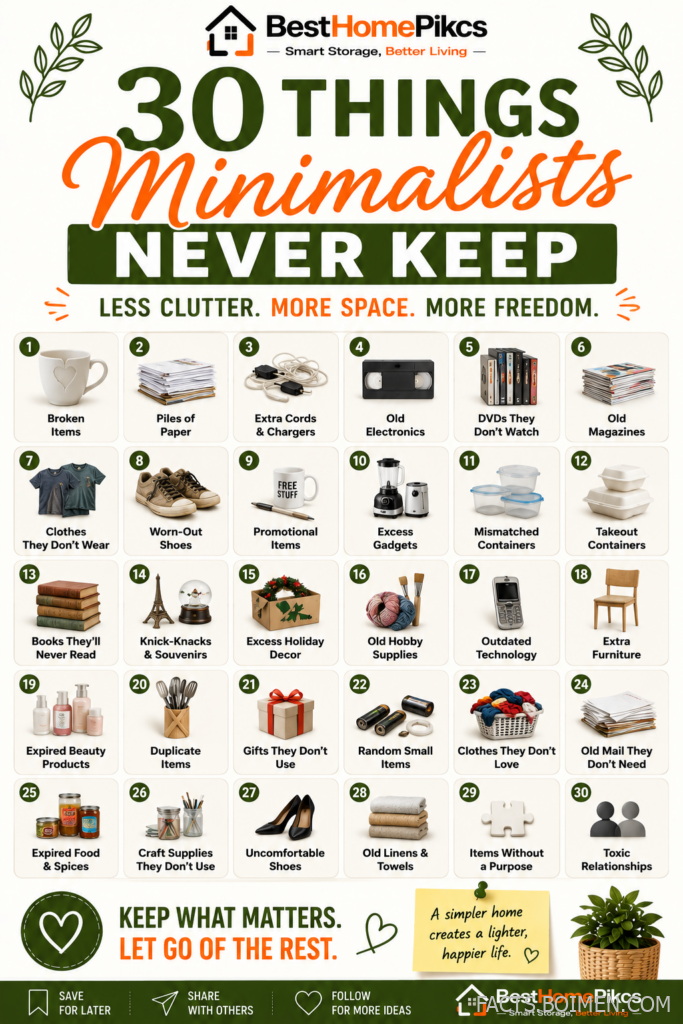
- 30 Things Minimalists Never Keep
- 1. Broken Piles of Extra Cords and Chargers
- 2. Old DVDs and Discs You Never Watch
- 3. Old Electronics and Dead Gadgets
- 4. Paper Magazines and Old Catalogs
- 5. Clothes You Never Wear
- 6. Worn-Out Shoes
- 7. Mismatched Containers and Lids
- 8. Excess Takeout Containers
- 9. Promotional Items and Free Swag
- 10. Excess Holiday Decorations
- 11. Books They Will Never Reread
- 12. Knick-Knacks and Dust Collectors
- 13. Old Hobby Supplies
- 14. Duplicate Kitchen Tools
- 15. Expired Pantry and Medicine Items
- 16. Old Paperwork and Manuals
- 17. Unused Beauty and Sample Products
- 18. Sentimental Items in Bulk
- Bonus: Old Cables for Devices You No Longer Own
- Bonus: Plastic Grocery Bag Hoards
- Bonus: Broken Furniture Waiting for Repair
- Bonus: Expired Coupons and Gift Cards
- Bonus: Digital Clutter on Old Hard Drives
- The Quiet Freedom of a Shorter List
Why Letting Go of 30 Common Items Changes Everything
Clutter is rarely one big decision. It is hundreds of small defaults: the cord you might need someday, the shirt that almost fits, the container that came with a meal. Each item is cheap on its own, but together they consume shelf space, drawer space, and — more importantly — attention. Every time you open a cabinet and see a jumble, your brain spends a fraction of a second sorting it. Multiply that by a decade and the cost is real.
Minimalists solve this by refusing to negotiate item by item. They keep a short list of categories that never get to stay, so the decision is made once and applied forever. The 30 entries below are drawn directly from the kinds of things that pile up in most homes: broken cords, unwatched discs, dead electronics, unread magazines, clothes that never get worn, and the endless supply of promotional objects that arrive for free and stay forever.
The benefit is not aesthetic. A home with fewer objects is faster to clean, easier to search, cheaper to move, and far less stressful to live in. Storage stops being a puzzle you solve every weekend. You stop buying duplicates because you can finally see what you already own. That is the trade: a few uncomfortable moments of letting go, in exchange for years of easier living.
30 Things Minimalists Never Keep
1. Broken Piles of Extra Cords and Chargers : Recycle the tangle and reclaim an entire drawer
What it is: The drawer or bin of unidentified cables, wall adapters, and chargers left over from devices you may not even own anymore.
Category: Electronics clutter
Why it stands out:
- Most cords are device-specific and cannot be repurposed for newer hardware.
- Tangled cables hide the two or three you actually use regularly.
- Electronic waste is recyclable through certified e-waste programs rather than the trash.
Best for: Anyone whose charging drawer has become a knot of mystery cables.
2. Old DVDs and Discs You Never Watch : Turn a shelf of plastic cases into cash or space
What it is: Movie and series collections that migrated to streaming years ago but still occupy shelf or box space.
Category: Media clutter
Why it stands out:
- Streaming services already cover the vast majority of titles people rewatch.
- Discs degrade and players are increasingly rare in new homes.
- Buyback services and libraries accept donations, so nothing needs to be wasted.
Best for: Households with a media shelf that has not been opened in over a year.
3. Old Electronics and Dead Gadgets : Stop storing devices that will never power on again
What it is: Phones with cracked screens, obsolete tablets, dead e-readers, and accessories for hardware that no longer works.
Category: Electronics clutter
Why it stands out:
- Many retailers run trade-in and recycling programs that accept old devices.
- Batteries in stored electronics can swell and damage whatever is nearby.
- Data on old drives is a privacy risk worth resolving properly.
Best for: Anyone with a box labeled “old phones” that has not been opened in years.
4. Paper Magazines and Old Catalogs : Clear the reading pile you will never get to
What it is: Stacks of magazines, mail-order catalogs, and newsletters kept because they seemed interesting at the time.
Category: Paper clutter
Why it stands out:
- Most articles are now searchable online within seconds.
- Paper stacks attract dust and make shelves look permanently unfinished.
- Libraries and recycling centers accept magazines in bulk.
Best for: Homes where a magazine pile has become a permanent piece of furniture.
5. Clothes You Never Wear : Keep only what fits the life you actually live
What it is: Garments that no longer fit, suit an old job, or were bought for a version of you that never showed up.
Category: Wardrobe clutter
Why it stands out:
- A common rule is to move unworn items to a separate rack and see what survives a season.
- Resale platforms turn decent clothing into money instead of guilt.
- Fewer visible options make getting dressed faster every morning.
Best for: Anyone whose closet is full but who wears the same ten pieces.
6. Worn-Out Shoes : Retire footwear that no longer supports you
What it is: Sneakers with worn soles, dress shoes that pinch, and pairs kept “for messy jobs” that never happen.
Category: Wardrobe clutter
Why it stands out:
- Worn soles and collapsed cushioning reduce comfort on long walks.
- Shoe piles block entryways and hide the pairs you actually rotate.
- Many charities accept gently used footwear for reuse programs.
Best for: Entryways where shoes have formed a permanent pile.
7. Mismatched Containers and Lids : End the lid-hunting ritual for good
What it is: Plastic tubs, glass jars, and lids that no longer match anything in the cupboard.
Category: Kitchen clutter
Why it stands out:
- A lid without a base is functionally useless and takes real space.
- Matching sets stack neatly and make leftovers genuinely easier.
- Recycling centers accept clean plastic containers in most areas.
Best for: Anyone who has ever owned a drawer that was 40 percent orphaned lids.
8. Excess Takeout Containers : Stop hoarding disposable containers you never reuse
What it is: The growing tower of plastic and paper containers saved from delivery orders.
Category: Kitchen clutter
Why it stands out:
- Most are not designed for repeated microwave or freezer use.
- A small, deliberate set of reusable containers covers nearly every need.
- Clearing them frees cabinet space that is currently unusable.
Best for: Kitchens with a cabinet that opens onto a wall of takeout lids.
9. Promotional Items and Free Swag : Let go of branded objects you never chose
What it is: Conference tote bags, logo pens, stress balls, keychains, and drinkware that arrived free.
Category: Miscellaneous clutter
Why it stands out:
- Free items still cost storage space and mental attention.
- Most duplicate something you already own and prefer.
- Donation centers accept usable promotional goods for resale.
Best for: Anyone whose junk drawer is mostly branded giveaways.
10. Excess Holiday Decorations : Keep the pieces you truly display each year
What it is: Boxes of seasonal decor that come out partially, or not at all, every year.
Category: Seasonal clutter
Why it stands out:
- Storage bins for rarely used decor quietly occupy prime closet space.
- A single labeled bin per holiday keeps traditions without the overflow.
- Broken or faded decorations are the easiest first cut.
Best for: Households storing more decorations than they can display.
11. Books They Will Never Reread : Curate a shelf instead of warehousing one
What it is: Novels and reference books kept out of guilt or aspiration rather than genuine use.
Category: Media clutter
Why it stands out:
- Books you will not reread are better shared than shelved.
- Donation programs and used-book buyers make removal easy.
- A smaller shelf makes the books you love more visible.
Best for: Readers whose shelves have become storage rather than library.
12. Knick-Knacks and Dust Collectors : Reduce surfaces that need constant cleaning
What it is: Small decorative objects that fill shelves but add little beyond visual noise.
Category: Decorative clutter
Why it stands out:
- Every small object multiplies dusting time across the room.
- Fewer pieces make the ones you keep feel intentional.
- Sentimental favorites can be rotated seasonally instead of all at once.
Best for: Anyone who spends weekends dusting objects they barely notice.
13. Old Hobby Supplies : Release the projects you have outgrown
What it is: Yarn, beads, model kits, and craft tools from hobbies you have not touched in years.
Category: Hobby clutter
Why it stands out:
- Supplies for abandoned hobbies create guilt every time you see them.
- Craft swaps and community centers welcome usable donations.
- Keeping one active hobby’s kit is easier than storing five dormant ones.
Best for: Craft rooms that have become storage units for past interests.
14. Duplicate Kitchen Tools : One good tool beats three mediocre ones
What it is: The third spatula, the second can opener, and gadgets that do what a knife already does.
Category: Kitchen clutter
Why it stands out:
- Duplicates crowd drawers and hide the tools you reach for daily.
- Specialty gadgets often go unused after the first week.
- A pared-down drawer makes cooking measurably faster.
Best for: Kitchens where every drawer is full but nothing is findable.
15. Expired Pantry and Medicine Items : Clear the shelves of things past their date
What it is: Spices, canned goods, and over-the-counter medicines past their printed dates.
Category: Pantry clutter
Why it stands out:
- Expired items take prime shelf space in the most-used cabinet.
- Old spices lose flavor and quietly ruin recipes.
- Proper disposal guidance for medicines is available from health agencies.
Best for: Anyone whose spice rack contains jars older than their phone.
16. Old Paperwork and Manuals : Keep the documents that matter, shred the rest
What it is: Instruction manuals, outdated statements, and receipts for items long gone.
Category: Paper clutter
Why it stands out:
- Most manuals are available as PDFs from the manufacturer.
- Tax and financial records follow clear retention guidelines.
- A single labeled folder replaces an entire drawer of loose paper.
Best for: Homes with a “important papers” drawer nobody wants to open.
17. Unused Beauty and Sample Products : Stop saving products you will never open
What it is: Travel-sized samples, half-used bottles, and shades that never matched.
Category: Bathroom clutter
Why it stands out:
- Opened cosmetics have limited shelf life after first use.
- Samples accumulate faster than anyone can realistically use them.
- A clear counter makes daily routines quicker and calmer.
Best for: Bathroom counters covered in bottles you stopped noticing.
18. Sentimental Items in Bulk : Honor memories without storing every object
What it is: Boxes of cards, ticket stubs, and keepsakes kept in bulk rather than curated.
Category: Sentimental clutter
Why it stands out:
- Photographing meaningful items preserves the memory without the box.
- Choosing a handful of true keepsakes honors the past more clearly.
- Bulk sentimental storage often goes unopened for decades.
Best for: Anyone storing multiple boxes labeled “memories” they never revisit.
Bonus: Old Cables for Devices You No Longer Own
If a cable’s matching device left the house years ago, the cable is already gone in spirit. Recycle it with e-waste rather than storing it indefinitely.
Bonus: Plastic Grocery Bag Hoards
Most households keep far more bags than they will ever reuse. Many grocery stores maintain collection bins for recycling them properly.
Bonus: Broken Furniture Waiting for Repair
A wobbly chair that has waited two years for glue is not a project; it is furniture-shaped clutter. Repair it this month or pass it on.
Bonus: Expired Coupons and Gift Cards
Expired offers cannot be redeemed, and forgotten balances are worth checking before the card is tossed. Either way, they should not live in your wallet.
Bonus: Digital Clutter on Old Hard Drives
Duplicate photo folders and forgotten downloads are the digital version of a junk drawer. A single afternoon of cleanup frees real storage and makes files findable again.
The Quiet Freedom of a Shorter List
None of these 30 categories are dramatic on their own. A single orphaned lid costs nothing; a drawer of them costs a small piece of your patience every day. That is why minimalists treat them as a list rather than a series of individual decisions — the list does the negotiating so you do not have to.
Start with the easiest entries: broken cords, expired pantry items, orphaned lids. Each one you remove makes the next decision slightly easier, and the visible result — an open shelf, a drawer that closes smoothly, a closet where you can see your clothes — reinforces the habit. Within a few weekends, storage stops being a problem you manage and becomes simply a place where things live.
The goal is not an empty house. It is a home where everything present has earned its spot, and everything else has moved on to someone who will actually use it. That is the version of “more space, more freedom” worth chasing.
Which of these 30 items is hiding in your home right now — and what is the first one you plan to let go of this week?